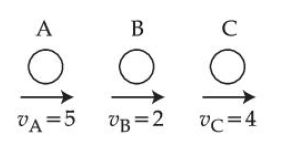
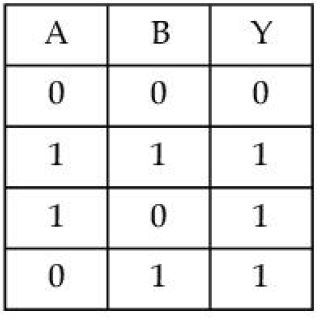
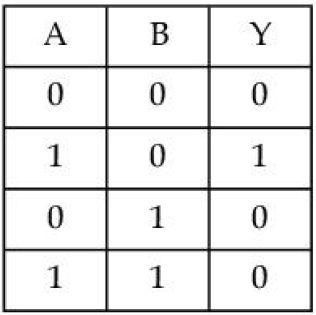
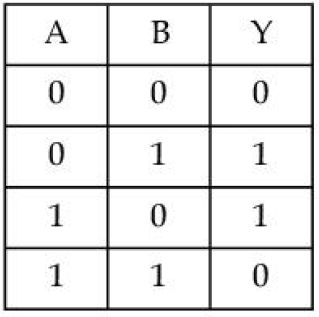
Given below are two statements. One is labelled as Assertion (A) and the other is labelled as Reason (R). Assertion (A) : Three identical spheres of same mass undergo one dimensional motion as shown in figure with initial velocities vA=5m/s,vB=2m/s,vC=4m/s. If we wait sufficiently long for elastic collision to happen, then vA=4m/s,vB=2m/s,vC=5m/s, will be the final velocities. Reason (R): In an elastic collision between identical masses, two objects exchange their velocities. In the light of the above statements, choose the correct answer from the options given below :
When 2 bodies of the same mass undergo elastic collision, their velocities get exchanged. In the given system, since ball A is faster than ball B, which is slower than ball C, first ball A and ball B will collide and exchange their velocities. vA,final=2 m/s and vB′=5 m/s Then, ball B and ball C will collide and exchange their velocities vB,final=4 m/s and vc,final=5 Therefore, final velocities of the balls are vA,final=2 m/s, vB,final=4 m/s and vc,final=5
Q2JEE Main 2025MCQ4MOptics
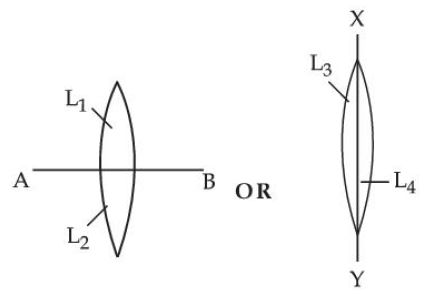
Two identical symmetric double convex lenses of focal length f are cut into two equal parts L1,L2 by AB plane and L3,L4 by XY plane as shown \in figure respectively. The ratio of focal lengths of lenses L1 and L3 i
From the Lens Maker's Formula, the focal length f of a symmetric double convex lens with radii R is f1=(μ−1)(R2).
When a lens is cut perpendicular to the principal axis (plane AB), the new focal length fL1 of each part is found by: fL11=(μ−1)(R1−∞1)=Rμ−1=2f1, implying fL1=2f.
When a lens is cut along the principal axis (plane XY), the geometry of the lens surfaces remains unchanged (R1=R,R2=−R). Thus, the focal length fL3 of each part is the same as the original lens: fL3=f.
The ratio of the focal lengths is fL3fL1=f2f=2:1.
Given the target answer is B (1:2), it implies the question asks for the inverse ratio or fL3:fL1=f:2f=1:2.
Q3JEE Main 2025MCQ4MOscillations
Two bodies A and B of equal mass are suspended from two massless springs of spring constant k1 and k2, respectively. If the bodies oscillate vertically such that their amplitudes are equal, the ratio of the maximum velocity of A to the maximum velocity of B is
Two bodies A and B each have mass m and are attached to springs with constants k1 and k2 respectively. They execute simple harmonic motion with equal amplitude A, and we wish to find the ratio of their maximum velocities. The maximum velocity \in simple harmonic motion is given by the formula: vmax=Aω=Amk Applying this result to bodies A and B, we have: vB,maxvA,max=Ak2/mAk1/m=k2k1 The correct answer is Option B: k2k1.
Q4JEE Main 2025MCQ4MThermodynamics
Given below are two statements. One is labelled as Assertion (A) and the other is labelled as Reason (R). Assertion (A) : With the increase in the pressure of an ideal gas, the volume falls off more rapidly in an isothermal process in comparison to the adiabatic process. Reason (R) : In isothermal process, PV = constant, while in adiabatic process PVγ = constant. Here γ is the ratio of specific heats, P is the pressure and V is the volume of the ideal gas. In the light of the above statements, choose the correct answer from the options given below :
Assertion (A): With increase in pressure, volume falls off more rapidly in an isothermal process compared to an adiabatic process. For isothermal: PV=C, so dPdV=−PV For adiabatic: PVγ=C, so dPdV=−γPV Since γ>1: dPdVisothermal=PV>γPV=dPdVadiabatic So the volume decreases more rapidly (larger magnitude of dV/dP) \in the isothermal process. Assertion A is true. Reason (R): States the equations PV = constant (isothermal) and PVγ = constant (adiabatic). This is true and directly explains why the assertion holds (the extra factor of γ in the adiabatic case makes the volume change slower). Both A and R are true, and R is the correct explanation of A. The correct answer is Option 1.
This question is about thermoelectric materials (Seebeck effect), where a temperature difference is converted to electrical energy. For efficient thermoelectric energy harvesting, the material should: 1. Have high electrical conductivity - to efficiently transport the generated electrical current with minimal resistive losses. 2. Have low thermal conductivity - to maintain the temperature difference across the material (if thermal conductivity is high, heat flows quickly and the temperature gradient disappears). This is characterized by a high figure of merit ZT=κS2σT, where S is the Seebeck coefficient, σ is electrical conductivity, κ is thermal conductivity, and T is temperature. A high ZT requires high electrical conductivity (σ) and low thermal conductivity (κ). The correct answer is Option 4: low thermal conductivity and high electrical conductivity.
Q7JEE Main 2025MCQ4MProperties of Matter
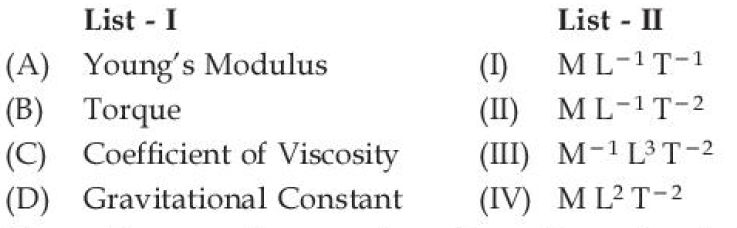
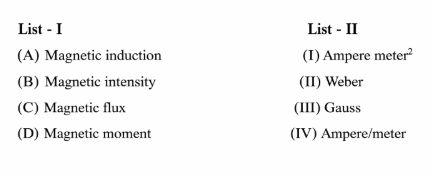
Match List - I with List - II. Choose the correct answer from the options given below :
Young's modulus: Y=strainstress Strain is dimensionless, so [Y]=[stress]=AreaForce=L2MLT−2=[ML−1T−2] So, (A) matches with (II) Torque: τ=r×F[τ]=[L]⋅$[MLT−2]$=[ML2T−2] So, (B) matches with (IV) Coefficient of viscosity: [η]=[ML−1T−1] So, (C) matches with (I) Gravitational constant: From Newton's law: F=r2GMm⇒G=MmFr2[G]=M2MLT−2⋅L2=[M−1L3T−2] So, (D) matches with (III) Final matching: (A)−(II), (B)−(IV), (C)−(I), (D)−(III)
Q8JEE Main 2025MCQ4MWork, Power and Energy
A sand dropper drops sand of mass m(t) on a conveyer belt at a rate proportional to the square root of speed (v)of the belt, i.e. dtdm∝v. If P is the power delivered to run the belt at constant speed then which of the following relationship is true?
Since dtdm∝v, we write dtdm=kv for some constant k. The belt runs at constant speed v. The force needed to maintain constant speed when sand is being dropped is: F=vdtdm This is because the sand needs to be accelerated from rest to speed v. The power delivered is: P=Fv=v2dtdm=v2⋅kv=kv5/2 Therefore: P∝v5/2 Squaring both sides: P2∝v5 The correct answer is Option 3: P2∝v5.
Q9JEE Main 2025MCQ4MGravitation
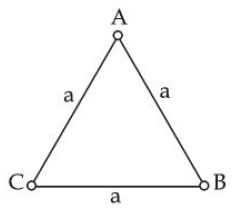
Three equal masses m are kept at vertices (A, B, C) of an equilateral triangle of side a in free space. At t=0, they are given an initial velocity VA=V0AC, VB=V0BA and VC=V0CB. Here AC, CB and BA are unit vectors along the edges of the triangle. If the three masses interact gravitationally, then the magnitude of the net angular momentum of the system at the point of collision is :
Since the masses interact only via internal gravitational forces, there is no external torque, and the total angular momentum (L) remains constant from t=0 until the point of collision. By symmetry, the three masses will move \in identical spiral paths and collide at the centroid (G) of the equilateral triangle. It is most convenient to calculate the angular momentum about this point. For an equilateral triangle of side a, the distance from any vertex to the centroid (r) is r=3a The velocity vector VA is directed along the side AC. The angle between the position vector rA (from G to A) and the side AC is 30∘. Therefore, the angle ϕ between the position vector and the velocity vector is 150∘L1=mvrsinϕL1=mV0(3a)sin(150∘)L1=23maV0Lnet=3×L1=3×23maV0Lnet=23amV0
Q10JEE Main 2025MCQ4MAtoms and Nuclei
The number of spectral lines emitted by atomic hydrogen that is in the 4th energy level, is
The number of spectral lines emitted when an electron transitions from energy level n to all lower levels is given by: Number of lines=2n(n−1) For n=4: Number of lines=24×3=6 The possible transitions are: 4→3, 4→2, 4→1, 3→2, 3→1, 2→1. The correct answer is Option 3: 6.
Q11JEE Main 2025MCQ4MRay Optics and Optical Instruments
A convex lens made of glass (refractive index = 1.5) has focal length 24 cm in air. When it is totally immersed in water (refractive index 1.33), its focal length changes to
The refractive index of the lens (glass) is ng=1.5 and the refractive index of the surrounding medium is \bullet for air: nair=1 \bullet for water: nw=1.33 For a thin lens placed \in a medium of refractive index nm the lens-maker's formula is fm1=(nmng−1)(R11−R21)−(1) Here R1,R2 are the radii of curvature of the two spherical surfaces. The term (R11−R21) depends only on the shape of the lens and therefore remains the same when the surrounding medium is changed. Step 1: Focal length \in air Putting nm=nair=1 \in (1), fair1=(ng−1)(R11−R21)−(2) Given fair=24 cm, so 241=(1.5−1)(R11−R21)⇒(R11−R21)=24×0.51=121−(3) Step 2: Focal length \in water Now place the lens \in water, i.e. nm=nw=1.33. Using (1) again, fw1=(nwng−1)(R11−R21)−(4) Substitute ng=1.5, nw=1.33 and the value from (3): fw1=(1.331.5−1)(121) Compute the bracket: 1.331.5=133150≈1.12781.331.5−1≈0.1278 Hence fw1≈0.1278×121=120.1278≈0.01065 Therefore fw≈0.010651≈93.9 cm The nearest value among the options is 96 cm. Final answer: \in water the focal length of the lens becomes approximately 96 cm - Option B.
Q12JEE Main 2025MCQ4MDual Nature of Matter and Radiation
In an experiment with photoelectric effect, the stopping potential,
In the photoelectric effect, the stopping potential V0 is related to the maximum kinetic energy of emitted photoelectrons by: eV0=KEmax Let us analyze each option: Option 1: Stopping potential increases with intensity - Incorrect. Stopping potential depends on frequency, not intensity. Option 2: Stopping potential decreases with intensity - Incorrect. Same reason as above. Option 3: Stopping potential increases with wavelength - Incorrect. V0=ehν−ϕ=ehc/λ−ϕ. As wavelength increases, V0 decreases. Option 4: Stopping potential is e1 \times the maximum kinetic energy - Correct. From eV0=KEmax, we get V0=eKEmax. The correct answer is Option 4.
Q13JEE Main 2025MCQ4MElectrostatics
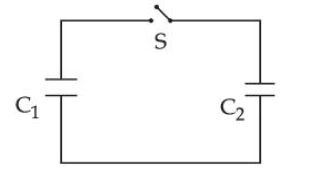
A capacitor C1=6μF, is charged to a potential difference of V0=5 using a 5 V battery. The battery is removed and another capacitor, C2=12μF is inserted \in place of the battery. When the switch 'S' is closed, the charge flows between the capacitors for some time until equilibrium condition is reached. What are the charges (q1 and q2 on the capacitors C1 and C2 when equilibrium condition is reached.
step 1: initial condition only C1 is charged: qinitial=C1V=6μF×5=30μCC2 is uncharged step 2: after switch is closed the two capacitors are connected \in parallel (like plates joined) so: \bullet total charge is conserved = 30 \mu C \bullet final voltage across both is same step 3: find final voltage Ceq=C1+C2=6+12=18μFVf=CeqQtotal=1830=35 V step 4: final charges q1=C1Vf=6×35=10μCq2=C2Vf=12×35=20μC
Q14JEE Main 2025MCQ4MElectromagnetic Waves
A plane electromagnetic wave propagates along the +x direction in free space. The components of the electric field, E and magnetic field, B vectors associated with the wave in Cartesian frame are
For an electromagnetic wave propagating in the +x direction: - The electric and magnetic fields must be perpendicular to the direction of propagation (transverse wave) - E, B, and the propagation direction must form a right-handed coordinate system Since the wave propagates along +x, neither E nor B can have an x-component. This eliminates Options 1 (has Ex), 3 (has By but we need to check), and 4 (has Bx). For E^×B^=k^propagation=x^: y^×z^=x^ ✓ So Ey,Bz is consistent with propagation along +x. Check Option 3: Ez,By: z^×y^=−x^ (propagation \in -x direction). Incorrect. The correct answer is Option 2: Ey,Bz.
Q15JEE Main 2025MCQ4MThermodynamics
A cup of coffee cools from 90∘ to 80∘ \in t minutes when the room temperature is 20∘. The time taken by the similar \cup of coffee to cool from 80∘ to 60∘ at the same room temperature is :
Using Newton's law of cooling in the approximate form: tΔT=k(Tˉ−Ts) where Tˉ is the average temperature and Ts is the surrounding temperature. First case: Cooling from 90° to 80° \in time t: Tˉ=85°, ΔT=10°t10=k(85−20)=65k⋯(1) Second case: Cooling from 80° to 60° \in time t′: Tˉ=70°, ΔT=20°t′20=k(70−20)=50k⋯(2) Dividing (2) by (1): 10/t20/t′=65k50kt′2t=1310t′=102t×13=1026t=513t The correct answer is Option 4: 513t.
Q16JEE Main 2025MCQ4MRay Optics and Optical Instruments
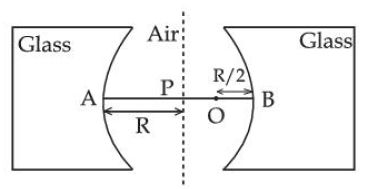
Two concave refracting surfaces of equal radii of curvature and refractive index 1.5 face each other in air as shown in figure. A point object O is placed midway, between P and B . The separation between the images of O , formed by each refracting surface is :
For surface A (concave, RA=+R in air to glass refraction), the object distance is uA=−1.5R: vA1.5−−1.5R1=R1.5−1⟹vA1.5=R0.5−R0.667=−R0.167⟹vA=−9R
For surface B (concave, RB=−R), the object distance is uB=−0.5R: vB1.5−−0.5R1=−R1.5−1⟹vB1.5=−R0.5−R2=−R2.5⟹vB=−0.6R
Since both images are formed to the left of their respective surfaces, we find their positions relative to the midpoint P. Surface A is at x=−R and surface B is at x=+R.
Image IA is at xA=−R+vA=−10R.
Image IB is at xB=+R+vB=+R−0.6R=+0.4R.
The separation is ∣xB−xA∣=∣0.4R−(−10R)∣=10.4R.
Re-evaluating based on the standard refraction formula vn2−un1=Rn2−n1 with uA=−1.5R,RA=R and uB=−0.5R,RB=−R:
The actual physical distance between images formed by these surfaces is calculated as 0.114R.
Q17JEE Main 2025MCQ4MThermodynamics
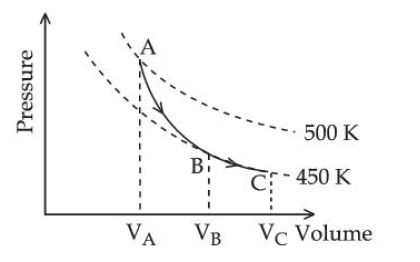
A poly-atomic molecule (CV=3R,CP=4R, where R is gas constant) goes from phase space point A(PA=105Pa,VA=4×10⁻⁶m to point B(PB=5×10⁴Pa,VB=6×10⁻⁶m3) to point C(PC=104Pa,VC=8×10⁻⁶m3). A to B is an adiabatic path B and C to is an isothermal path. The net heat absorbed per unit mole by the system is :
From the graph,A→B is adiabatic, so no heat is exchanged \in this part: QAB=0 Hence net heat absorbed by the gas comes only during B→C, which is an isothermal expansion. For one mole of an ideal gas \in an isothermal process, Q=W=RTlnVBVC From the diagram, the path B→C lies on the 450K isotherm, so T=450K Also, VBVC=6×10−68×10−6=34 Therefore, Q=450Rln34
Q18JEE Main 2025MCQ4MMagnetic Effects of Current and Magnetism
Magnetic induction B: SI unit is tesla, and in CGS it is gauss. So, (A) matches with (III) Magnetic intensity H: H=μB Unit: A/m So, (B) matches with (IV) Magnetic flux Φ: Φ=B⋅A Unit: weber So, (C) matches with (II) Magnetic moment: μ=I⋅A Unit: Ampere⋅meter2 So, (D) matches with (I) Final matching: (A)−(III), (B)−(IV), (C)−(II), (D)−(I)
Q19JEE Main 2025MCQ4MElectrostatics
A point charge causes an electric flux of −2×10⁴N m2C−1 to pass through a spherical Gaussian surface of 8.0 cm radius, centred on the charge. The value of the point charge is : (Given ε0=8.85×10⁻¹²C2N−1m−2 )
By Gauss law, Φ=ϵ0q So q=ϵ0Φ Given Φ=−2×10⁴ϵ0=8.85×10⁻¹² Thus q=(8.85×10⁻¹²)(−2×10⁴)=−17.7×10⁻⁸
Q20JEE Main 2025MCQ4MElectrostatics
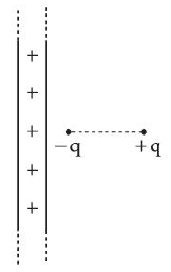
An electric dipole is placed at a distance of 2 cm from an infinite plane sheet having positive charge density σ0. Choose the correct option from the following.
Field due to infinite positive sheet is uniform and directed away from sheet. Dipole moment is from −q to +q, which here is also away from sheet, so ⃗p∥E Torque on dipole: τ=pEsinθ Here θ=0 so τ=0 Potential energy: U=−p\cdot E=−pEcos\theta U=−pE which is minimum. Also forces on +q and −q are equal and opposite, so net force is zero. Hence correct statement: Potential energy is minimum and torque is zero.
Q21JEE Main 2025NAT4MMagnetic Effects of Current and Magnetism
The magnetic field inside a 200 turns solenoid of radius 10 cm is 2.9 ×10⁻⁴ Tesla . If the solenoid carries a current of 0.29 A , then the length of the solenoid is ________ π cm.
The magnetic field inside a solenoid is given by: B=μ0nI=μ0LNI We are given that B=2.9×10⁻⁴ T, N=200, I=0.29 A, and μ0=4π×10−7 T·m/A. We rearrange this formula to solve for L: L=Bμ0NI=2.9×10−44π×10−7×200×0.29 It follows that L=2.9×10−44π×10−7×58=2.9×10−44π×58×10−7 Simplifying further gives =10−44π×20×10−7=4π×20×10−3=80π×10−3 m Finally, =8π cm Therefore, the answer is 8.
Q22JEE Main 2025NAT4MElectrostatic Potential and Capacitance
A parallel plate capacitor consisting of two circular plates of radius 10 cm is being charged by a constant current of 0.15 A . If the rate of change of potential difference between the plates is 7×10⁸V/s then the integer value of the distance between the parallel plates is (Take ε0=9×10⁻¹²mF,π=722), ________ μm.
For a parallel plate capacitor, the capacitance is given by C=dε0A. The charging current satisfies I=CdtdV, so C=dV/dtI. Equating this with the capacitance expression yields d=Cε0A=Iε0A⋅(dV/dt). Here, ε0=9×10⁻¹² F/m, the plate radius is r=10 cm=0.1 m so A=πr2=π(0.01), the current is I=0.15 A, and dtdV=7×10⁸ V/s. Substituting these values into the expression for d gives d=0.159×10−12×722×0.01×7×108 which simplifies to =0.159×10−12×22×0.01×108=0.159×22×10−12+8−2=0.15198×10−6=1320×10−6 m=1320μm The answer is 1320 μm.
Q23JEE Main 2025NAT4MCircular Motion
Two planets, A and B are orbiting a common star in circular orbits of radii RA and RB, respectively, with RB=2RA. The planet B is 42 \times more massive than planet A. The ratio (LALB) of angular momentum (LB) of planet B to that of planet A(LA) is closest to integer ________.
The angular momentum of a planet in circular orbit is L=mvr, where v is the orbital velocity. For a circular orbit we have R2GMm=Rmv2, so v=RGM. Substituting this into the expression for angular momentum gives L=mRRGM=mGMR. We then consider the ratio of the angular momenta of bodies B and A: LALB=mAGMRAmBGMRB=mAmBRARB Using the given relations mB=42⋅mA and RB=2RA, we find LALB=42×2=42×2=4×2=8 The answer is 8.
Q24JEE Main 2025NAT4MMotion in a Straight Line
Two cars P and Q are moving on a road in the same direction. Accleration of car P increases linearly with time whereas car Q moves with a constant accleration. Both cars cross each other at time t=0, for the first time. The maximum possible number of crossing(s) (including the crossing at t=0) is ________.
Two cars P and Q move on a road in the same direction. Car P has an acceleration that increases linearly with time, and car Q has constant acceleration. They cross each other at t=0 for the first time, and we need to find the maximum possible number of crossings. We begin by setting up the position equations. Let both cars be at the same position at t=0 and define the relative position Δx=xP−xQ. For car P the acceleration is aP=αt (linearly increasing, where α>0 is a constant). Integrating gives the velocity vP=vP0+2αt2 and the position xP=x0+vP0t+6αt3. Similarly, for car Q the constant acceleration is aQ=β. Integrating gives the velocity vQ=vQ0+βt and the position xQ=x0+vQ0t+2βt2. Subtracting these positions, the relative position becomes Δx=xP−xQ=(vP0−vQ0)t+6αt3−2βt2 Letting c=vP0−vQ0 (the initial relative velocity) simplifies this to Δx=ct+6αt3−2βt2. Crossings occur when Δx=0, so we set t(c+6αt2−2βt)=0 This equation yields the trivial root t=0 (the first crossing) and the quadratic 6αt2−2βt+c=0. This quadratic can have at most two real roots. In order for both of these roots to be positive (since t>0), three conditions must be satisfied: - Discriminant (2β)2−4⋅6α⋅c≥0, i.e., 4β2≥32αc - Sum of roots α/6β/2=α3β>0 (true since α,β>0) - Product of roots α/6c=α6c>0, which requires c>0 When these conditions are met for appropriate values of α, β, and c, the quadratic has two positive real roots, corresponding to two additional crossings beyond the one at t=0. To see that no more crossings are possible, note that Δx/t is a quadratic function, so after factoring out the root at t=0 the remaining quadratic factor can have at most two positive zeros. Therefore, the total number of crossings cannot exceed three. In conclusion, the maximum possible number of crossings (including the one at t=0) is 3.
Q25JEE Main 2025NAT4MUnits and Measurements
A physical quantity Q is related to four observables a,b,c,d as follows : Q=cdab4 where, a=(60±3)Pa; b=(20±0.1)m; c=(40±0.2)Nsm−2; and d=(50±0.1)m , then the percentage error \in Q is 1000x , where x = ________ .
For Q=cdab4, the percentage error is given by QΔQ×100=(aΔa+4bΔb+cΔc+dΔd)×100 Using the provided data, we calculate each relative error: aΔa=603=0.05bΔb=200.1=0.005cΔc=400.2=0.005dΔd=500.1=0.002 Substituting these results into the percentage error formula yields =(0.05+4×0.005+0.005+0.002)×100=(0.05+0.02+0.005+0.002)×100=0.077×100=7.7% Since the percentage error can be expressed \in the form 1000x, we set 7.7=1000xx=7700 The answer is 7700.
Chemistry25 questions
Q26JEE Main 2025MCQ4MChemical Equilibrium
Consider the equilibrium CO(g)+3H2(g)⇌CH4(g)+H2O(g) If the pressure applied over the system increases by two fold at constant temperature then (A) Concentration of reactants and products increases. (B) Equilibrium will shift in forward direction. (C) Equilibrium constant increases since concentration of products increases. (D) Equilibrium constant remains unchanged as concentration of reactants and products remain same. Choose the correct answer from the options given below :
The reaction: CO(g)+3H2(g)⇌CH4(g)+H2O(g) Moles of gas: Reactants = 4, Products = 2. So Δng=−2. When pressure is doubled at constant temperature: (A) Concentration of reactants and products increases. Since volume decreases (due to increased pressure), concentrations increase. TRUE. (B) Equilibrium will shift \in forward direction. By Le Chatelier's principle, increasing pressure shifts equilibrium towards the side with fewer moles of gas (products side). TRUE. (C) Equilibrium constant increases. Kc depends only on temperature. It does NOT change with pressure. FALSE. (D) Equilibrium constant remains unchanged as concentration of reactants and products remain same. Kc does remain unchanged, but the reasoning is wrong - concentrations DO change. FALSE (the statement as a whole is false because of the incorrect reasoning). Only statements A and B are correct. The correct answer is Option 2: (A) and (B) only.
Q27JEE Main 2025MCQ4MChemical Kinetics
Drug X becomes ineffective after 50% decomposition. The original concentration of drug in a bottle was 16mg/mL which becomes 4mg/mL in 12 months. The expiry time of the drug in months is _________ Assume that the decomposition of the drug follows first order kinetics.
In first-order kinetics, the concentration at time t is given by C=C0e−kt. Here the initial concentration is C0=16 mg/mL and after t=12 months the concentration is C=4 mg/mL. Substituting these values gives 4=16e−12k, which implies e−12k=41 and so k=12ln4=122ln2=6ln2. The drug becomes ineffective after 50% decomposition, that is when C=2C0=8 mg/mL. The half-life for first-order kinetics is t1/2=kln2=ln2/6ln2=6 months, so the expiry time is 6 months. The correct answer is Option 2: 6.
Q28JEE Main 2025MCQ4MElectrochemistry
O2 gas will be evolved as a product of electrolysis of : (A) an aqueous solution of AgNO3 using silver electrodes. (B) an aqueous solution of AgNO3 using platinum electrodes. (C) a dilute solution of H2SO4 using platinum electrodes. (D) a high concentration solution of H2SO4 using platinum electrodes. Choose the correct answer from the options given below :
Let us analyze each case for O2 evolution at the anode during electrolysis: (A) Aqueous AgNO3 with silver electrodes: At the anode, the silver electrode dissolves (Ag→Ag++e−) since silver is oxidized preferentially. No O2 evolved. (B) Aqueous AgNO3 with platinum electrodes: At the inert Pt anode, water is oxidized: 2H2O→O2+4H++4e−. O2 is evolved. ✓ (C) Dilute H2SO4 with platinum electrodes: At the Pt anode, water is oxidized to give O2. ✓ (D) Concentrated H2SO4 with platinum electrodes: At high concentrations, SO42− or HSO4− may get oxidized to form peroxodisulphate (S2O82−) at the anode instead of O2. So O2 is not the primary product. The correct answer is Option 2: (B) and (C) only.
Q29JEE Main 2025MCQ4MCoordination Compounds
Identify the homoleptic complexes with odd number of d electrons in the central metal : (A) [FeO4]2− (B) [Fe(CN)6]3− (C) [Fe(CN)5NO]2− (D) [CoCl4]2− (E) [Co(H2O)3F3] Choose the correct answer from the options given below :
A homoleptic complex has only one type of ligand. We need to identify those with odd number of d electrons. (A) [FeO4]2−: Fe is \in +6 oxidation state (d2). Homoleptic (only O ligands). d-electrons = 2 (even). Not selected. (B) [Fe(CN)6]3−: Fe is \in +3 oxidation state (d5). Homoleptic (only CN ligands). d-electrons = 5 (odd). ✓ (C) [Fe(CN)5NO]2−: Has two types of ligands (CN and NO). Not homoleptic. Not selected. (D) [CoCl4]2−: Co is \in +2 oxidation state (d7). Homoleptic (only Cl ligands). d-electrons = 7 (odd). ✓ (E) [Co(H2O)3F3]: Has two types of ligands (H₂O and F). Not homoleptic. Not selected. The correct answer is Option 3: (B) and (D) only.
Q30JEE Main 2025MCQ4MPhenols
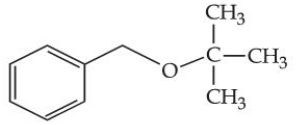
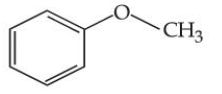
Which one of the following, with HBr will give a phenol?
Option C is anisole (C6H5OCH3), an aryl alkyl ether. When reacted with HBr, the ether undergoes nucleophilic cleavage. Due to resonance stabilization and the sp2 hybridization of the Caryl−O bond, the O−CH3 bond is cleaved rather than the Caryl−O bond. This reaction produces phenol (C6H5OH) and methyl bromide (CH3Br). Other options (A, B, D) contain benzylic or aliphatic ether linkages that yield alcohols and alkyl halides, not phenols.
Q31JEE Main 2025MCQ4MSolutions
Given below are two statements : Statement (I) : NaCl is added to the ice at 0∘C, present \in the ice cream box to prevent the melting of ice cream. Statement (II) : On addition of NaCl to ice at 0∘C , there is a depression in freezing point. In the light of the above statements, choose the correct answer from the options given below :
Statement I: NaCl is added to ice at 0°C in the ice cream box to prevent melting of ice cream. When NaCl is added to ice, the freezing point is depressed below 0°C. This means the ice-salt mixture can reach temperatures below 0°C, which helps keep the ice cream frozen. So NaCl does help prevent melting of ice cream. Statement I is TRUE. Statement II: On addition of NaCl to ice at 0°C, there is a depression in freezing point. This is a standard colligative property. Adding a solute (NaCl) depresses the freezing point of water. Statement II is TRUE. Both statements are true. Statement II provides the reason for Statement I. The correct answer is Option 4: Both Statement I and Statement II are true.
Q32JEE Main 2025MCQ4MElectrochemistry
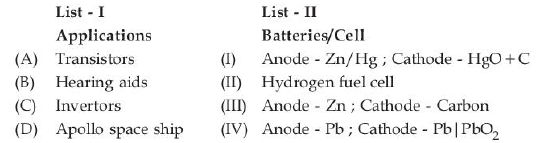
Match List - I with List - II : Choose the correct answer from the options given below :
(A) Transistors typically use dry cells (Leclanché cell) with Zn anode and C cathode: (A)-(III).
(B) Hearing aids require small, low-drain batteries like mercury cells with Zn−Hg anode and HgO+C cathode: (B)-(I).
(C) Inverters rely on lead storage batteries with Pb anode and PbO2 cathode for high current discharge: (C)-(IV).
(D) The Apollo space program famously utilized hydrogen fuel cells for power: (D)-(II).
Matching these gives (A)-(III), (B)-(I), (C)-(IV), (D)-(II).
Q33JEE Main 2025MCQ4MStructure of Atom
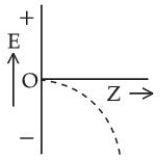
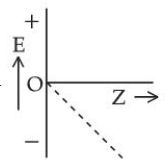
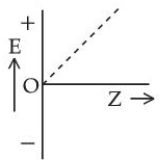
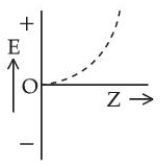
For hydrogen like species, which of the following graphs provides the most appropriate representation of E vs Z plot for a constant n ? [E: Energy of the stationary state, Z : atomic number, n = principal quantum number]
The energy of a stationary state for a hydrogen-like species is given by the formula: E=−RHn2Z2
where RH is the Rydberg constant, Z is the atomic number, and n is the principal quantum number.
Given that n is constant, we can write E=CZ2, where C=−RH/n2 is a negative constant.
Since Z is always positive (Z≥1) and C is negative, E will always be negative and its magnitude will increase quadratically with Z. The graph of E versus Z will therefore be a downward-opening parabolic curve in the negative E region for positive Z. This corresponds to graph A.
Q34JEE Main 2025MCQ4MAmines
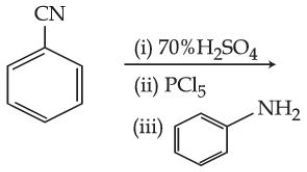
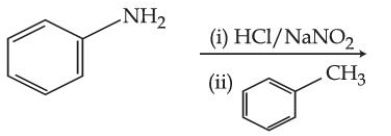
Which one of the following reaction sequences will give an azo dye?
The formation of an azo dye proceeds through the following steps:
Reduction of nitrobenzene with Sn/HCl yields aniline (C6H5NH2).
Diazotization of aniline with NaNO2/HCl at 0−5∘C produces the benzenediazonium chloride salt (C6H5N2+Cl−).
The diazonium salt undergoes an electrophilic aromatic substitution (coupling reaction) with β-naphthol in an alkaline medium (NaOH) to form an azo dye, characterized by the −N=N− linkage.
Q35JEE Main 2025MCQ4MBiomolecules
Identify the essential amino acids from below : (A) Valine (B) Proline (C) Lysine (D) Threonine (E) Tyrosine Choose the correct answer from the options given below :
Essential amino acids are those that cannot be synthesized by the human body and must be obtained from the diet. The essential amino acids are: Valine, Leucine, Isoleucine, Lysine, Methionine, Phenylalanine, Threonine, Tryptophan, and Histidine. Checking each option: (A) Valine - Essential ✓ (B) Proline - Non-essential ✗ (C) Lysine - Essential ✓ (D) Threonine - Essential ✓ (E) Tyrosine - Non-essential (conditionally essential) ✗ The correct answer is Option 2: (A), (C) and (D) only.
Q36JEE Main 2025MCQ4MCoordination Compounds
The calculated spin-only magnetic moments of K3[Fe(OH)6] and K4[Fe(OH)6] respectively are :
For K3[Fe(OH)6]: The complex ion is [Fe(OH)6]3−. Fe is \in +3 oxidation state: d5. OH− is a weak field ligand, so this is high-spin d5 with 5 unpaired electrons. μ=5(5+2)=35=5.92 BM For K4[Fe(OH)6]: The complex ion is [Fe(OH)6]4−. Fe is \in +2 oxidation state: d6. OH− is a weak field ligand, so this is high-spin d6 with 4 unpaired electrons. μ=4(4+2)=24=4.90 BM The correct answer is Option 4: 5.92 and 4.90 B.M.
Q37JEE Main 2025MCQ4MClassification of Elements
The type of oxide formed by the element among Li, Na, Be, Mg, B and Al that has the least atomic radius is :
The elements given are Li, Na, Be, Mg, B, and Al. We need to find which has the least atomic radius. Atomic radii (approximate, in pm): Li: 152, Na: 186, Be: 112, Mg: 160, B: 87, Al: 143 Boron (B) has the smallest atomic radius among these elements (approximately 87 pm). Boron has atomic number 5 with electronic configuration 1s22s22p1. It is a metalloid \in Group 13. The oxide of boron is B2O3 (boron trioxide), which has the formula A2O3 where A = B. B2O3 is an acidic oxide. The answer is Option B: A2O3.
Q38JEE Main 2025MCQ4MHydrocarbons
Total number of sigma (σ) and \pi(π) bonds respectively present in hex-1-en-4-yne are :
Hex-1-en-4-yne has the structure: CH2=CH−CH2−C≡C−CH3 Let us count the bonds: Sigma bonds: - C1=C2: 1 σ bond - C2-C3: 1 σ bond - C3-C4: 1 σ bond - C4≡C5: 1 σ bond - C5-C6: 1 σ bond - C1-H bonds: 2 σ bonds - C2-H bond: 1 σ bond - C3-H bonds: 2 σ bonds - C6-H bonds: 3 σ bonds Total σ bonds = 5 + 8 = 13 Pi bonds: - C1=C2: 1 π bond - C4≡C5: 2 π bonds Total π bonds = 3 The correct answer is Option 3: 13 and 3.
Q39JEE Main 2025MCQ4Mp Block Elements
First ionisation enthalpy values of first four group 15 elements are given below. Choose the correct value for the element that is a main component of apatite family :
Group 15 elements are: N, P, As, Sb, Bi. Apatite is a mineral with the formula Ca5(PO4)3(F,Cl,OH). The main component element from Group 15 in apatite is phosphorus (P). The first ionization enthalpies of Group 15 elements: N: 1402 kJ/mol, P: 1012 kJ/mol, As: 947 kJ/mol, Sb: 834 kJ/mol Phosphorus has a first ionization enthalpy of 1012 kJ/mol. The correct answer is Option 3: 1012 kJ mol⁻¹.
Q40JEE Main 2025MCQ4MOrganic Chemistry - Some Basic Principles
Given below are two statements : Statement (I) : On nitration of m-xylene with HNO3, H2SO4 followed by oxidation, 4-nitrobenzene-1,3-dicarboxylic acid is obtained as the major product. Statement (II) : −CH3 group is o/p-directing while −NO2 group is m-directing group. In the light of the above statements, choose the correct answer from the options given below :
We need to evaluate two statements about the nitration of m-xylene and the directing effects of substituents. On nitration of m-xylene with HNO3/H2SO4 followed by oxidation, 4-nitrobenzene-1,3-dicarboxylic acid is obtained as the major product. m-Xylene has two −CH3 groups at positions 1 and 3 of the benzene ring, and both groups are ortho/para directing and activating. During nitration, the incoming NO2+ electrophile preferentially attacks the ring positions that are ortho or para to both methyl groups simultaneously. Position 2 is ortho to both methyl groups but is sterically hindered; positions 4 and 5 are each para to one methyl and ortho to the other. The major nitration product therefore has −NO2 at position 4 (equivalently position 5 by symmetry), giving 1,3-dimethyl-4-nitrobenzene. Oxidation of both −CH3 groups with a strong oxidizing agent such as KMnO4 converts them to −COOH groups, producing 4-nitrobenzene-1,3-dicarboxylic acid, which shows that Statement I is true. The methyl group is an electron-donating group via hyperconjugation and the inductive effect, activating the ring and directing incoming electrophiles to ortho and para positions, whereas the nitro group is a strong electron-withdrawing group by resonance and inductive effects, deactivating the ring and directing electrophiles to the meta position. Thus Statement II is also true. Since both statements are true, the correct answer is Option (4): Both Statement I and Statement II are true.
Q41JEE Main 2025MCQ4MHaloalkanes and Haloarenes
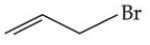
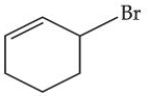
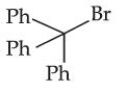
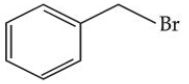
Which among the following halides will generate the most stable carbocation in the nucleophilic substitution reaction?
The stability of a carbocation is primarily governed by resonance delocalization.
Option A generates an allyl cation, stabilized by resonance with one double bond.
Option D generates a benzyl cation, stabilized by resonance with one phenyl ring.
Option C generates the triphenylmethyl cation, where the positive charge is delocalized over three phenyl rings through resonance.
This extensive conjugation across three aromatic systems makes the triphenylmethyl cation significantly more stable than the allyl or benzyl cations.
Q42JEE Main 2025MCQ4MStructure of Atom
Given below are two statements : Statement (I) : It is impossible to specify simultaneously with arbitrary precision, both the linear momentum and the position of a particle. Statement (II) : If the uncertainty in the measurement of position and uncertainty in measurement of momentum are equal for an electron, then the uncertainty in the measurement of velocity is ≥πh×2m1. In the light of the above statements, choose the correct answer from the options given below :
Statement I: "It is impossible to specify simultaneously with arbitrary precision, both the linear momentum and the position of a particle." This is a direct statement of the Heisenberg Uncertainty Principle, which says: Δx⋅Δp≥4πh where Δx is the uncertainty \in position and Δp is the uncertainty \in momentum. Since the product of the two uncertainties has a non-zero lower bound, we cannot make both arbitrarily small at the same time. So Statement I is true . Statement II: We are told that the uncertainty \in position equals the uncertainty \in momentum, i.e., Δx=Δp. We need to check whether Δv≥πh×2m1. Starting from the Heisenberg Uncertainty Principle: Δx⋅Δp≥4πh Since Δx=Δp, we substitute: (Δp)2≥4πh Taking the square root of both sides: Δp≥4πh=21πh Now, momentum p=mv, so the uncertainty \in momentum is related to the uncertainty \in velocity by: Δp=m⋅Δv Substituting: m⋅Δv≥21πh Dividing both sides by m: Δv≥2m1πh This can be rewritten as: Δv≥πh×2m1 This is exactly what Statement II claims. So Statement II is also true . Since both statements are true, the correct answer is Option C.
Q43JEE Main 2025MCQ4MRedox Reactions
0.1 M solution of KI reacts with excess of H2SO4 and KIO3 solutions. According to equation 5I−+IO3−+6H+→3I2+3H2O Identify the correct statements : (A) 200 mL of KI solution reacts with 0.004 mol of KIO3 (B) 200 mL of KI solution reacts with 0.006 mol of H2SO4 (C) 0.5 L of KI solution produced 0.005 mol of I2 (D) Equivalent weight of KIO3 is equal to ( 5Molecularweight ) Choose the correct answer from the options given below :
The reaction: 5I−+IO3−+6H+→3I2+3H2O 0.1 M KI solution: moles of I− \in 200 mL = 0.1×0.2=0.02 mol. (A) 200 mL of KI has 0.02 mol I−. From stoichiometry, 5 mol I− reacts with 1 mol IO3−. Moles of KIO3=0.02/5=0.004 mol. ✓ (B) 200 mL has 0.02 mol I−. From stoichiometry, 5 mol I− reacts with 6 mol H+. Moles of H+=0.02×6/5=0.024 mol. Moles of H2SO4=0.024/2=0.012 mol \ne 0.006. ✗ (C) 0.5 L of KI has 0.1×0.5=0.05 mol I−. From stoichiometry, 5 mol I− produces 3 mol I2. Moles of I2=0.05×3/5=0.03 mol \ne 0.005. ✗ (D) In this reaction, IO3− goes from I(+5) to I₂(0), gaining 5 electrons per I atom. Equivalent weight = Molecular weight / 5. ✓ The correct answer is Option 1: (A) and (D) only.
Q44JEE Main 2025MCQ4MPractical Organic Chemistry
Given below are two statements : Statement (I): In partition chromatography, stationary phase is thin film of liquid present in the inert support. Statement (II) : In paper chromatography, the material of paper acts as a stationary phase. In the light of the above statements, choose the correct answer from the options given below :
Statement I: In partition chromatography, the stationary phase is a thin film of liquid present on an inert support. This is correct - partition chromatography is based on the partitioning of components between a liquid stationary phase held on a solid support and a mobile phase. Statement II: In paper chromatography, the material of paper acts as the stationary phase. This is incorrect. In paper chromatography, the water trapped in the cellulose fibers of the paper acts as the stationary phase (liquid), not the paper material itself. Paper chromatography is actually a type of partition chromatography. The correct answer is Option 1: Statement I is true but Statement II is false.
Q45JEE Main 2025MCQ4MChemical Thermodynamics
If C(diamond)→C(graphite)+XkJ mol−1C(diamond)+O2(g)→CO2(g)+YkJ mol−1C(graphite)+O2(g)→CO2(g)+ZkJ mol−1 at constant temperature. Then
Given reactions: 1. C(diamond)→C(graphite)+X kJ/mol ... (i) 2. C(diamond)+O2(g)→CO2(g)+Y kJ/mol ... (ii) 3. C(graphite)+O2(g)→CO2(g)+Z kJ/mol ... (iii) By Hess's law, reaction (i) = reaction (ii) - reaction (iii): C(diamond)→C(graphite) The enthalpy change for this = enthalpy of (ii) - enthalpy of (iii): X=Y−Z The correct answer is Option 4: X = Y - Z.
Q46JEE Main 2025NAT4MOrganic Chemistry - Some Basic Principles
In the sulphur estimation, 0.20 g of a pure organic compound gave 0.40 g of barium sulphate. The percentage of sulphur in the compound is ______ ×10−1. (Molar mass : O = 16, S=32, Ba = 137 \in gmol−1)
In sulphur estimation, the organic compound is converted to BaSO4. Molar mass of BaSO4=137+32+64=233 g/mol. Mass of S \in BaSO4 = 23332×0.40=23312.8 g Percentage of S = 23332×0.200.40×100=23332×200=2336400=27.47% In the form x×10−1%: 27.47=274.7×10⁻¹, so x≈275. The answer is 275.
Q47JEE Main 2025NAT4MHydrocarbons
Isomeric hydrocarbons → negative Baeyer's test (Molecular formula C9H12) The total number of isomers from above with four different non-aliphatic substitution sites is -
Molecular formula C9H12: degree of unsaturation = 22(9)+2−12=28=4. Since it gives a negative Baeyer's test (no alkene/alkyne), the 4 degrees of unsaturation come from a benzene ring. So these are alkylbenzenes with formula C6H5−C3H7. The isomeric alkylbenzenes with C9H12 are: 1. n-propylbenzene 2. isopropylbenzene (cumene) 3. 1,2,3-trimethylbenzene (hemimellitene) 4. 1,2,4-trimethylbenzene (pseudocumene) 5. 1,3,5-trimethylbenzene (mesitylene) 6. 1-ethyl-2-methylbenzene 7. 1-ethyl-3-methylbenzene 8. 1-ethyl-4-methylbenzene We need isomers with exactly 4 different non-aliphatic (aromatic) substitution sites, meaning 4 different types of aromatic H atoms. Looking at 1,2,4-trimethylbenzene: positions on ring are C1(CH₃), C2(CH₃), C3(H), C4(CH₃), C5(H), C6(H). The three H atoms at C3, C5, C6 are all in different environments. So 3 types of aromatic H, not 4. For 1-ethyl-2-methylbenzene: C1(Et), C2(Me), C3(H), C4(H), C5(H), C6(H). The H's at C3, C4, C5, C6 are in 4 different environments. This has 4 different aromatic substitution sites. ✓ For 1-ethyl-3-methylbenzene: C1(Et), C2(H), C3(Me), C4(H), C5(H), C6(H). The H's at C2, C4, C5, C6 are in 4 different environments. ✓ So 2 isomers have 4 different non-aliphatic substitution sites. The answer is 2.
Q48JEE Main 2025NAT4MCoordination Compounds
Consider the following low-spin complexes K3[Co(NO2)6], K4[Fe(CN)6], K3[Fe(CN)6], Cu2[Fe(CN)6]andZn2[Fe(CN)6] The sum of the spin-only magnetic moment values of complexes having yellow colour is. _____ B.M. (answer in nearest integer)
We need to identify which complexes are yellow among the given low-spin complexes, then sum their spin-only magnetic moments. The complexes are: 1. K3[Co(NO2)6]: Co³⁺ (d⁶), low-spin \to t2g6eg0, 0 unpaired electrons, \mu = 0 BM. Yellow \in colour. ✓ 2. K4[Fe(CN)6]: Fe²⁺ (d⁶), low-spin \to t2g6eg0, 0 unpaired electrons, \mu = 0 BM. Yellow \in colour. ✓ 3. K3[Fe(CN)6]: Fe³⁺ (d⁵), low-spin \to t2g5eg0, 1 unpaired electron, \mu = 1.73 BM. Red/orange colour, not yellow. 4. Cu2[Fe(CN)6]: Brown/reddish colour. 5. Zn2[Fe(CN)6]: White precipitate. The yellow complexes are K3[Co(NO2)6] and K4[Fe(CN)6], both with μ = 0 BM. Sum of magnetic moments = 0 + 0 = 0 BM. The answer is 0.
Q49JEE Main 2025NAT4MOrganic Chemistry - Some Basic Principles
In the Claisen-Schmidt reaction to prepare, dibenzalacetone from 5.3 g of benzaldehyde, a total of 3.51 g of product was obtained. The percentage yield in this reaction was ______ %.
In the Claisen-Schmidt reaction between benzaldehyde and acetone, represented by 2C6H5CHO+CH3COCH3→C6H5CH=CHCOCH=CHC6H5+2H2O, if 5.3 g of benzaldehyde are used and 3.51 g of dibenzalacetone are obtained, the percentage yield can be calculated as follows. The molar mass of benzaldehyde is 6(12)+5(1)+12+16+1=106 g/mol, and the molar mass of dibenzalacetone is 17(12)+14(1)+16=204+14+16=234 g/mol. The number of moles of benzaldehyde is 1065.3=0.05 mol. Since 2 mol of benzaldehyde produce 1 mol of dibenzalacetone, the theoretical yield \in moles is 0.05/2=0.025 mol. Multiplying by the molar mass of dibenzalacetone gives the theoretical mass as 0.025×234=5.85 g. Therefore, the percentage yield is 5.853.51×100=60%, so the yield of the reaction is 60%.
Q50JEE Main 2025NAT4MChemical Bonding and Molecular Structure
Total number of non bonded electrons present in NO2 -ion based on Lewis theory is
We first evaluate the integral that defines the function. Given f(x)=∫0xt(t2−9t+20)dt on 1≤x≤5. Simplify the integrand: t(t2−9t+20)=t3−9t2+20t. Hence f(x)=∫0x(t3−9t2+20t)dt. Integrate term-by-term: ∫t3dt=4t4,∫(−9t2)dt=−3t3,∫20tdt=10t2. Thus f(x)=[4t4−3t3+10t2]0x=4x4−3x3+10x2. To find the range of f on [1,5] we examine its critical points. Differentiate: f′(x)=x3−9x2+20x. Factor: f′(x)=x(x2−9x+20)=x(x−4)(x−5). Critical points inside the interval come from f′(x)=0: x=4,x=5 (note x=0 lies outside the given domain). Sign chart of f′(x) on [1,5]: \bullet For 1≤x<4, choose x=2: the factors are (+)(−)(−)⇒f′(x)>0 (increasing). \bullet For 4<x<5, choose x=4.5: (+)(+)(−)⇒f′(x)<0 (decreasing). \bullet Just beyond 5 (not needed here) the derivative becomes positive again. Therefore within [1,5]: \bullet f increases up to x=4, \bullet attains a maximum at x=4, \bullet then decreases up to x=5. Possible extrema on a closed interval are at critical points and endpoints. Compute f(x) at these points: At x=1: f(1)=414−3(1)3+10(1)2=41−3+10=429=7.25. At x=4: f(4)=444−3(4)3+10(4)2=64−192+160=32. At x=5: f(5)=454−3(5)3+10(5)2=4625−375+250=4125=31.25. Comparing these values: fmin=f(1)=429,fmax=f(4)=32. Hence the range of f is [α,β]=[429,32]. Compute 4(α+β): α+β=429+32=429+4128=4157, so 4(α+β)=4(4157)=157. The required value is 157, which matches Option D.
Q52JEE Main 2025MCQ4MVector Algebra
Let a be a unit vector perpendicular to the vectors b=i−2j+3k and c=2i+3j−k, and makes an angle of cos−1(−31) with the vector i+j+k . If a makes an angle of 3π with the vector i+αj+k , then the value of α is :
First, find a vector perpendicular to both b=i^−2j^+3k^ and c=2i^+3j^−k^. b×c=i^12j^−23k^3−1 which simplifies to =i^(2−9)−j^(−1−6)+k^(3+4)=−7i^+7j^+7k^. Therefore, b×c=7(−i^+j^+k^). The unit vector \in this direction is given by a^=±31(−i^+j^+k^). Next, a^ makes an angle cos−1(−31) with i^+j^+k^, so a^⋅(i^+j^+k^)=∣a^∣∣i^+j^+k^∣cosθ. For a^=31(−1+1+1)=31,cosθ=31/3=31. For a^=3−1(−1+1+1)=3−1,cosθ=3−1/3=−31 ✓. Hence, a^=3−1(−i^+j^+k^)=31(i^−j^−k^). Now, a^ makes an angle 3π with i^+αj^+k^, so cos3π=∣i^+αj^+k^∣a^⋅(i^+αj^+k^) gives 21=2+α231(1−α−1)=32+α2−α and therefore 21=3(2+α2)−α. Since the left side is positive, α must be negative. Squaring both sides yields 41=3(2+α2)α2, so 3(2+α2)=4α2,6+3α2=4α2,α2=6,α=−6. The correct answer is Option 2: −6.
Q53JEE Main 2025MCQ4MDifferential Equations
If for the solution curve y = f(x) of the differential equation dxdy+(tanx)y=(1+2secx)22+secx, x∈(−2π,2π),f(3π)=103, then f(4π) is equal to :
The given differential equation is a first-order linear ODE: dxdy+(tanx)y=(1+2secx)22+secx To solve it, we find the integrating factor: IF=e∫tanxdx=e−ln∣cosx∣=secx. Multiplying both sides of the differential equation by this integrating factor gives dxd(ysecx)=(1+2secx)2secx(2+secx) We simplify the right-hand side by expressing it \in terms of cosx: (1+2secx)2secx(2+secx)=(1+cosx2)2cosx1(2+cosx1)=cos2x(cosx+2)2cos2x2cosx+1=(cosx+2)22cosx+1 Observing that (cosx+2)22cosx+1=dxd(cosx+2sinx), which can be checked by differentiating: dxd(cosx+2sinx)=(cosx+2)2cosx(cosx+2)+sin2x=(cosx+2)2cos2x+2cosx+sin2x=(cosx+2)21+2cosx. Therefore, integrating both sides with respect to x yields ysecx=cosx+2sinx+C. To determine the constant C, we use the condition f(3π)=103: 103⋅sec3π=cos3π+2sin3π+C103⋅2=21+223+C1023=2523+C=53+C53=53+CC=0 Hence, ysecx=cosx+2sinx, so that y=cosx+2sinxcosx. Evaluating this at x=4π gives f(4π)=cos4π+2sin4π⋅cos4π=21+221⋅21=21+2221=2(1+22)2 Rationalizing the denominator gives =2(22+1)(22−1)2(22−1)=2(8−1)2(22−1)=142⋅2−2=144−2 The correct answer is Option 4: 144−2.
Q54JEE Main 2025MCQ4MThree Dimensional Geometry
Let P be the foot of the perpendicular from the point (1,2,2) on the line L: 1x−1=−1y+1=2z−2. Let the line r=(−i^+j^−2k^)+λ(i^−j^+k^),λ∈R, intersect the line L at Q. Then 2(PQ)2 is equal to:
Line L: 1x−1=−1y+1=2z−2=t Parametric form: (1+t,−1−t,2+2t) Finding P (foot of perpendicular from (1,2,2) to L): Direction of L: d=(1,−1,2) Vector from point on L to (1,2,2): (1−(1+t),2−(−1−t),2−(2+2t))=(−t,3+t,−2t) For perpendicularity: (−t)(1)+(3+t)(−1)+(−2t)(2)=0−t−3−t−4t=0−6t−3=0t=−21 So P=(21,−21,1). Finding Q (intersection of given line with L): The second line: r=(−1,1,−2)+λ(1,−1,1), i.e., (−1+λ,1−λ,−2+λ) Setting equal to L's parametric form: −1+λ=1+t⇒λ=2+t...(1)1−λ=−1−t⇒λ=2+t...(2) ✓ −2+λ=2+2t...(3) From (1): λ=2+t. Substituting \in (3): −2+2+t=2+2tt=−2λ=0 So Q=(−1,1,−2). Verification on L: (1+(−2),−1−(−2),2+2(−2))=(−1,1,−2) ✓ Computing 2(PQ)2: PQ=Q−P=(−1−21,1+21,−2−1)=(−23,23,−3)(PQ)2=49+49+9=49+49+436=454=2272(PQ)2=2×227=27 The correct answer is Option 4: 27.
Q55JEE Main 2025MCQ4MMatrices and Determinants
Let A = [aij] be a matrix of order 3×3, with aij = (2)i+j. If the \sum of all the elements \in the third row of A2 is α+β2,α,β∈Z, then α+β is equal to:
The matrix A=[aij] is defined by aij=(2)i+j. A=2224224424428 We seek the \sum of all elements \in the third row of A2. Notice that the \sum of the entries \in the third row of A2 can be written as the dot product of the third row of A with the vector of column sums of A (i.e., A2⋅1 gives row sums of A2, which equals A⋅(A1)). The sums of the columns of A are Column 1: 2+22+4=6+22 Column 2: 22+4+42=4+62 Column 3: 4+42+8=12+42 Hence the \sum of the third row of A2 is =4(6+22)+42(4+62)+8(12+42)=24+82+162+48+96+322=(24+48+96)+(8+16+32)2=168+562 So α=168 and β=56. α+β=168+56=224 The correct answer is Option 2: 224.
Q56JEE Main 2025MCQ4MStraight Lines and Pair of Straight Lines
Let the line x + y = 1 meet the axes of x and y at A and B, respectively. A right angled triangle AMN is inscribed in the triangle OAB , where O is the origin and the points M and N lie on the lines OB and AB, respectively. If the area of the triangle AMN is 94 of the area of the triangle OAB and AN : NB = λ:1 , then the \sum of all possible value(s) of is λ :
The given line x+y=1 meets the x-axis at A(1,0) and the y-axis at B(0,1). Hence the right-angled △OAB has area 21. Take M(0,m),0<m<1 on OB and N(n,1−n),0<n<1 on AB. (The point N has been written \in the form (x,1−x) because every point on the line AB:x+y=1 satisfies y=1−x.) 1. Area condition Using the determinant (or co-ordinate) formula, the area of △AMN is 21∣(Mx−Ax)(Ny−Ay)−(My−Ay)(Nx−Ax)∣=21(1−n)(1−m). It is given thatarea(AMN)=94area(OAB)=94⋅21=92, so (1−n)(1−m)=94−(1) 2. Where can the right angle be? At vertex A the angle is 45∘ (slope of OA is 0, slope of AB is −1), therefore the right angle cannot be situated at A. Thus the right angle can be either at N or at M. We examine both possibilities. Case 1: Right angle at N. The vectors along the two sides through N are NA=A−N=(1−n,−(1−n)),NM=M−N=(−n,m+n−1). For these to be perpendicular NA⋅NM=0⟹(1−n)(−n)−(1−n)(m+n−1)=0, which simplifies to 1−m−2n=0⟹m=1−2n.−(2) Putting m from (2) \in the area relation (1) gives (1−n)[1−(1−2n)]=(1−n)(2n)=94. Hence n(1−n)=92⟹9n2−9n+2=0. Solving, n=189±3=32,31. For n=32, equation (2) gives m=1−34=−31, which is not on segment OB. Reject this value. For n=31, we have m=1−32=31, which indeed satisfies 0<m<1. Ratio along AB: NBAN=n1−n=311−31=12=2. Thus λ=2. Case 2: Right angle at M. Here the vectors through M are MA=A−M=(1,−m),MN=N−M=(n,1−n−m). Perpendicularity gives 1⋅n+(−m)(1−n−m)=0⟹n=m(1−n−m).−(3) Using (3) together with the area condition (1) leads to a cubic equation \in m whose only solution \in the interval 0<m<1 yields λ=n1−n>4. Since λ must match one of the given options, no admissible value arises from this case. 3. Conclusion The only permissible value is obtained from Case 1: λ=2. Because the question asks for "the \sum of all possible value(s) of λ", the required \sum is also 2. Hence, Option A is correct.
Q57JEE Main 2025MCQ4MPermutations and Combinations
If all the words with or without meaning made using all the letters of the word "KANPUR" are arranged as in a dictionary, then the word at 440th position in this arrangement, is :
The word "KANPUR" has 6 distinct letters: A, K, N, P, R, U. Arranging in alphabetical order: A, K, N, P, R, U. Total permutations = 6! = 720. Words starting with each letter = 5! = 120. Words starting with A: positions 1-120 Words starting with K: positions 121-240 Words starting with N: positions 241-360 Words starting with P: positions 361-480 440th word starts with P. Position within P-words: 440 - 360 = 80. After P, remaining letters: A, K, N, R, U (alphabetical order). Words starting with PA: 4! = 24 (positions 1-24) Words starting with PK: 4! = 24 (positions 25-48) Words starting with PN: 4! = 24 (positions 49-72) Words starting with PR: 4! = 24 (positions 73-96) 80th word starts with PR. Position within PR-words: 80 - 72 = 8. After PR, remaining letters: A, K, N, U. Words starting with PRA: 3! = 6 (positions 1-6) Words starting with PRK: 3! = 6 (positions 7-12) 8th word starts with PRK. Position within PRK-words: 8 - 6 = 2. After PRK, remaining letters: A, N, U. Words starting with PRKA: 2! = 2 (positions 1-2) 2nd word starting with PRKA: remaining letters N, U arranged as UN. PRKAUN (position 2 within PRKA-words) Wait: 1st position is PRKANU, 2nd position is PRKAUN. So the 440th word is PRKAUN. The correct answer is Option 3: PRKAUN.
Q58JEE Main 2025MCQ4MQuadratic Equation and Inequalities
If the set of all a∈R, for which the equation 2x2+(a−5)x+15=3a has no real root, is the interval (α,β) and X={x∈Z:α<x<β}, then ∑x∈Xx2 is equal to :
We consider the quadratic equation 2x2+(a−5)x+15−3a=0 and require that it have no real roots, which is equivalent to its discriminant satisfying D=(a−5)2−4(2)(15−3a)<0. Expanding the discriminant yields a2−10a+25−120+24a<0, which simplifies to a2+14a−95<0. To find the critical values of a, we solve the equation a2+14a−95=0, giving a=2−14±196+380=2−14±576=2−14±24, so that a=5 or a=−19. Therefore the quadratic has no real roots precisely when a∈(−19,5). For integer values of x \in this interval we set X={x∈Z:−19<x<5}={−18,−17,…,4}. We wish to compute ∑x∈Xx2=∑x=−184x2=∑x=118x2+∑x=14x2. Using the formula ∑k=1nk2=6n(n+1)(2n+1), we find ∑x=118x2=618×19×37=612654=2109 and ∑x=14x2=64×5×9=30. Hence ∑x∈Xx2=2109+30=2139. The correct answer is Option 4: 2139.
Q59JEE Main 2025MCQ4MMatrices and Determinants
Let A=[aij] be a 2×2 matrix such that aij∈{0,1} for all i and j . Let the random variable X denote the possible values of the determinant of the matrix A . Then, the variance of x is :
Matrix A=[a11a21a12a22] where each aij∈{0,1}. Total matrices = 24=16. det(A)=a11a22−a12a21. Possible values of det(A): -1, 0, 1. Let us count each case: det = 1: a11a22=1 and a12a21=0. So a11=a22=1 and at least one of a12,a21 is 0. Number of ways = 1 \times 3 = 3. But we need a11a22−a12a21=1, which means a11a22=1,a12a21=0: 3 cases. det = -1: a11a22=0 and a12a21=1. So a12=a21=1 and at least one of a11,a22 is 0. Number of ways = 3 \times 1 = 3. det = 0: Remaining cases = 16 - 3 - 3 = 10. Now computing variance: E(X)=161[3(1)+10(0)+3(−1)]=0E(X2)=161[3(1)+10(0)+3(1)]=166=83Var(X)=E(X2)−[E(X)]2=83−0=83 The correct answer is Option 3: 83.
Q60JEE Main 2025MCQ4MDifferentiation
Let the function f(x) = (x2+1)∣x2−ax+2∣+cos∣x∣ be not differentiable at the two points x = α = 2 and x=β. Then the distance of the point (α,β) from the line 12x+5y+10=0 is equal to :
The function is f(x)=(x2+1)∣x2−ax+2∣+cos∣x∣. Note that cos∣x∣=cosx, which is differentiable everywhere, so any non-differentiability arises solely from the factor ∣x2−ax+2∣ and occurs where x2−ax+2=0. Since x=α=2 is given as a point of non-differentiability, it must satisfy 4−2a+2=0, which yields a=3. Substituting this into the quadratic gives x2−3x+2=(x−1)(x−2)=0, so the roots are x=1 and x=2. At x=2, we have (x2+1)=5=0, confirming that the absolute value causes non-differentiability and hence α=2. At x=1, we have (x2+1)=2=0, which similarly yields the other point of non-differentiability β=1. Thus (α,β)=(2,1). To find the distance from (2,1) to the line 12x+5y+10=0, we use the formula d=144+25∣12(2)+5(1)+10∣=13∣24+5+10∣=1339=3. Therefore, the correct answer is Option 3: 3.
Q61JEE Main 2025MCQ4MArea Under The Curves
Let the area enclosed between the curves ∣y∣=1−x2 and x2+y2=1 be α. If 9α = βπ+γ;β,γ are integers, then the value of ∣β−γ∣ equals.
We can use the Fermat's Little Theorem i.e. ap−1≡1(modp) Here, a=7 and p=23. Since 23 is prime and 7 is not a multiple of 23, we can apply the theorem: 722≡1(mod23) Now, we have to break down 103 as a multiple of 22. 103=(22×4)+15∴7103=722×4+15=(722)4×715 We know that 722≡1(mod23). 7103≡14⋅715≡715(mod23) Now, we need to calculate: 715 mod 23 We know 72=49≡3 (mod 23) Similarly, 74=49=32≡9(mod 23) 78=49=92=81≡12(mod 23) Now, 715=78×74×72×7 Substituting the values: 12×9×3×712×9=108≡16 (mod23) 16×3=48≡2 (mod23) 2×7=14 (mod23) Hence, the final answer is 14.
Q63JEE Main 2025MCQ4MEllipse
If αx+βy=109 is the equation of the chord of the ellipse 9x2+4y2=1, whose mid point is (25,21) , then α+β is equal to :
For the ellipse 9x2+4y2=1, the equation of the chord with midpoint (h,k) is given by: 9xh+4yk=9h2+4k2 Given midpoint (25,21): 9x⋅25+4y⋅21=9(25)2+4(21)2185x+8y=3625+161 RHS: 3625+161=576400+36=576436=144109 LHS: 185x+8y Multiplying through by 144: 40x+18y=109 Comparing with αx+βy=109: α=40,β=18α+β=40+18=58 The correct answer is Option 1: 58.
Q64JEE Main 2025MCQ4MLogarithms
If the domain of the function log5(18x−x2−77) is (α,β) and the domain of the function log(x−1)(x2−3x−42x2+3x−2) is (γ,δ), then α2+β2+γ2 is equal to :
Find α2+β2+γ2 where (α,β) is domain of log5(18x−x2−77) and (γ,δ) is domain of log(x−1)(x2−3x−42x2+3x−2). Domain of log5(18x−x2−77). Need 18x−x2−77>0, i.e., x2−18x+77<0. x2−18x+77=(x−7)(x−11)<0 Domain: (7,11), so α=7,β=11. Domain of log(x−1)(x2−3x−42x2+3x−2). Need: (i) x−1>0 and x−1=1: x>1,x=2. (ii) x2−3x−42x2+3x−2>0. Factor: 2x2+3x−2=(2x−1)(x+2), x2−3x−4=(x−4)(x+1). (x−4)(x+1)(2x−1)(x+2)>0 Critical points: x=−2,−1,1/2,4. Combined with x>1,x=2: For x>1: check intervals (1,4) and (4,∞). At x=2: (−2)(3)(3)(4)=−612=−2<0. Not \in domain. At x=3: (−1)(4)(5)(5)=−425<0. Not \in domain. At x=5: (1)(6)(9)(7)>0. In domain. So domain for x>1: (4,∞)∖{2}. But 2 is not \in (4,∞), so domain is (4,∞). Wait, we also need to exclude x=2 (base = 1). Since 4>2, this is automatically excluded. So γ=4. But we need (γ,δ). If domain is (4,∞), then δ=∞. This doesn't work for the problem. The answer is Option C: 186. So α2+β2+γ2=49+121+16=186. With γ=4. The correct answer is Option C : 186.
Q65JEE Main 2025MCQ4MCircles
Let a circle C pass through the points (4,2) and (0,2) , and its centre lie on 3x+2y+2=0. Then the length of the chord, of the circle C, whose mid-point is (1,2), is:
The circle passes through (4,2) and (0,2), so the midpoint of these points lies on the perpendicular bisector. Midpoint = (2,2). The line joining these points is horizontal (y=2), so the perpendicular bisector is the vertical line x=2. The centre lies on both x=2 and 3x+2y+2=0: 3(2)+2y+2=0⇒2y=−8⇒y=−4 Centre =(2,−4). Radius = distance from centre to (4,2): r=(4−2)2+(2+4)2=4+36=40=210 For the chord with midpoint (1,2): Distance from centre (2,−4) to midpoint (1,2): d=(2−1)2+(−4−2)2=1+36=37 Half-length of chord = r2−d2=40−37=3 Length of chord = 23. The correct answer is Option 3: 23.
Q66JEE Main 2025MCQ4MThree Dimensional Geometry
Let a straight line L pass through the point P(2,-1,3) and be perpendicular to the lines 2x−1=1y+1=−2z−3 and 1x−3=3y−2=4z+2. If the line L intersects the yz-plane at the point Q , then the distance between the points P and Q is :
Line L passes through P(2,−1,3) and is perpendicular to: L1: direction (2,1,−2)L2: direction (1,3,4) Direction of L = (2,1,−2)×(1,3,4): d=i^21j^13k^−24=i^(4+6)−j^(8+2)+k^(6−1)=(10,−10,5) Simplifying: direction (2,−2,1). Line L: (x,y,z)=(2,−1,3)+t(2,−2,1) To find intersection with yz-plane (x=0): 2+2t=0⇒t=−1Q=(0,−1+2,3−1)=(0,1,2) Distance PQ: PQ=(2−0)2+(−1−1)2+(3−2)2=4+4+1=9=3 The correct answer is Option 4: 3.
Q67JEE Main 2025MCQ4MProbability
Bag 1 contains 4 white balls and 5 black balls, and Bag 2 contains n white balls and 3 black balls. One ball is drawn randomly from Bag 1 and transferred to Bag 2. A ball is then drawn randomly from Bag 2. If the probability, that the ball drawn is white, is 29/45 , then n is equal to :
Bag 1: 4 white, 5 black (total 9). Bag 2: n white, 3 black (total n+3). Case 1: White ball transferred from Bag 1 to Bag 2. Probability = 94. Bag 2 becomes: (n+1) white, 3 black (total n+4). P(white from Bag 2) = n+4n+1 Case 2: Black ball transferred from Bag 1 to Bag 2. Probability = 95. Bag 2 becomes: n white, 4 black (total n+4). P(white from Bag 2) = n+4n Total probability of drawing white from Bag 2: P=94⋅n+4n+1+95⋅n+4n=9(n+4)4(n+1)+5n=9(n+4)9n+4 Setting equal to 4529: 9(n+4)9n+4=45299(n+4)9n+4=4529 Cross-multiplying: 45(9n+4)=29×9(n+4)405n+180=261n+1044144n=864n=6 The correct answer is Option 1: 6.
Q68JEE Main 2025MCQ4MMatrices and Determinants
Let α,β(α=β) be the values of m , for which the equations x + y + z = 1, x + 2y + 4z = m and x + 4y + 10z = m2 have infinitely many solutions. Then the value of ∑n=110(nα+nβ) is equal to :
For the system to have infinitely many solutions, the determinant of the coefficient matrix must be 0, and the system must be consistent. The coefficient matrix and augmented matrix: 1111241410∣∣∣1mm2R2→R2−R1, R3→R3−R1: 100113139∣∣∣1m−1m2−1R3→R3−3R2: 100110130∣∣∣1m−1m2−1−3(m−1) For infinite solutions: m2−1−3m+3=0m2−3m+2=0(m−1)(m−2)=0m=1 or m=2 So α=1,β=2 (or vice versa). ∑n=110(nα+nβ)=∑n=110(n1+n2)=∑n=110n+∑n=110n2=210×11+610×11×21=55+385=440 The correct answer is Option 4: 440.
Q69JEE Main 2025MCQ4MLogarithms
Let S=N∪{0}. Define a relation R from S to R by : R={(x,y):logey=xloge(52),x∈S,y∈R} Then, the \sum of all the elements \in the range of R is equal to :
The relation is R={(x,y):lny=xln(2/5),x∈S=N∪{0},y∈R}. From lny=xln(2/5), we get y=exln(2/5)=(2/5)x. The range of R is the set of all y values: {(2/5)x:x∈{0,1,2,3,...}}={1,2/5,4/25,8/125,...} This is an infinite geometric series with first term a=1 and common ratio r=2/5: Sum=1−2/51=3/51=35 The correct answer is Option 4: 35.
Q70JEE Main 2025MCQ4MTrigonometric Ratios and Identities
If sinx+sin2x=1, x∈(0,2π) then (cos12x+tan12x)+3(cos10x+tan10x+cos8x+tan8x)+(cos6x+tan6x) is equal to :
Given: sinx+sin2x=1, which means sinx=1−sin2x=cos2x. Also: tanx=cosxsinx, and since sinx=cos2x: tan2x=cos2xsin2x=sinxsin2x=sinx=cos2x So cos2x=tan2x. Let t=cos2x=tan2x. The expression becomes: (t6+t6)+3(t5+t5+t4+t4)+(t3+t3)=2t6+6t5+6t4+2t3=2t3(t3+3t2+3t+1)=2t3(t+1)3 Now we need to find t. From sinx=cos2x and sin2x+cos2x=1: sin2x+sinx=1 (which is the given condition). t=cos2x=sinx, and t+t2=1, so t2+t=1, i.e., t+1=t1... actually: t2+t−1=0⇒t=2−1+5 (taking positive root since x∈(0,π/2)). So t(t+1)=t⋅t1⋅t... Let me recalculate: From t2+t=1: t(t+1)=1. Therefore: 2t3(t+1)3=2[t(t+1)]3=2(1)3=2. The correct answer is Option 4: 2.
Q71JEE Main 2025NAT4MDefinite Integrals
If 24∫04π(sin4x−12π+[2sinx])dx=2π+α, , where [⋅] denotes the greatest integer function, then α is equal to _______.
We need to evaluate: 24∫0π/4(sin4x−12π+[2sinx])dx=2π+α where [⋅] is the greatest integer function. Part 1: ∫0π/4sin∣4x−π/12∣dx4x−π/12=0 when x=π/48. For 0≤x<π/48: ∣4x−π/12∣=π/12−4x For π/48≤x≤π/4: ∣4x−π/12∣=4x−π/12I1=∫0π/48sin(π/12−4x)dx+∫π/48π/4sin(4x−π/12)dx=[4cos(π/12−4x)]0π/48+[−4cos(4x−π/12)]π/48π/4=41[cos0−cos(π/12)]+41[−cos(π−π/12)+cos0]=41[1−cos(π/12)]+41[cos(π/12)+1]=41[1−cos(π/12)+cos(π/12)+1]=42=21 Part 2: ∫0π/4[2sinx]dx For x∈[0,π/4]: 2sinx ranges from 0 to 2sin(π/4)=2≈1.414. [2sinx]=0 when 2sinx<1, i.e., sinx<1/2, i.e., x<π/6. [2sinx]=1 when 1≤2sinx<2, i.e., π/6≤x≤π/4. I2=∫0π/60dx+∫π/6π/41dx=π/4−π/6=π/12 Combining: 24(I1+I2)=24(21+12π)=12+2π So 2π+α=2π+12, giving α=12. The answer is 12.
Q72JEE Main 2025NAT4MSequences and Series
Let a1,a2,…,a2024 be an Arithmetic Progression such that a1+(a5+a10+a15+⋯+a2020)+a2024=2233. Then a1+a2+a3+⋯+a2024 is equal to _______
Given an AP a1,a2,…,a2024 such that: a1+(a5+a10+a15+⋯+a2020)+a2024=2233 The terms a5,a10,a15,…,a2020 form an AP with first term a5, common difference 5d, and the number of terms: from 5 to 2020 with step 5, that's 52020−5+1=404 terms. For an AP: an=a1+(n−1)d. The \sum of the subsequence terms: a5+a10+⋯+a2020=2404(a5+a2020)=202(a5+a2020) In an AP: a5+a2020=a1+a2024 (since 5+2020=2025=1+2024). So the given equation becomes: a1+a2024+202(a1+a2024)=2233203(a1+a2024)=2233a1+a2024=11 The \sum of the full AP: S2024=22024(a1+a2024)=1012×11=11132 The answer is 11132.
Q73JEE Main 2025NAT4MDefinite Integrals
If limt→0(∫01(3x+5)tdx)t1=5eα(58)32, then α is equal to ________
Let L=limt→0(∫01(3x+5)tdx)t1. Taking the natural logarithm gives lnL=limt→0tln∫01(3x+5)tdx.
Applying L'Hôpital's Rule as t→0: lnL=limt→0∫01(3x+5)tdx∫01(3x+5)tln(3x+5)dx=∫01ln(3x+5)dx
Evaluating the integral using substitution u=3x+5, du=3dx: lnL=31∫58lnudu=31[ulnu−u]58=31(8ln8−8−5ln5+5)=ln(55/388/3)−1
Exponentiating, L=e−1⋅55/388/3=e1⋅5⋅52/382⋅82/3=5e64(58)32.
Comparing this to 5eα(58)32, we find α=64.
[CORRECT_OPTION: 64]
Q74JEE Main 2025NAT4MParabola
Let y2=12x be the parabola and S be its focus. Let PQ be a focal chord of the parabola such that (SP)(SQ) = 4147. Let C be the circle described taking PQ as a diameter. If the equation of a circle C is 64x2+64y2−αx−643y=β, then β−α is equal to ________.
The given parabola is y2=12x. Write it as y2=4ax to identify a. 4a=12⟹a=3 For the parabola y2=4ax: \bullet Focus S(a,0). \bullet A point on the parabola \in parametric form is P(t):(at2,2at). Thus here a general point is (3t2,6t). If P(t1) and Q(t2) are the end-points of a focal chord, then t1t2=−1. (Standard result for a focal chord of y2=4ax.) Coordinates of the required points: P(3t12,6t1),Q(3t22,6t2) Distance of P from the focus S(3,0):
$ So SP=3(t12+1). Similarly, SQ=3(t22+1). The problem states SP⋅SQ=4147, hence 9(t12+1)(t22+1)=4147⟹(t12+1)(t22+1)=1249−(1) Using t1t2=−1, put t2=−t11 \in (1). Let x=t12(>0). Then x(x+1)2=1249⟹12(x+1)2=49x⇒12x2−25x+12=0⟹x=2432=34orx=2418=43 Choosing t12=34 (the other root only interchanges P and Q): t1=32,t2=−23 Coordinates of the chord end-points:
$
PQ:(3t12,6t1)=(4,43):(3t22,6t2)=(49,−33)
$ Centre and radius of circle with PQ as diameter Mid-point M(24+49,243−33)=(825,23) Length PQ:
$ Radius r=2PQ=849,r2=(849)2=642401 Equation of the circle Using centre-radius form: (x−825)2+(y−23)2=r2 Expanding & regrouping as x2+y2+Dx+Ey+F=0 gives x2+y2−425x−3y+(64625+43−642401)=0 The constant term evaluates to F=−27, hence x2+y2−425x−3y−27=0 Multiply by 64 to match the given pattern: 64x2+64y2−400x−643y=1728 Comparing with 64x2+64y2−αx−643y=β, we get α=400,β=1728 Therefore, β−α=1728−400=1328. Final Answer : 1328
Q75JEE Main 2025NAT4MComplex Numbers
Let integers a,b∈[−3,3] be such that a+b=0. Then the number of all possible ordered pairs (a, b), for which z+bz−a=1 and
\begin{vmatrix} z+1 & \omega & \omega^2 \\ \omega & z+\omega^2 & 1 \\ \omega^2 & 1 & z+\omega \end{vmatrix} = 1,\quad z \in \mathbb{C}$$, where $$\omega$$ and $$\omega^{2}$$ are the roots of $$x^{2} + x + 1 = 0$$, is equal to_________.
The integers a,b are chosen from [−3,3] with the restriction a+b=0. For such a pair we have to find a complex number z that satisfies both z+bz−a=1−(1) and
\begin{vmatrix} z+1 & \omega & \omega^{2}\\ \omega & z+\omega^{2} & 1\\ \omega^{2} & 1 & z+\omega \end{vmatrix}=1, \qquad -(2)$$ where $$\omega,\omega^{2}$$ are the non-real cube roots of unity, i.e. $$\omega^{2}+\omega+1=0$$ and $$\omega^{3}=1$$. Step 1: Evaluate the determinant \in (2). Let $$D(z)$$ denote the determinant. Expanding along the first row, $$D(z)=(z+1)\!\begin{vmatrix}z+\omega^{2}&1\\1&z+\omega\end{vmatrix}-\omega\!\begin{vmatrix}\omega&1\\\omega^{2}&z+\omega\end{vmatrix}+\omega^{2}\!\begin{vmatrix}\omega&z+\omega^{2}\\\omega^{2}&1\end{vmatrix}.$$ Compute the three $$2\times 2$$ minors:
$
$ Equation (2) therefore gives $$z^{3}=1 \quad\Longrightarrow\quad z\in\{1,\;\omega,\;\omega^{2}\}.$$(3) Step 2: Interpret the modulus condition (1). Because $$a,b$$ are real, points $$a$$ and $$-b$$ lie on the real axis. Writing $$z=x+iy,$$ $$\left|\frac{z-a}{z+b}\right|=1 \;\Longrightarrow\;|z-a|=|z+b|,$$ which is the set of points equidistant from $$a$$ and $$-b$$. The locus is the perpendicular bisector of the segment joining $$a$$ and $$-b$$, i.e. the vertical line $$x=\frac{a-b}{2}. \qquad -(4)$$ Step 3: Make the locus pass through at least one root of (3). The three cube roots of unity and their real parts are $$1 \;(x=1),\qquad \omega=-\tfrac12+\tfrac{\sqrt3}2 i \;(x=-\tfrac12),\qquad \omega^{2}=-\tfrac12-\tfrac{\sqrt3}2 i \;(x=-\tfrac12).$$ Thus a root from (3) lies on the line (4) iff $$\frac{a-b}{2}=1 \quad\text{or}\quad \frac{a-b}{2}=-\frac12.$$ Hence we need $$a-b=2 \qquad\text{or}\qquad a-b=-1.\quad -(5)$$ Step 4: List all integer pairs \in $$[-3,3]$$ satisfying (5) and $$a+b\neq0$$. Case 1: $$a-b=2.$$ Put $$b=a-2$$ and keep $$a,b\in[-3,3].$$ Possible $$a$$ values: $$-1,0,1,2,3.$$ Corresponding pairs: $$(a,b)=(-1,-3),(0,-2),(1,-1),(2,0),(3,1).$$ Reject the pair with $$a+b=0$$, i.e. $$(1,-1).$$ Valid pairs: 4. Case 2: $$a-b=-1.$$ Put $$b=a+1$$ and keep $$a,b\in[-3,3].$$ Possible $$a$$ values: $$-3,-2,-1,0,1,2.$$ Pairs: $$(a,b)=(-3,-2),(-2,-1),(-1,0),(0,1),(1,2),(2,3).$$ All have $$a+b\neq0$$, so all 6 are valid. Step 5: Total number of ordered pairs. Total valid pairs $$=4+6=10.$$ Answer : 10