Q1JEE Main 2025MCQ4MDual Nature of Matter and Radiation
During the transition of electron from state A to state C of a Bohr atom, the wavelength of emitted radiation is 2000 A˚ and it becomes 6000 A˚ when the electron jumps from state B to state C. Then the wavelength of the radiation emitted during the transition of electrons from state A to state B is:
Transition A→C corresponds to λ1=2000 Å and B\to C to λ2=6000 Å. We denote the wavelength for A\to B by λ3. Since the energy of A\to C equals the \sum of energies of A\to B and B\to C, EA→C=EA→B+EB→C. Expressing each energy as hc/λ gives λ1hc=λ3hc+λ2hc. Substituting the given wavelengths yields λ31=λ11−λ21=20001−60001=60003−1=30001. This gives λ3=3000 Å. Therefore the correct answer is 3000 Å .
Q2JEE Main 2025MCQ4MSemiconductor Electronics
Consider the following statements: A. The junction area of solar cell is made very narrow compared to a photo diode. B. Solar cells are not connected with any external bias. C. LED is made of lightly doped p-n junction. D. Increase of forward current results in continuous increase of LED light intensity. E. LEDs have to be connected in forward bias for emission of light. Choose the correct answer from the options given below:
Let us analyze each statement: A. The junction area of solar cell is made very narrow compared to a photodiode. This is false. In a solar cell, the junction area is made very large (not narrow) to capture maximum sunlight. It is the photodiode that typically has a smaller junction area. B. Solar cells are not connected with any external bias. This is true. Solar cells operate on the photovoltaic effect and generate their own EMF. They work without any external bias - they are essentially self-biased by the sunlight. C. LED is made of lightly doped p-n junction. This is false. LEDs are made of heavily doped p-n junctions to ensure high recombination rates and efficient light emission. D. Increase of forward current results in continuous increase of LED light intensity. This is false. Initially, increasing forward current increases light intensity, but beyond a certain point, the LED may reach saturation or get damaged. The increase is not continuous - there is a maximum rated current. E. LEDs have to be connected in forward bias for emission of light. This is true. LEDs emit light when electrons and holes recombine at the junction, which occurs only under forward bias. The correct statements are B and E only. The answer is Option A: B, E Only.
Q3JEE Main 2025MCQ4MAlternating Current
An alternating current is given by I=IAsinωt+IBcosωt. The r.m.s. current will be:
The given current, I=IAsinωt+IBcosωt, represents a sinusoidal alternating current. We can express this in the standard form I=I0sin(ωt+ϕ), where I0 is the peak amplitude of the current. The peak amplitude is found by combining the amplitudes of the sine and cosine components as vectors, resulting in I0=IA2+IB2.
The r.m.s. value of any sinusoidal current is related to its peak value by the formula Irms=2I0.
Substituting the expression for the peak current I0 into this formula gives: Irms=2IA2+IB2
Bringing the denominator inside the square root, we get the final expression: Irms=2IA2+IB2
Q4JEE Main 2025MCQ4MLaws of Motion
A car of mass m moves on a banked road having radius ′r′ and banking angle θ. To avoid slipping from the banked road, the maximum permissible speed of the car is v0. The coefficient of friction μ between the wheels of the car and the banked road is:
consider forces on the car on a banked road forces acting: weight = mg (vertical downward) normal reaction = N (perpendicular to surface) friction = f (along surface) for maximum speed , the car tends to slip up the incline , so friction acts down the slope resolve forces: along horizontal (towards center → provides centripetal force) N sinθ + f cosθ = m v₀² / r along vertical (no vertical acceleration) N cosθ − f sinθ = mg at limiting condition: f = μN substitute f = μN horizontal: N sinθ + μN cosθ = m v₀² / r N (sinθ + μ cosθ) = m v₀² / r ...(1) vertical: N cosθ − μN sinθ = mg N (cosθ − μ sinθ) = mg ...(2) divide (1) by (2): (sinθ + μ cosθ) / (cosθ − μ sinθ) = (v₀² / rg) cross multiply: sinθ + μ cosθ = (v₀² / rg)(cosθ − μ sinθ) expand: sinθ + μ cosθ = (v₀² / rg)cosθ − (v₀² / rg)μ sinθ collect μ terms: μ cosθ + (v₀² / rg)μ sinθ = (v₀² / rg)cosθ − sinθ factor μ: μ [cosθ + (v₀² / rg) sinθ] = (v₀² / rg)cosθ − sinθ final expression: μ = [ (v₀² / rg)cosθ − sinθ ] / [ cosθ + (v₀² / rg) sinθ ] μ=rg+v02tanθv02−rgtanθ this is the required coefficient of friction for maximum speed.
Q5JEE Main 2025MCQ4MCircular Motion
A satellite is launched into a circular orbit of radius R around the earth. A second satellite is launched into an orbit of radius 1.03R. The time period of revolution of the second satellite is larger than the first one approximately by:
T2∝R3⟹T∝R3/2 (Kepler's Third Law) Since the increase \in radius is small (R to 1.03R, a 3% change), we can use the approximation method for small percentage changes. The percentage change \in the radius is: RΔR×100=R1.03R−R×100=3%Percentage change \inT≈23×(Percentage change \inR)Percentage change \inT≈23×3%=4.5%
Q6JEE Main 2025MCQ4MThermodynamics
An ideal gas goes from an initial state to final state. During the process, the pressure of gas increases linearly with temperature. A. The work done by gas during the process is zero. B. The heat added to gas is different from change in its internal energy. C. The volume of the gas is increased. D. The internal energy of the gas is increased. E. The process is isochoric (constant volume process) Choose the correct answer from the options given below:
Use ideal gas law: PV=nRT Given pressure increases linearly with temperature, P∝T or TP=constant From ideal gas law, TP=VnR Since P/T is constant, V=constant So process is isochoric. Hence statement E is true. For isochoric process, W=∫PdV=0 So A is true. First law: Q=ΔU+W Since W=0 Q=ΔU So B ("heat added is different from change in internal energy") is false. Volume does not increase (constant), so C is false. Pressure increases linearly with temperature, so temperature increases. For ideal gas internal energy depends only on temperature, so internal energy increases. D is true. Correct statements: A, D, E
Q7JEE Main 2025MCQ4MDual Nature of Matter and Radiation
An electron of mass m with an initial velocity v=v0i^(v0>0) enters an electric field E=−E0k^. If the initial de Broglie wavelength is λ0, the value after time t would be:
Electron with v=v0i^ enters field E=−E0k^. Find de Broglie wavelength after time t. The force on the electron is F=−eE=eE0k^. Integrating acceleration gives vz=meE0t while vx=v0 remains constant. Hence the speed is v=v02+m2e2E02t2. The de Broglie wavelength is λ=mvh=mv02+e2E02t2/m2h. This can be written as λ=mv01+e2E02t2/(m2v02)h. Therefore λ=1+m2v02e2E02t2λ0.
Q8JEE Main 2025MCQ4MRay Optics and Optical Instruments
What is the relative decrease in focal length of a lens for an increase in optical power by 0.1D from 2.5D?[’D’ stands for dioptre]
Initial power is P1=2.5 D, which gives f1=1/2.5=0.4 m. When the power increases to P2=2.6 D, the focal length becomes f2=1/2.6 m. The relative decrease is f1f1−f2=1−f1f2=1−P2P1=1−2.62.5=2.60.1≈0.0385≈0.04. Therefore the correct answer is Option 2: 0.04.
Q9JEE Main 2025MCQ4MWork, Power and Energy
A force F=α+βx2 acts on an object \in the x-direction. The work done by the force is 5J when the object is displaced by 1m. If the constant α=1N then β will be:
Given the force F=α+βx2, the work done is 5 J over a displacement of 1 m and \alpha = 1 N, so we need to find \beta . Since the work is given by the integral of the force from 0 to 1, we have W=∫01(α+βx2)dx=$[αx+3βx3]01=α+3β. Substituting the values gives 5=1+3β, and therefore solving for \beta yields β=12 N/m². Thus the correct answer is Option 2: 12 N/m².
Q10JEE Main 2025MCQ4MRay Optics and Optical Instruments
A thin plano convex lens made of glass of refractive index 1.5 is immersed in a liquid of refractive index 1.2. When the plane side of the lens is silver coated for complete reflection, the lens immersed in the liquid behaves like a concave mirror of focal length 0.2 m . The radius of curvature of the curved surface of the lens is
The combination of a silvered lens acts as an equivalent mirror. The power of this equivalent mirror, Peq, is given by the sum of the powers of the components, accounting for the path of light: Peq=2Plens+Pmirror
The system behaves as a concave mirror of focal length f=0.2 m. The power of a mirror is P=1/f. Thus, Peq=0.21=5 D.
The power of the plano-convex lens immersed in the liquid is found using the Lens Maker's formula, where ng=1.5 is the refractive index of glass and nl=1.2 is the refractive index of the liquid. For a plano-convex lens with radius of curvature R: Plens=(nlng−1)(R1−∞1)=(1.21.5−1)R1=(1.20.3)R1=4R1
The silvered side is plane, so the mirror is a plane mirror. A plane mirror has zero power, so Pmirror=0.
Substituting these into the equivalent power equation: Peq=2(4R1)+0=2R1
Since we know Peq=5 D: 5=2R1⟹10R=1⟹R=0.10 m
Q11JEE Main 2025MCQ4MOscillations
A particle is executing simple harmonic motion with time period 2s and amplitude 1cm. If D and d are the total distance and displacement covered by the particle \in 12.5s, then dD is:
A particle executes SHM with time period T=2 s and amplitude A=1 cm. We need the ratio D/d after 12.5 s, where D = total distance and d = displacement. Since 12.5 s=6×2+0.5=6T+T/4, the particle completes 6 full periods and an additional T/4. In each complete period the particle traverses a distance of 4A, so \in 6 complete periods the distance is 6×4A=24A. In the additional T/4 the particle moves from the mean position to the extreme, covering a distance A. Therefore D=24A+A=25A=25 cm. After 6 complete periods the displacement is zero, and during the additional T/4 the particle reaches the extreme, so d=A=1 cm. Therefore dD=125=25, which corresponds to Option (4): 25.
Q12JEE Main 2025MCQ4MWork, Power and Energy
The amount of work done to break a big water drop of radius ′R′ into 27 small drops of equal radius is 10J. The work done required to break the same big drop into 64 small drops of equal radius will be:
Work to break a drop of radius R into 27 drops is 10 J and we need the work to break it into 64 drops. Since the work is given by W=T×ΔA=T(n×4πr2−4πR2), and volume conservation implies n×34πr3=34πR3⇒r=R/n1/3, substituting \in yields W=4πTR2(n1/3−1). For 27 drops W1=4πTR2(271/3−1)=4πTR2(3−1)=8πTR2=10 J For 64 drops W2=4πTR2(641/3−1)=4πTR2(4−1)=12πTR2 This gives W1W2=8πTR212πTR2=23, therefore W2=23×10=15 J
Q13JEE Main 2025MCQ4MRay Optics and Optical Instruments
A plano-convex lens having radius of curvature of first surface 2cm exhibits focal length f1 \in air. Another plano-convex lens with first surface radius of curvature 3cm has focal length f2 when it is immersed \in a liquid of refractive index 1.2. If both the lenses are made of same glass of refractive index 1.5, then the ratio f1:f2 will be:
We use the Lens Maker's formula: f1=(μmediumμlens−1)(R11−R21). For a plano-convex lens, one radius is infinity (R2=∞), so the formula simplifies.
For the first lens in air (μm=1), with R1=2 cm and μg=1.5: f11=(11.5−1)(21−0)=(0.5)(21)=41
For the second lens in the liquid (μm=1.2), with R1′=3 cm and μg=1.5: f21=(1.21.5−1)(31−0)=(1.21.5−1.2)(31)=(1.20.3)(31)=41×31=121
To find the ratio f1:f2, we can take the ratio of the reciprocals of focal lengths: f2f1=1/f11/f2=1/41/12=124=31
Thus, the ratio f1:f2 is 1:3.
Q14JEE Main 2025MCQ4MProperties of Matter
An air bubble of radius 0.1cm lies at a depth of 20cm below the free surface of a liquid of density 1000kg/m3. If the pressure inside the bubble is 2100N/m2 greater than the atmospheric pressure, then the surface tension of the liquid \in SI unit is (g=10m/s2):
An air bubble of radius r=0.1 cm = 0.001 m at depth h=20 cm = 0.20 m has excess pressure of 2100 N/m² above atmospheric. We need the surface tension. The pressure inside the bubble exceeds atmospheric pressure by both the hydrostatic pressure and the surface tension pressure: Pinside−Patm=ρgh+r2T Note: For a bubble \in a liquid (not a soap bubble), there is only one surface, so the excess pressure due to surface tension is r2T. 2100=1000×10×0.20+0.0012T2100=2000+2000T100=2000TT=2000100=0.05 N/m The correct answer is Option (2): 0.05 .
Q15JEE Main 2025MCQ4MRotational Motion
A uniform solid cylinder of mass m and radius r rolls along an inclined rough plane of inclination 45∘. If it starts to roll from rest from the top of the plane, then the linear acceleration of the cylinder's axis will be:
The Young's double slit interference experiment is performed using light consisting of 480nm and 600nm wavelengths. The least number of the bright fringes of 480nm light that are required for the first coincidence with the bright fringes formed by 600nm light is:
In Young's double slit experiment, the position of the nth bright fringe is given by yn=dnλD, where λ is the wavelength, D is the distance to the screen, and d is the slit separation. To determine the least number of bright fringes of 480 nm light that will coincide with those of 600 nm light, one sets the positions of the n1th bright fringe of λ1=480 nm and the n2th bright fringe of λ2=600 nm equal. Equating their expressions, dn1λ1D=dn2λ2D, simplifies to n1λ1=n2λ2, or n1×480=n2×600. This equation can be written as n2n1=480600=45, meaning the smallest integer values satisfying the ratio are n1=5 and n2=4. Verification shows 5×480=2400 nm and 4×600=2400 nm, confirming that the 5th bright fringe of 480 nm light coincides with the 4th bright fringe of 600 nm light. Therefore, the least number of bright fringes of 480 nm light required for the first coincidence is 5. The correct answer is Option 1: 5.
Q17JEE Main 2025MCQ4MElectrostatic Potential and Capacitance
A parallel plate capacitor was made with two rectangular plates, each with length l=3cm and breadth b=1cm. The distance between the plates is3μm. Out of the following, which are the ways to increase the capacitance by a factor of 10? A. l=30cm,b=1cm,d=1μmB.l=3cm,b=1cm,d=30μmC.l=6cm,b=5cm,d=3μmD.l=1cm,b=1cm,d=10μmE.l=5cm,b=2cm,d=1μm Choose the correct answer from the options given below:
The original capacitor has l=3 cm, b=1 cm, d=3μm. Capacitance formula: C=dϵ0A=dϵ0⋅l⋅b. Original: C0=3ϵ0⋅3⋅1=ϵ0 (\in relative units). We need C=10C0, i.e., dl⋅b=10×33⋅1=10. A: l=30,b=1,d=1: 130×1=30=10. No. B: l=3,b=1,d=30: 303×1=0.1=10. No. C: l=6,b=5,d=3: 36×5=10. Yes! D: l=1,b=1,d=10: 101×1=0.1=10. No. E: l=5,b=2,d=1: 15×2=10. Yes! Options C and E give a capacitance 10 times the original. The correct answer is Option D: C and E only.
Q18JEE Main 2025MCQ4MElectrostatic Potential and Capacitance
Consider a parallel plate capacitor of area A (of each plate) and separation d between the plates. If E is the electric field and ε0 is the permittivity of free space between the plates, then potential energy stored in the capacitor is:
To express the potential energy stored in a parallel plate capacitor in terms of the electric field E, plate area A, separation d, and permittivity ε0, recall that the general formula for the energy isU=21CV2where C is the capacitance and V the potential difference across the plates. For a parallel plate capacitor, the capacitance is given byC=dε0Aand the uniform electric field relates to the potential difference viaV=Ed.Substituting these expressions into the energy formula leads toU=21dε0A(Ed)2=21ε0E2Ad. An alternative derivation begins with the energy density of an electric field,u=21ε0E2,and notes that the volume between the plates is Ad. Multiplying givesU=u×(Ad)=21ε0E2Ad,which agrees with the previous result. Thus, the energy stored \in the parallel plate capacitor can be written as21ε0E2Ad.
Q19JEE Main 2025MCQ4MRotational Motion
An object of mass m is projected from origin \in a vertical xy plane at an angle 45∘ with the x -axis with an initial velocity v0. The magnitude and direction of the angular momentum of the object with respect to origin, when it reaches at the maximum height, will be [g is acceleration due to gravity]
An object of mass m is projected from the origin \in the vertical xy-plane at an angle of 45° with initial speed v0. To find its angular momentum about the origin at its maximum height, we first determine the time and position at that instant. The time to reach the maximum height occurs when the vertical component of velocity becomes zero, namely at t=gv0sin45°=2gv0. During this interval the horizontal component of motion remains uniform, so the x-coordinate is x=v0cos45°×t=2v0×2gv0=2gv02. The maximum height itself is given by y=H=2gv02sin245°=4gv02. Hence the position vector at maximum height is r=2gv02i^+4gv02j^. At this instant the vertical velocity vanishes and only the horizontal component remains, so v=v0cos45°i^=2v0i^. The angular momentum about the origin is given by L=m(r×v). Evaluating the cross product, r×v=(2gv02i^+4gv02j^)×(2v0i^). Since i^×i^=0 and j^×i^=−k^, it follows that r×v=2gv022v0(i^×i^)+4gv022v0(j^×i^)=−42gv03k^. Therefore L=m(r×v)=−42gmv03k^. The magnitude of the angular momentum is 42gmv03 directed along the negative z-axis. The correct answer is Option 3: 42gmv03 along the negative z-axis.
Q20JEE Main 2025MCQ4MUnits and Measurements
For an experimental expression y=27.432.3×1125, where all the digits are significant. Then to report the value of y we should write
We need to compute y=27.432.3×1125 and report it with the correct number of significant figures. First, let us count the significant figures \in each quantity: 32.3 has 3 significant figures. 1125 has 4 significant figures. 27.4 has 3 significant figures. In multiplication and division, the final result must have the same number of significant figures as the quantity with the fewest significant figures. Here, the minimum is 3 significant figures. Now let us compute the value step by step. 32.3×1125=36337.5y=27.436337.5=1326.186... We must round this to 3 significant figures. The first three significant digits of 1326.186 are 1, 3, and 2. The next digit is 6, which is ≥5, so we round up. 1326.186...≈1330 Hence, the correct answer is Option B.
Q21JEE Main 2025NAT4MMagnetic Effects of Current and Magnetism
A current of 5A exists \in a square loop of side 21m. Then the magnitude of the magnetic field B at the centre of the square loop will be p×10−6T, where value of p is .[μ0=4π×10−7TmA−1]$
The magnetic field at the centre of a square loop carrying current can be found by applying the Biot-Savart law to one side and then using symmetry. Given that I = 5 A, a = 1/√2 m and μ₀ = 4π×10⁻⁷ T m A⁻¹, consider a single straight segment of the loop. For a finite straight wire the field at a perpendicular distance d, subtending angles θ₁ and θ₂ at the observation point, is Bwire=4πdμ0I(sinθ1+sinθ2). In our square loop the distance from the centre to each side is d = a/2, and each side subtends equal angles \theta ₁ = \theta ₂ = 45° at the centre. Substituting these values gives B1=4π(a/2)μ0I(sin45°+sin45°)=2πaμ0I×22=2πa2μ0I. By symmetry all four sides contribute equally and their fields add \in the same direction, so the total field is B=4B1=42πa2μ0I=πa22μ0I. Substituting I = 5 A, a = 1/√2 m and \mu ₀ = 4\pi \times 10⁻⁷ T m A⁻¹ yields B=π×(1/2)22×4π×10−7×5. The \pi factors cancel, giving B=1/222×4×5×10−7=402×10−7×2=40×2×10−7=8×10−6 T. Therefore, the magnetic field at the centre of the square loop is B=8×10⁻⁶ T, and the required value of p is 8.
Q22JEE Main 2025NAT4MElectrostatics
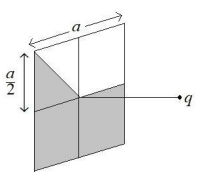
A square loop of sides a=1m is held normally \in front of a point charge q=1C. The flux of the electric field through the shaded region is p5×ε01Nm2C−1, where the value of p is .
Use solid angle idea. Flux through any surface due to point charge is Φ=4πε0qΩ where \Omega \Omega\Omega is solid angle subtended by the surface at the charge. The charge is located on the normal through the center of the square, and from the geometry shown, the whole square subtends a solid angle corresponding to a face of a cube with charge at cube center. Flux through entire square is therefore Φsquare=6ε0q since total flux ε0q gets equally shared among 6 cube faces. Given q=1C so Φsquare=6ε01 Now look at shaded region. its area is 85a2 So shaded fraction of the square is 85 Flux through the whole square (one face of the imaginary cube) is 6ε0q Hence flux through shaded region is Φ=85⋅6ε0q With q=1 Φ=48ε05 Comparing with p5⋅ε01 we get p=48
Q23JEE Main 2025NAT4MThermodynamics
The temperature of 1 mole of an ideal monoatomic gas is increased by 50∘C at constant pressure. The total heat added and change \in internal energy are E1 and E2, respectively. If E2E1=9x, then the value of x is .
For 1 mole of an ideal monoatomic gas with temperature increase ΔT=50°C at constant pressure: Heat added at constant pressure: E1=nCpΔT. Change \in internal energy: E2=nCvΔT. For a monoatomic ideal gas: Cp=25R and Cv=23R. E2E1=CvCp=3/25/2=35. Given E2E1=9x: 9x=35x=9×35=15. The answer is 15.
Q24JEE Main 2025NAT4MUnits and Measurements
The least count of a screw gauge is 0.01mm. If the pitch is increased by 75% and number of divisions on the circular scale is reduced by 50%, the new least count will be ×10−3mm.
Screw gauge: LC = 0.01 mm. Pitch increased by 75%, divisions reduced by 50%. Find new LC. LC = pitch/divisions. If pitch becomes 1.75p and divisions become 0.5d: New LC = 1.75p/(0.5d) = 3.5(p/d) = 3.5 × 0.01 = 0.035 mm In units of 0.001 mm: 35 The answer is 35.
Q25JEE Main 2025NAT4MCurrent Electricity
A wire of resistance 9Ω is bent to form an equilateral triangle. Then the equivalent resistance across any two vertices will be Ω.
Wire of 9Ω bent into equilateral triangle. Equivalent resistance across two vertices. Each side = 3Ω. Across two vertices: one 3Ω in parallel with two 3Ω in series (6Ω). Req=3+63×6=2 Ω The answer is 2.
Chemistry25 questions
Q26JEE Main 2025MCQ4MBiomolecules
The carbohydrate "Ribose" present in DNA, is A. A pentose sugar B. present in pyranose from C. in "D" configuration D. a reducing sugar, when free E. in α-anomeric form Choose the correct answer from the options given below:
The sugar unit present in DNA is 2-deoxyribose. Step 1: Count of carbon atoms. 2-Deoxyribose contains five carbon atoms, so it is a pentose. \Rightarrow Statement A is correct. Step 2: Ring size \in nucleic acids. Inside DNA the sugar occurs as a five-membered furanose ring, not a six-membered pyranose ring. \Rightarrow Statement B is incorrect. Step 3: Absolute (D/L) configuration. Naturally occurring ribose and deoxyribose possess the configuration related to D-glyceraldehyde. \Rightarrow Statement C is correct. Step 4: Reducing property when free. A sugar is reducing if it has a free hemiacetal (aldehyde) group. Free 2-deoxyribose has such a group, so it reduces Tollens' and Fehling's reagents. \Rightarrow Statement D is correct. Step 5: Anomeric configuration \in DNA. The base is attached to the anomeric carbon through a β-N-glycosidic bond. Hence the sugar \in DNA is the β-anomer, not the α-anomer. ⇒ Statement E is incorrect. Collecting the correct statements: A, C and D. Therefore the correct option is Option B .
Q27JEE Main 2025MCQ4MHaloalkanes and Haloarenes
Given below are two statements: Statement I: The conversion proceeds well in the less polar medium. CH3−CH2−CH2−CH2−ClHO−CH3−CH2−CH2−CH2−OH+Cl(−) Statement II: The conversion proceeds well in the more polar medium. In the light of the above statements, choose the correct answer from the options given below
This question asks about the effect of solvent polarity on a nucleophilic substitution (SN2) reaction. CH3−CH2−CH2−CH2−Cl+HO(−)→CH3−CH2−CH2−CH2−OH+Cl(−)
Let's analyze the role of the solvent in this reaction.
Analysis of Statement I: "The conversion proceeds well in the less polar medium."
This statement is true when comparing a highly polar protic solvent (like water) to a less polar protic solvent (like ethanol). In water, the small, charged nucleophile (HO−) is heavily stabilized by hydrogen bonding (solvation). This high stability of the reactant increases the activation energy, slowing the reaction. In a less polar medium like ethanol, solvation is weaker, making the nucleophile more reactive and accelerating the reaction.
Analysis of Statement II: "The conversion proceeds well in the more polar medium."
This statement is also true when comparing a nonpolar solvent (like hexane) to a polar solvent (like acetone or DMSO). The ionic reactant (HO−, typically from NaOH or KOH) is insoluble in nonpolar solvents, so the reaction cannot proceed. A polar solvent is necessary to dissolve the nucleophile and to stabilize the charge separation in the transition state and the leaving group (Cl−). Thus, compared to a nonpolar medium, the reaction proceeds well in a more polar medium.
Since both statements can be considered correct depending on the reference point of comparison, and valid chemical principles support both, we conclude that both statements are true.
Q28JEE Main 2025MCQ4MAmines
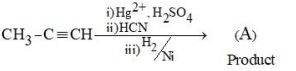
The product (A) formed in the following reaction sequence is
Step 1: Propyne undergoes acid-catalyzed hydration with Hg2+/H2SO4 (Kucherov's reaction). This hydration follows Markovnikov's rule, yielding an unstable enol that tautomerizes to a ketone, acetone. CH3−C≡CHHg2+,H2SO4,H2OCH3−C(O)−CH3
Step 2: Acetone undergoes nucleophilic addition with hydrogen cyanide (HCN) to form a cyanohydrin. CH3−C(O)−CH3HCN(CH3)2C(OH)CN
Step 3: The nitrile group (−CN) of the cyanohydrin is reduced to a primary amine (−CH2NH2) by catalytic hydrogenation using H2/Ni. The tertiary alcohol group remains unchanged. (CH3)2C(OH)CNH2/Ni(CH3)2C(OH)CH2NH2
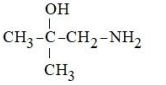
The final product (A) is 1-amino-2-methylpropan-2-ol, which corresponds to the structure shown in option B.
Q29JEE Main 2025MCQ4MAldehydes, Ketones and Carboxylic Acids
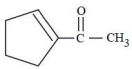
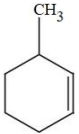
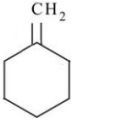
Aman has been asked to synthesise the molecule (x).He thought of preparing the molecule using an aldol condensation reaction. He found a few cyclic alkenes in his laboratory. He thought of performing ozonolysis reaction on alkene to produce a dicarbonyl compound followed by aldol reaction to prepare " x ". Predict the suitable alkene that can lead to the formation of " x ".
To synthesize the target molecule (x), 1-acetylcyclopentene, via an intramolecular aldol condensation, we must first identify the necessary dicarbonyl precursor. The formation of a 5-membered ring through aldol cyclization requires a 1,6-dicarbonyl compound. The structure of (x) indicates that the specific precursor needed is 6-oxoheptanal.
6-oxoheptanalCH3−CO−(CH2)4−CHOIntramolecular Aldol1-acetylcyclopentene (x)(Image of x)+H2O
The next step is to determine which starting alkene would yield 6-oxoheptanal upon ozonolysis. Ozonolysis cleaves a carbon-carbon double bond and replaces it with two carbonyl groups. Therefore, by reversing this process (a retro-ozonolysis), we can find the required alkene by joining the two carbonyl carbons of 6-oxoheptanal with a double bond.
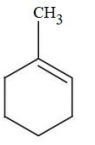
Connecting the ketone carbon (C6) and the aldehyde carbon (C1) of 6-oxoheptanal forms a six-membered ring with a double bond. The carbon that was part of the ketone has a methyl group attached, resulting in 1-methylcyclohexene.
1-methylcyclohexene (C)(Image of C)1.O3,2.Zn/H2O6-oxoheptanalCH3−CO−(CH2)4−CHO
Therefore, 1-methylcyclohexene (Option C) is the correct starting material.
Q30JEE Main 2025MCQ4MAldehydes, Ketones and Carboxylic Acids
Which of the following arrangements with respect to their reactivity in nucleophilic addition reaction is correct?
Nucleophilic addition to a carbonyl group occurs at the electrophilic carbon of the C=O bond. The rate depends on two main factors: \bullet Electronic effects: groups that withdraw electrons ( −I and/or −R) increase the partial positive charge on the carbonyl carbon and enhance reactivity. Groups that donate electrons ( +I and/or +R) decrease the charge and slow the reaction. \bullet Steric effects: less‐hindered carbonyls are more accessible to the nucleophile. First compare aldehydes and ketones attached to an aromatic ring. \bullet Aldehydes have only one alkyl/aryl group attached to the carbonyl carbon, so they are less sterically hindered and receive less +I donation than ketones. Hence aromatic aldehydes are more reactive than aromatic ketones. \bullet Therefore acetophenone (Ar-CO-CH3) is expected to be the least reactive of the four compounds. Now compare the three aromatic aldehydes: 1. p-nitrobenzaldehyde contains a NO2 group. NO2 is strongly electron-withdrawing by both −I (inductive) and −R (resonance) effects, so it makes the carbonyl carbon highly electrophilic. This gives the HIGHEST reactivity. 2. benzaldehyde has no extra substituent on the ring, so its reactivity is taken as the reference among aldehydes. 3. p-tolualdehyde (para-methylbenzaldehyde) contains a CH3 group. CH3 is electron-donating by +I and weakly +R, so it reduces the electrophilicity of the carbonyl carbon, lowering the reactivity below that of unsubstituted benzaldehyde. Putting the steric and electronic arguments together: Least reactive⟶acetophenone<p-tolualdehyde<benzaldehyde<p-nitrobenzaldehyde⟶Most reactive This sequence matches Option D. Answer: Option D (acetophenone<p-tolualdehyde<benzaldehyde<p-nitrobenzaldehyde)
Q31JEE Main 2025MCQ4MChemical Thermodynamics
Let us consider an endothermic reaction which is non-spontaneous at the freezing point of water. However, the reaction is spontaneous at boiling point of water. Choose the correct option.
We need to determine the signs of ΔH and ΔS for a reaction that is endothermic, non-spontaneous at the freezing point of water (273 K), but spontaneous at the boiling point of water (373 K). Because the reaction absorbs heat, it is endothermic , so ΔH>0(positive). Recall that the Gibbs free energy change is given by ΔG=ΔH−TΔS and that a reaction is spontaneous when ΔG<0 and non-spontaneous when ΔG>0. At the freezing point (T = 273 K), the reaction is non-spontaneous, so ΔG>0. Thus ΔH−273ΔS>0 which implies ΔH>273ΔS. At the boiling point (T = 373 K), the reaction becomes spontaneous, so ΔG<0 and hence ΔH−373ΔS<0 giving ΔH<373ΔS, i.e., ΔS>373ΔH. Since ΔH>0, the inequality ΔS>373ΔH requires that ΔS>0 (positive). Indeed, with both ΔH>0 and ΔS>0, at the lower temperature (273 K) the term TΔS is relatively small so ΔG=ΔH−TΔS>0 (non-spontaneous), while at the higher temperature (373 K) the term TΔS becomes large enough to exceed ΔH, making ΔG<0 (spontaneous). The transition from non-spontaneous to spontaneous occurs at the critical temperature T∗=ΔSΔH which lies between 273 K and 373 K. The correct answer is Option D : Both ΔH and ΔS are positive.
Q32JEE Main 2025MCQ4Md and f Block Elements
Preparation of potassium permanganate from MnO2 involves two step process \in which the 1st step is a reaction with KOH and KNO3 to produce:
The preparation of potassium permanganate (KMnO4) from MnO2 involves two steps. First, MnO2 is fused with KOH \in the presence of an oxidizing agent like KNO3 (or atmospheric oxygen): 2MnO2+4KOH+O2→2K2MnO4+2H2O In this step, Mn is oxidized from +4 to +6 oxidation state, forming potassium manganate (K2MnO4), which is a green compound. Then, K2MnO4 is oxidized to KMnO4 (Mn goes from +6 to +7) by electrolytic oxidation or treatment with chlorine or ozone. The product of the first step is K2MnO4. The correct answer is Option D: K2MnO4.
Q33JEE Main 2025MCQ4MChemical Equilibrium
For a reaction, N2O5(g)→2NO2(g)+21O2(g) \in a constant volume container, no products were present initially. The final pressure of the system when 50% of reaction gets completed is:
N2O5→2NO2+21O2. Find final pressure when 50% reacts. Initial: P₀ (N₂O₅ only) At 50% decomposition: N₂O₅ = P₀/2, NO₂ = 2(P₀/2) = P₀, O₂ = ½(P₀/2) = P₀/4 Total = P₀/2 + P₀ + P₀/4 = 7P₀/4 The correct answer is Option 4: 47 times initial pressure.
Q34JEE Main 2025MCQ4MCoordination Compounds
One mole of the octahedral complex compound Co(NH3)5Cl3 gives 3 moles of ions on dissolution \in water. One mole of the same complex reacts with excess AgNO3 solution to yield two moles of AgCl(s). The structure of the complex is:
We need to determine the structure of the complex Co(NH3)5Cl3 using experimental evidence. The experimental observations are as follows. One mole of the complex gives 3 moles of ions on dissolution \in water, and one mole of the complex reacts with excess AgNO3 to give 2 moles of AgCl . We begin by interpreting the AgCl precipitation data. Silver nitrate precipitates only the free chloride ions (those outside the coordination sphere) as AgCl. Chloride ions directly coordinated to the metal ion inside the complex do not react with AgNO3 under normal conditions. Since 2 moles of AgCl are formed, there are 2 free Cl− ions outside the coordination sphere. With a total of 3 chloride ions and 2 free, the number of coordinated chloride ions is 3−2=1. Assuming the complex has the formula [Co(NH3)5Cl]Cl2, it dissociates as: [Co(NH3)5Cl]Cl2→[Co(NH3)5Cl]2++2Cl−. This gives 3 ions total (1 complex cation + 2 chloride anions), which matches the given data. ✓ In the cation [Co(NH3)5Cl]2+, cobalt is coordinated to 5 NH3 molecules and 1 Cl− ion, giving a coordination number of 6, which is consistent with the octahedral geometry stated \in the question. ✓ The correct answer is Option 3 : [Co(NH3)5Cl]Cl2.
Q35JEE Main 2025MCQ4MElectrochemistry
Which of the following ions is the strongest oxidizing agent? (Atomic Number of Ce=58,Eu=63,Tb=65,Lu=71)
We need to identify the strongest oxidising agent among the given lanthanide/actinide ions. Key Concept: An oxidising agent gains electrons (gets reduced). The stronger the tendency to gain electrons, the stronger the oxidising agent. For lanthanide ions, unusual oxidation states are strongly driven towards the most stable +3 state, and ions that strongly want to reach a stable electronic configuration make the best oxidising agents. Analysing each ion: Option 1: Eu2+ (Z = 63) Eu2+: [Xe] 4f7. This has a half-filled 4f shell, which is very stable. Eu2+ is actually relatively stable and is a reducing agent (it wants to lose an electron to form Eu3+ [Xe]4f6, but the half-filled stability resists this). It is not a strong oxidising agent. Option 2: Tb4+ (Z = 65) Tb4+: [Xe] 4f7. Terbium \in the +4 state also has a half-filled 4f7 configuration. However, Tb4+ strongly tends to gain an electron to become Tb3+ [Xe]4f8, because the +3 state is the most common and stable oxidation state for lanthanides. The high charge (+4) combined with the strong drive to reach +3 makes Tb4+ a very strong oxidising agent . Option 3: Lu3+ (Z = 71) Lu3+: [Xe] 4f14. This has a completely filled 4f shell and is already \in the most stable +3 oxidation state. It has no tendency to gain or lose electrons easily. It is not an oxidising agent. Option 4: Ce3+ (Z = 58) Ce3+: [Xe] 4f1. Cerium \in the +3 state has one 4f electron. While Ce4+ (4f0, noble gas configuration) is a good oxidising agent, Ce3+ itself is stable and not an oxidising agent. Conclusion: Tb4+ is the strongest oxidising agent because it has the strongest tendency to gain an electron to achieve the stable +3 state. The correct answer is Option 2 : Tb4+.
Q36JEE Main 2025MCQ4MIonic Equilibrium
Ksp for Cr(OH)3 is 1.6×10⁻³⁰. What is the molar solubility of this salt in water?
Ksp for Cr(OH)₃ = 1.6×10⁻³⁰. Find molar solubility. Cr(OH)3⇌Cr3++3OH− If solubility = s: Ksp=s(3s)3=27s4s4=271.6×10⁻³⁰s=4271.6×10−30 The correct answer is Option 3.
Q37JEE Main 2025MCQ4MClassification of Elements
Which of the following statements are NOT true about the periodic table? A. The properties of elements are function of atomic weights. B. The properties of elements are function of atomic numbers. C. Elements having similar outer electronic configurations are arranged in same period. D. An element's location reflects the quantum numbers of the last filled orbital. E. The number of elements in a period is same as the number of atomic orbitals available in energy level that is being filled. Choose the correct answer from the options given below:
We need to identify which statements are NOT true about the periodic table. A. The properties of elements are function of atomic weights. This was Mendeleev's original idea but is incorrect. Properties are a function of atomic numbers (modern periodic law). Statement A is NOT true. B. The properties of elements are function of atomic numbers. This is the modern periodic law. TRUE statement. C. Elements having similar outer electronic configurations are arranged in same period. Elements with similar outer electronic configurations are in the same GROUP (not period). Elements in the same period have the same principal quantum number. Statement C is NOT true. D. An element's location reflects the quantum numbers of the last filled orbital. This is true. The period number corresponds to the principal quantum number, and the block/group corresponds to the azimuthal and magnetic quantum numbers. TRUE statement. E. The number of elements in a period is same as the number of atomic orbitals available in energy level that is being filled. The number of elements in a period equals the number of available orbitals times 2 (since each orbital holds 2 electrons), not just the number of orbitals. For example, Period 2 has 8 elements (4 orbitals × 2). Statement E is NOT true. Statements that are NOT true: A, C, and E. The correct answer is Option A: A, C and E Only.
Q38JEE Main 2025MCQ4MAmines
Given below are two statements I and II. Statement I: Dumas method is used for estimation of "Nitrogen" in an organic compound. Statement II: Dumas method involves the formation of ammonium sulphate by heating the organic compound with conc H2SO4. In the light of the above statements, choose the correct answer from the options given below
Statement I: Dumas method is used for estimation of nitrogen in an organic compound. This is true. The Dumas method involves heating the organic compound with copper oxide (CuO) in an atmosphere of CO2, which converts nitrogen \in the compound to N2 gas. The volume of N2 collected is measured to estimate the nitrogen content. Statement II: Dumas method involves the formation of ammonium sulphate by heating the organic compound with concentrated H2SO4. This is false. The description \in Statement II corresponds to the Kjeldahl method, not the Dumas method. In the Kjeldahl method, the organic compound is heated with concentrated H2SO4, which converts nitrogen to ammonium sulphate. The Dumas method uses CuO, not H2SO4. The answer is Option A: Statement I is true but Statement II is false.
Q39JEE Main 2025MCQ4MChemical Bonding and Molecular Structure
Which of the following statement is true with respect to H2O,NH3 and CH4?A. The central atoms of all the molecules are sp3 hybridized. B. The H−O−H,H−N−H and H−C−H angles \in the above molecules are 104.5∘,107.5∘ and 109.5∘ respectively. C. The increasing order of dipole moment is CH4<NH3<H2O.D. Both H2O and NH3 are Lewis acids and CH4 is a Lewis base. E. A solution of NH3 \in H2O is basic. In this solution NH3 and H2O act as Lowry-Bronsted acid and base respectively. Choose the correct answer from the options given below:
We analyze each statement about H2O, NH3, and CH4: A. Central atoms of all molecules are sp3 hybridized. H2O: O has 2 bond pairs + 2 lone pairs = sp3. NH3: N has 3 bond pairs + 1 lone pair = sp3. CH4: C has 4 bond pairs = sp3. Correct. B. Bond angles are 104.5°, 107.5°, and 109.5° respectively. H-O-H = 104.5°, H-N-H = 107° (approximately 107.5°), H-C-H = 109.5°. Correct. C. Increasing order of dipole moment: CH4<NH3<H2O. CH4 has zero dipole moment (symmetric). NH3 has μ=1.47 D. H2O has μ=1.85 D. So CH4<NH3<H2O. Correct. D. Both H2O and NH3 are Lewis acids and CH4 is a Lewis base. H2O and NH3 have lone pairs and act as Lewis BASES (not acids). CH4 is neither a good Lewis acid nor base. Incorrect. E. A solution of NH3 \in H2O is basic. NH3 and H2O act as Lowry-Bronsted acid and base respectively. In the reaction NH3+H2O⇌NH4++OH−, NH3 acts as a Bronsted BASE (accepts H+) and H2O acts as a Bronsted ACID (donates H+). The statement says NH3 is the acid and H2O is the base, which is reversed. Incorrect. Correct statements: A, B, and C only. The correct answer is Option A: A, B and C only.
Q40JEE Main 2025MCQ4MAlcohols, Phenols and Ethers
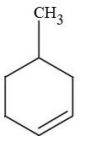
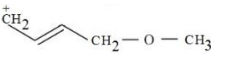
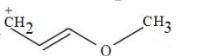
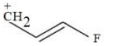
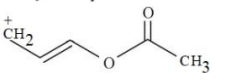
Which one of the carbocations from the following is most stable?
The stability of a carbocation is determined by electronic effects. All the given carbocations are allylic, which are stabilized by resonance. We must compare the additional electronic effects of the substituent on the double bond.
Analyze Substituent Effects: Carbocation stability is increased by electron-donating groups (EDG) and decreased by electron-withdrawing groups (EWG).
Option B: The methoxy group (−OCH3) is directly attached to the conjugated system. The lone pairs on the oxygen atom can participate in resonance, acting as a powerful electron-donating group (+R effect). This creates an additional resonance structure: +CH2−CH=CH−O¨−CH3⟷CH2=CH−CH=O+−CH3
This new structure is exceptionally stable because every heavy atom (C, O) has a complete octet.
Comparison with other options: In C, the fluorine atom is strongly electron-withdrawing (-I effect), destabilizing the carbocation. In D, the acetyl group pulls the oxygen's lone pairs away from the allylic system (cross-conjugation), reducing their donating ability. In A, the ether group is separated by a CH2 and has only a weak inductive effect.
Conclusion: The powerful +R effect of the methoxy group in option B provides the greatest stabilization by delocalizing the positive charge and forming a resonance structure where all atoms have an octet.
Q41JEE Main 2025MCQ4MHaloalkanes and Haloarenes
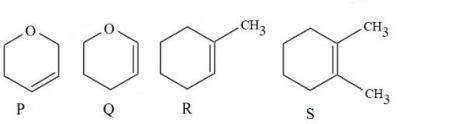
Following are the four molecules "P", "Q", "R" and "S". Which one among the four molecules will react with H−Br(aq) at the fastest rate?
The reaction of an alkene with HBr is an electrophilic addition. The rate of this reaction is determined by the stability of the carbocation intermediate formed in the rate-determining step. A more stable carbocation leads to a faster reaction rate.
Molecule P: Protonation forms a secondary carbocation, which is relatively unstable.
Molecules R and S: Protonation forms a more stable tertiary carbocation, stabilized by hyperconjugation from the alkyl groups.
Molecule Q: This molecule is a vinyl ether. Protonation at the β-carbon (C-3) forms a carbocation at the α-carbon (C-2), which is directly attached to the oxygen atom. Intermediate from Q:
This carbocation is highly stabilized by resonance (+M effect), as the lone pair of electrons on the oxygen atom can be delocalized to form a more stable oxonium ion.
Comparing Stabilities: Resonance stabilization is a much stronger effect than hyperconjugation. Therefore, the carbocation intermediate from molecule Q is the most stable among all the options.
Since the stability of the carbocation intermediate from Q is the highest, molecule Q will react with HBr at the fastest rate.
Q42JEE Main 2025MCQ4MElectrochemistry
For the given cell Fe(aq)2++Ag(aq)+→Fe(aq)3++Ag(s), the standard cell potential of the above reaction is Given:
For the cell reaction: Fe2+(aq)+Ag+(aq)→Fe3+(aq)+Ag(s) Given half-cell potentials: Ag++e−→Ag,E°=x V Fe2++2e−→Fe,E°=y V Fe3++3e−→Fe,E°=z V We need the standard potential for Fe3++e−→Fe2+. Using the relation between Gibbs energies: ΔG°=−nFE°. For Fe3++3e−→Fe: ΔG°1=−3Fz For Fe2++2e−→Fe: ΔG°2=−2Fy The half-cell Fe3++e−→Fe2+ can be obtained by subtracting: ΔG°3=ΔG°1−ΔG°2=−3Fz−(−2Fy)=−3Fz+2Fy Since ΔG°3=−1⋅F⋅E°(Fe3+/Fe2+): E°(Fe3+/Fe2+)=3z−2y For the given cell reaction, the cathode is Ag+/Ag and the anode is Fe2+/Fe3+: E°cell=E°cathode−E°anode=x−(3z−2y)=x+2y−3z The correct answer is Option C: x+2y−3z.
Q43JEE Main 2025MCQ4MClassification of Elements
The large difference between the melting and boiling points of oxygen and sulphur may be explained on the basis of
Large difference between melting/boiling points of O₂ and S. Oxygen exists as O₂ (diatomic) while sulfur exists as S₈ (octatomic). The larger molecular size of S₈ leads to much stronger van der Waals forces, causing much higher melting and boiling points. The correct answer is Option 1: Atomicity.
Q44JEE Main 2025MCQ4MSolutions
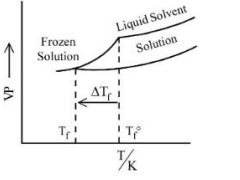
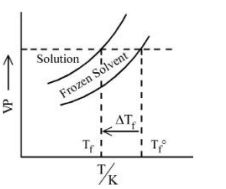
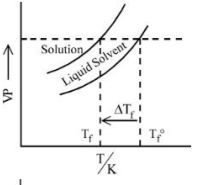
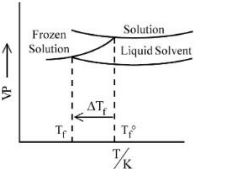
Consider the given plots of vapour pressure (VP) vs temperature (T/K). Which amongst the following options is correct graphical representation showing ΔTf, depression in the freezing point of a solvent in a solution?
The freezing point is the temperature at which the liquid and solid phases of a substance are in equilibrium, meaning they have the same vapour pressure (VP). The plot shows VP as a function of temperature (T).
Pure Solvent: The freezing point of the pure solvent, Tf∘, is the temperature where the VP of the "Liquid Solvent" curve intersects the VP of the "Frozen Solvent" curve.
Solution: According to Raoult's law, adding a non-volatile solute lowers the solvent's vapour pressure. Therefore, the "Solution" VP curve lies below the "Liquid Solvent" VP curve.
Freezing Point of Solution: The freezing point of the solution, Tf, is the temperature at which the "Solution" VP curve intersects the "Frozen Solvent" curve (assuming only pure solvent freezes out).
Depression in Freezing Point (ΔTf): Because the solution's VP curve is lower, its intersection with the frozen solvent curve occurs at a lower temperature. This results \in Tf<Tf∘. The depression \in freezing point is the difference: ΔTf=Tf∘−Tf.
Graph A correctly illustrates these principles, showing the solution curve below the liquid solvent curve, leading to a lower freezing point Tf.
Q45JEE Main 2025MCQ4MChemical Bonding and Molecular Structure
Which of the following linear combination of atomic orbitals will lead to formation of molecular orbitals in homonuclear diatomic molecules [internuclear axis in z-direction] ? A. 2pz and 2px B. 2 s and 2px C. 3 dxy and 3 dx2−y2 D. 2 s and 2pz E. 2pz and 3dx2−y2 Choose the correct answer from the options given below:
For the formation of molecular orbitals in homonuclear diatomic molecules (with the internuclear axis along the z-direction), the combining atomic orbitals must have the same symmetry with respect to the internuclear axis. The rule is: Orbitals combine only if they have the same symmetry about the molecular axis. Specifically, they must have the same value of ml along the z-axis (σ for ml=0, π for ∣ml∣=1, δ for ∣ml∣=2). A. 2pz and 2px: 2pz has ml=0, 2px has ∣ml∣=1. Different symmetry. Cannot combine. No. B. 2s and 2px: 2s has ml=0 (σ), 2px has ∣ml∣=1 (π). Different symmetry. Cannot combine. No. C. 3dxy and 3dx2−y2: 3dxy has ∣ml∣=2 (δ), 3dx2−y2 also has ∣ml∣=2 (δ). Same symmetry, but these are on the same atom. For a homonuclear diatomic, the 3dxy on one atom combines with 3dxy on the other. The statement says combining 3dxy with 3dx2−y2, which are different orbitals on different atoms with the same ∣ml∣ but different orientations. They do not form bonding/antibonding pairs with each other. No. D. 2s and 2pz: Both have ml=0 (σ symmetry). They can combine to form molecular orbitals. Yes. E. 2pz and 3dx2−y2: 2pz has ml=0, 3dx2−y2 has ∣ml∣=2. Different symmetry. Cannot combine. No. Only D leads to formation of molecular orbitals. The correct answer is Option B: D Only.
Q46JEE Main 2025NAT4MAldehydes, Ketones and Carboxylic Acids
Xg of benzoic acid on reaction with aq. NaHCO3 released CO2 that occupied 11.2L volume at STP. X is g.
We need to find the mass of benzoic acid that produces CO2 occupying 11.2 L at STP. Benzoic acid reacts with aqueous sodium bicarbonate: C6H5COOH+NaHCO3→C6H5COONa+H2O+CO2↑ The stoichiometry shows that 1 mole of benzoic acid produces 1 mole of CO2. At STP (Standard Temperature and Pressure: 0 degC, 1 atm), 1 mole of any ideal gas occupies 22.4 L. Moles of CO2=22.4 L/mol11.2 L=0.5 mol From the 1:1 stoichiometry: Moles of benzoic acid=Moles of CO2=0.5 mol The molar mass of benzoic acid (C6H5COOH=C7H6O2) is (7×12)+(6×1)+(2×16)=84+6+32=122 g/molX=0.5×122=61 g The answer is 61 g.
Q47JEE Main 2025NAT4MSome Basic Concepts of Chemistry
Consider the following reaction occurring in the blast furnace: Fe3O4(s)+4CO(g)→3Fe(l)+4CO2(g)x kg of iron is produced when 2.32×10³kgFe3O4 and 2.8×10²kgCO are brought together \in the furnace. The value of x is (nearest integer). Given: M(Fe3O4)=232gmol−1, molar mass of CO=28gmol−1, molar mass of (Fe)=56gmol−1.
The reaction: Fe3O4(s)+4CO(g)→3Fe(l)+4CO2(g) Given: 2.32×10³ kg Fe3O4 and 2.8×10² kg CO. Moles of Fe3O4=232 g/mol2.32×106 g=104 mol. Moles of CO =28 g/mol2.8×105 g=104 mol. From stoichiometry: 1 mol Fe3O4 needs 4 mol CO. 104 mol Fe3O4 needs 4×10⁴ mol CO, but only 104 mol CO is available. CO is the limiting reagent. From 4 mol CO, we get 3 mol Fe. From 104 mol CO: Fe produced =43×104=7500 mol. Mass of Fe =7500×56=420000 g =420 kg. The answer is 420.
Q48JEE Main 2025NAT4MChemical Equilibrium
37.8gN2O5 was taken \in a 1L reaction vessel and allowed to undergo the following reaction at 500 K 2N2O5(g)⇌2N2O4(g)+O2(g) The total pressure at equilibrium was found to be 18.65bar. Then, Kp=×10−2 [nearest integer]. Assume N2O5 to behave ideally under these conditions. Given: R=0.082barLmol−1K−1
First, we calculate the initial moles of N2O5 from its given mass. The molar mass of N2O5 is 108g/mol. ninitial=108g/mol37.8g=0.35mol
Using the ideal gas law, we find the initial pressure (P0) of N2O5 \in the 1L vessel at 500K. P0=VnRT=10.35×0.082×500=14.35bar
For the reaction 2N2O5(g)⇌2N2O4(g)+O2(g), let's set up an ICE table \in terms of pressure. Let 2p be the decrease \in pressure of N2O5. Ptotal=PN2O5+PN2O4+PO2=(P0−2p)+(2p)+(p)=P0+p
Given the total equilibrium pressure is 18.65bar, we can solve for p: 18.65=14.35+p⟹p=4.30bar
Now, we find the equilibrium partial pressures: PN2O5=14.35−2(4.30)=5.75bar PN2O4=2(4.30)=8.60bar PO2=p=4.30bar
Finally, we calculate the equilibrium constant, Kp: Kp=(PN2O5)2(PN2O4)2(PO2)=(5.75)2(8.60)2(4.30)=33.0625318.028≈9.619
To express this in the required format: 9.619=961.9×10⁻². The nearest integer is 962.
Q49JEE Main 2025NAT4MSalt Analysis
Among the following cations, the number of cations which will give characteristic precipitate in their identification tests with K4[Fe(CN)6] is . Cu2+,Fe3+,Ba2+,Ca2+,NH4+,Mg2+,Zn2+
We need to determine how many of the given cations give a characteristic precipitate with potassium ferrocyanide K4[Fe(CN)6]. Key Concept: Potassium ferrocyanide K4[Fe(CN)6] is used as a group reagent and gives characteristic coloured precipitates with certain metal ions by forming insoluble double salts or complex compounds. Testing each cation: 1. Cu2+: Gives a chocolate brown (reddish-brown) precipitate of copper(II) ferrocyanide: Cu2[Fe(CN)6]. This is a characteristic test for Cu2+. ✓ 2. Fe3+: Gives a deep Prussian blue precipitate of iron(III) ferrocyanide: Fe4[Fe(CN)6]3. This is a very well-known confirmatory test for Fe3+. ✓ 3. Ba2+: Does not give a characteristic precipitate with K4[Fe(CN)6]. Barium is typically identified using sulphate or chromate reagents. ✗ 4. Ca2+: Does not give a characteristic precipitate. Calcium is identified by flame test (brick red) or oxalate precipitation. ✗ 5. NH4+: Does not give a precipitate with K4[Fe(CN)6]. NH4+ is detected by Nessler's reagent or by heating with NaOH. ✗ 6. Mg2+: Does not give a characteristic precipitate with K4[Fe(CN)6]. ✗ 7. Zn2+: Gives a white (bluish-white) precipitate of zinc ferrocyanide: Zn2[Fe(CN)6]. This is a standard test for Zn2+. ✓ Count: Cu2+, Fe3+, and Zn2+ give characteristic precipitates. That is 3 cations. The answer is 3 .
Q50JEE Main 2025NAT4MChemical Equilibrium
Standard entropies of X2,Y2 and XY5 are 70,50 and 110JK−1mol−1 respectively. The temperature \in Kelvin at which the reaction 21X2+25Y2⇌XY5ΔH⊖=−35kJmol−1 will be at equilibrium is (Nearest integer).}
Standard entropies: X₂=70, Y₂=50, XY₅=110 J/K/mol. Find T where ½X₂ + 5/2Y₂ → XY₅ is at equilibrium with ΔH = -35 kJ/mol. ΔS = 110 - ½(70) - 5/2(50) = 110 - 35 - 125 = -50 J/K/mol At equilibrium: ΔG = 0, so T = ΔH/ΔS = -35000/(-50) = 700 K The answer is 700.
Mathematics25 questions
Q51JEE Main 2025MCQ4MCircles
Let circle C be the image of x2+y2−2x+4y−4=0 \in the line 2x−3y+5=0 and A be the point on C such that OA is parallel to the x-axis and A lies on the right hand side of the centre O of C. If B(α,β), with β<4, lies on C such that the length of the arc AB is (1/6)th of the perimeter of C, then β+3α is equal to
The equation of the original circle is x2+y2−2x+4y−4=0, which can be rewritten by completing the square as (x−1)2+(y+2)2=9. This circle has its center at C1(1,−2) and a radius of r=3.
The image circle C has its center O at the reflection of C1 in the line 2x−3y+5=0. Using the standard formula for reflection of a point across a line, the coordinates of O are found to be (−3,4). The radius of circle C remains r=3.
The equation of circle C is (x+3)2+(y−4)2=9. Point A lies on C such that OA is parallel to the x-axis and A is to the right of O(−3,4). This means the y-coordinate of A is 4. Substituting y=4 into the circle's equation gives (x+3)2=9, so x=0 or x=−6. Since A is to the right of O, xA=0. Thus, A=(0,4).
The length of the arc AB is 61 of the perimeter of C, which is 61(2πr)=61(6π)=π. The angle θ subtended by this arc at the center O is given by the formula s=rθ, so θ=rs=3π.
We can use parametric coordinates for B(α,β) on circle C: (α,β)=(−3+rcosϕ,4+rsinϕ). The point A(0,4) corresponds to a parameter angle ϕ=0. The point B corresponds to an angle of either ϕ=π/3 or ϕ=−π/3. The condition β<4 given in the problem leads to a result (4−33) not in the options, suggesting a typo. Let's check the other case, ϕ=π/3: α=−3+3cos(π/3)=−3+3(1/2)=−3/2. β=4+3sin(π/3)=4+33/2.
Finally, we calculate the required expression: β+3α=(4+233)+3(−23)=4+233−233=4
Q52JEE Main 2025MCQ4MThree Dimensional Geometry
Let in a △ABC, the length of the side AC be 6, the vertex B be (1,2,3) and the vertices A,C lie on the line 3x−6=2y−7=−2z−7. Then the area (\in sq. units) of △ABC is:
In triangle ABC, we have AC = 6, B = (1,2,3), and points A and C lie on the line 3x−6=2y−7=−2z−7. Parametrizing this line by (6+3t,7+2t,7−2t) gives all points on AC. To compute the altitude from B to line AC, choose the point corresponding to t=0, namely P=(6,7,7), on the line, and note that its direction vector is d=(3,2,−2). The vector from P to B is PB=(1−6,2−7,3−7)=(−5,−5,−4). The area of the parallelogram determined by PB and d is the magnitude of their cross product: PB×d=i^−53j^−52k^−4−2=i^(10+8)−j^(10+12)+k^(−10+15)=(18,−22,5), so ∣PB×d∣=324+484+25=833. Since ∣d∣=9+4+4=17, the distance from B to the line is 17833=17833=49=7, which is the length of the altitude. Finally, the area of triangle ABC is half the product of its base AC and its height: Area=21×AC×h=21×6×7=21. The correct answer is Option 2: 21.
Q53JEE Main 2025MCQ4MEllipse
Let the product of the focal distances of the point (3,21) on the ellipse a2x2+b2y2=1,(a>b), be 47. Then the absolute difference of the eccentricities of two such ellipses is
Let the point be P(x0,y0)=(3,21). The product of the focal distances from P is given by a2−e2x02. We are given this product is 47, so we have the equation: a2−3e2=47(1)
Since the point P lies on the ellipse, we have a23+b21/4=1. Using the relation b2=a2(1−e2), this becomes a23+4a2(1−e2)1=1, which simplifies to a2=4(1−e2)13−12e2(2).
Substituting (2) into (1) yields 4(1−e2)13−12e2−3e2=47. Simplifying this equation leads to a quadratic \in e2: 12(e2)2−17e2+6=0
Solving for e2, we find e2=2(12)17±(−17)2−4(12)(6)=2417±1. This gives two possible values, e12=2418=43 and e22=2416=32.
The corresponding eccentricities are e1=43=23 and e2=32=32.
The absolute difference is ∣e1−e2∣=23−32=23(3)2−22=233−22.
Q54JEE Main 2025MCQ4MMatrices and Determinants
If the system of equations
$
2x−y+z5x+λy+3z100x−47y+μz=4,=12,=212
$ has infinitely many solutions, then μ−2λ is equal to:
For infinitely many solutions, the third equation must be a linear combination of the first two. Let (iii) = α(i) + β(ii). Matching coefficients: 2α+5β=100 ... (A), −α+λβ=−47 ... (B), α+3β=μ ... (C), 4α+12β=212 ... (D) From (D): α+3β=53, so μ=53. From (A) and α=53−3β: 106−6β+5β=100, giving β=6 and α=35. From (B): −35+6λ=−47, so λ=−2. μ−2λ=53−2(−2)=57. The correct answer is Option 1 : 57.
Q55JEE Main 2025MCQ4MBinomial Theorem
For some n=10, let the coefficients of the 5th, 6th and 7th terms \in the binomial expansion of (1+x)n+4 be \in A.P. Then the largest coefficient \in the expansion of (1+x)n+4 is:
Coefficients of 5th, 6th and 7th terms of (1+x)n+4 are \in arithmetic progression. Let N = n + 4 so that the coefficient of the rth term is (r−1N). Hence the 5th term has coefficient (4N), the 6th term has coefficient (5N), and the 7th term has coefficient (6N). Imposing the arithmetic progression condition yields 2(5N)=(4N)+(6N). Using the identities (5N)=5N−4(4N) and (6N)=6N−5(5N) and dividing through by (4N) gives 25N−4=1+30(N−4)(N−5). Multiplying both sides by 30 leads to 12(N−4)=30+(N−4)(N−5). Setting m=N−4 transforms this into 12m=30+m(m−1), or m2−13m+30=0. Factoring, (m−3)(m−10)=0 so that m=3 or m=10. Thus N=7 or N=14, giving n=3 or n=10. Excluding n=10, we have n=3 and hence N=7. In the expansion of (1+x)7 the largest binomial coefficient is (37)=(47)=35. The correct answer is Option 3: 35.
Q56JEE Main 2025MCQ4MQuadratic Equation and Inequalities
The product of all the rational roots of the equation (x2−9x+11)2−(x−4)(x−5)=3 is equal to:
(x2−9x+11)2−(x−4)(x−5)=3(x−4)(x−5)=x2−9x+20 Let x2−9x+20=t(t−9)2−t=3t2−19t+78=0(t−13)(t−6)=0 So, t=13,6 Now, two cases will be formed: Case 1: t=13x2−9x+20=13x2−9x+7=0 The discriminant is 53. So, all the roots will be irrational. Case 2: t=6x2−9x+20=6x2−9x+14=0(x−7)(x−2)=0x=2,7 These roots are rational. We have to find the product of rational roots. Product = (2×7)=14∴ The required answer is A.
Q57JEE Main 2025MCQ4MThree Dimensional Geometry
Let the line passing through the points (−1,2,1) and parallel to the line 2x−1=3y+1=4z intersect the line 3x+2=2y−3=1z−4 at the point P. Then the distance of P from the point Q(4,−5,1) is:
A line through (−1,2,1) parallel to the direction (2,3,4) intersects the line 3x+2=2y−3=1z−4 at P. To find P, we parametrize the first line as (−1+2s,2+3s,1+4s) and the second line as (−2+3t,3+2t,4+t). Equating the coordinates yields the system: −1+2s=−2+3t⇒2s−3t=−12+3s=3+2t⇒3s−2t=11+4s=4+t⇒4s−t=3. From the second equation, t=23s−1. Substituting into the first gives 2s−3⋅23s−1=−1⇒4s−9s+3=−2⇒−5s=−5⇒s=1, so t=23(1)−1=1. Checking the third equation confirms 4(1)−1=3. Hence P=(−1+2,2+3,1+4)=(1,5,5). The distance from P to Q(4,−5,1) is (4−1)2+(−5−5)2+(1−5)2=9+100+16=125=55. The correct answer is Option 2: 55.
Q58JEE Main 2025MCQ4MStraight Lines and Pair of Straight Lines
Let the lines 3x−4y−α=0,8x−11y−33=0, and 2x−3y+λ=0 be concurrent. If the image of the point (1,2) \in the line 2x−3y+λ=0 is (1357,−1340), then ∣αλ∣ is equal to:
Lines 3x−4y−α=0, 8x−11y−33=0, and 2x−3y+λ=0 are concurrent, and the image of (1,2) \in the line 2x−3y+λ=0 is (1357,−1340). The midpoint of (1,2) and (1357,−1340) lies on 2x−3y+λ=0, and is calculated as (21+1357,22−1340)=(21370,2−1314)=(1335,−137). Substituting this into the line gives 2(1335)−3(−137)+λ=0⟹1370+1321+λ=0⟹7+λ=0⟹λ=−7. The condition for concurrency of the three lines is
\begin{vmatrix}3 & -4 & -\alpha\\8 & -11 & -33\\2 & -3 & -7\end{vmatrix}=0.$$ Expanding, we obtain $$3\bigl((-11)(-7)-(-33)(-3)\bigr)-(-4)\bigl((8)(-7)-(-33)(2)\bigr)+(-\alpha)\bigl((8)(-3)-(-11)(2)\bigr)$$ $$=3(77-99)+4(-56+66)+(-\alpha)(-24+22)$$ $$=3(-22)+4(10)+2\alpha$$ $$=-66+40+2\alpha=-26+2\alpha=0\quad\Longrightarrow\quad\alpha=13.$$ Hence $$|\alpha\lambda|=|13\times (-7)|=91.$$ The correct answer is Option 3: 91.
Q59JEE Main 2025MCQ4MComplex Numbers
If α and β are the roots of the equation 2z2−3z−2i=0, where i=−1, then 16⋅Re(α15+β15α19+β19+α11+β11)⋅Im(α15+β15α19+β19+α11+β11) is equal to:
Given the quadratic equation 2z2−3z−2i=0, its roots α and β satisfy the relations α+β=3/2 and αβ=−i from Vieta's formulas. From the product of roots, we find a key property: (αβ)4=(−i)4=1, which implies α4β4=1, so β4=α−4.
Let the expression be denoted by E. We can simplify the numerator by factoring: α19+β19+α11+β11=α15(α4+α−4)+β15(β4+β−4)
Using β4=α−4 and α4=β−4, the expression becomes (α15+β15)(α4+β4). Therefore, the original fraction simplifies to: E=α15+β15(α15+β15)(α4+β4)=α4+β4
Now, we compute α4+β4. First, α2+β2=(α+β)2−2αβ=(3/2)2−2(−i)=9/4+2i.
Then, E=α4+β4=(α2+β2)2−2(αβ)2=(9/4+2i)2−2(−i)2. E=(1681+2(49)(2i)+(2i)2)−2(−1)=(1681+9i−4)+2=1649+9i
The question asks for the value of 16⋅Re(E)⋅Im(E). With Re(E)=49/16 and Im(E)=9, we get: 16⋅1649⋅9=49⋅9=441
Q60JEE Main 2025MCQ4MStatistics
For a statistical data x1,x2,…,x10 of 10 values, a student obtained the mean as 5.5 and ∑i=110xi2=371. He later found that he had noted two values in the data incorrectly as 4 and 5, instead of the correct values 6 and 8 respectively. The variance of the corrected data is:
Mean = 5.5 for 10 values, ∑xi2=371. Two values 4,5 should be 6,8. Find corrected variance. The original \sum of the observations is ∑xi=10×5.5=55, and after replacing 4 and 5 with 6 and 8 the corrected \sum becomes 55−4−5+6+8=60 so that the corrected mean is 60/10=6. The original \sum of squares is 371, and after removing 16 and 25 and adding 36 and 64 the corrected \sum of squares becomes 371−16−25+36+64=430. The corrected variance is then given by σ2=n∑xi2−xˉ2=10430−36=43−36=7. The correct answer is Option 3: 7.
Q61JEE Main 2025MCQ4MArea Under The Curves
The area of the region {(x,y):x2+4x+2≤y≤∣x+2∣} is equal to:
To find the area of the region, we first identify the bounding curves and their intersection points. The upper boundary is y=∣x+2∣ and the lower boundary is the parabola y=x2+4x+2. By setting the functions equal, x2+4x+2=∣x+2∣, we find the intersection points are at x=−4 and x=0.
The area A is the integral of the upper function minus the lower function between these points. A=∫−40(∣x+2∣−(x2+4x+2))dx
The parabola y=(x+2)2−2 and the absolute value function y=∣x+2∣ are both symmetric about the line x=−2. We can use this symmetry to simplify the calculation by integrating from −2 to 0 and multiplying by 2. In this interval, ∣x+2∣=x+2.
A=2∫−20((x+2)−(x2+4x+2))dx A=2∫−20(−x2−3x)dx
Now, we evaluate the definite integral: A=2[−3x3−23x2]−20 A=2((0)−(−3(−2)3−23(−2)2))=2(−(38−212))=2(−38−18)=2(310)=320
Q62JEE Main 2025MCQ4MSequences and Series
Let Sn=21+61+121+201+⋯ upto n terms. If the \sum of the first six terms of an A.P. with first term −p and common difference p is 2026S2025, then the absolute difference between the 20th and 15th terms of the A.P. is:
Sn=21+61+121+201+⋯ upto n terms. S2025=21+61+121+201+.....2025termsS2025=1×22−1+3×23−2+4×34−3+....+2025×20262026−2025S2025=(11−21)+(21−31)+.....+(20251−20261)S2025=1−202612026×S2025=2026×20262025=2025 The \sum of the first six terms of an A.P. with first term −p and common difference p is 2026S2025−p+0+p+2p+3p+4p=20259p=45p=5a20=a+19d=(−p)+19p=18pa15=a+14d=(−p)+14p=13p Thus, a20−a15=18p−13p=5p=5×5=25
Q63JEE Main 2025MCQ4MDifferential Equations
Let f:R∖{0}→R be a function such that f(x)−6f(x1)=3x35−25. If limx→0(αx1+f(x))=β,α,β∈R, then α+2β is equal to:
We are given f(x)−6f(1/x)=3x35−25 and asked to find α+2β where limx→0(αx1+f(x))=β. Starting from the given relation, we have f(x)−6f(1/x)=3x35−25(i) Replacing x with 1/x yields f(1/x)−6f(x)=335x−25(ii) From equation (i) we solve for f(x) to get f(x)=6f(1/x)+3x35−25 Substituting this expression into (ii) gives f(1/x)−6[6f(1/x)+3x35−25]=335x−25 Rearranging terms yields −35f(1/x)=335x−25+x70−15=335x+x70−235 Hence f(1/x)=−3x−x2+21 Finally, replacing x with 1/x again yields f(x)=−3x1−2x+21 To evaluate the limit limx→0(αx1+f(x)), substitute the expression for f(x) to obtain αx1+f(x)=αx1−3x1−2x+21 and rearrange to =x1(α1−31)−2x+21. Since the limit exists only if the coefficient of 1/x vanishes, we require α1−31=0 which gives α=3. Consequently, the remaining part approaches β=limx→0(−2x+21)=21. Finally, α+2β=3+2×21=4. The correct answer is Option 3: 4.
Q64JEE Main 2025MCQ4MDefinite Integrals
If I(m,n)=∫01xm−1(1−x)n−1dx,m,n>0, then I(9,14)+I(10,13) is:
I(m,n)=∫01xm−1(1−x)n−1dx=B(m,n) (Beta function). Find I(9,14)+I(10,13). We start by recalling the Beta function identity: B(m,n)=Γ(m+n)Γ(m)Γ(n) Applying this to the integral with parameters (9,14) gives I(9,14)=Γ(23)Γ(9)Γ(14)=22!8!⋅13! Similarly, for (10,13) we have I(10,13)=Γ(23)Γ(10)Γ(13)=22!9!⋅12! Adding these two expressions yields I(9,14)+I(10,13)=22!8!⋅13!+9!⋅12!=22!8!⋅12!(13+9)=22!8!⋅12!⋅22 This simplifies further as 22!22⋅8!⋅12! On the other hand, using the same Beta function formula for (9,13) gives I(9,13)=21!8!⋅12! Hence, 22!22⋅8!⋅12!=22⋅21!22⋅8!⋅12!=21!8!⋅12!=I(9,13) The correct answer is Option 4: I(9, 13).
Q65JEE Main 2025MCQ4MProbability
A and B alternately throw a pair of dice. A wins if he throws a sum of 5 before B throws a sum of 8, and B wins if he throws a sum of 8 before A throws a sum of 5. The probability that A wins if A makes the first throw, is:
When a pair of dice is thrown, the ways in which we can get a sum of 5 are: (1,4), (4,1), (2,3) and (3,2), giving the total probability among all the 6×6 possibilities as 364 When a pair of dice is thrown, the ways \in which we can get a \sum of 8 are: (2,6), (6,2), (5,3), (3,5), and (4,4), giving the total probability among all the 6×6 possibilities as 365 The probability that A wins \in the very first throw is 364 The probability that A wins \in the second time he throws is 3636−4×3636−5×364 The probability that A wins \in the third time he throws is 3636−4×3636−5×3636−4×3636−5×364 And so on, The cases form a GP with the first term 364 and the common ratio of 3636−4×3636−5 Thus, the combined probability will be; 1−(3636−4×3636−5)4/36=304144=7636=199 Option B is the correct answer.
Q66JEE Main 2025MCQ4MFunctions
Let f(x)=22x+1+2x+4+322x+2+16. Then the value of 8(f(151)+f(152)+⋯+f(1559)) is equal to:
f(x)=22x+1+2x+4+322x+2+16=22x+8⋅2x+162x+1+8=(2x+4)22(2x+4) Which gives, f(x)=2x+42 Putting 4−x, we get, f(4−x)=24−x+42=24+4×2x2×2x⇒f(4−x)=2(2x+4)2x Thus, f(x)+f(4−x)=21 We therefore get, f(151)+f(1559)=21f(152)+f(1558)=21⋮f(1529)+f(1531)=21 With f(1530) remaining, which is simply equal to 22+42=41 Therefore, the \sum is equal to 8(41+29×21)=2+29×4=118
Q67JEE Main 2025MCQ4MDifferential Equations
Let y=y(x) be the solution of the differential equation (xy−5x21+x2)dx+(1+x2)dy=0,y(0)=0. Then y(3) is equal to:
Solve (xy−5x21+x2)dx+(1+x2)dy=0 with y(0) = 0. We start by rearranging the equation into a standard first‐order form. Writing (1+x2)dxdy+xy=5x21+x2 and then dividing through by 1+x2 gives dxdy+1+x2xy=1+x25x2. Next, we determine the integrating factor: IF=e∫1+x2xdx=e21ln(1+x2)=1+x2. Multiplying both sides of the differential equation by this factor yields dxd(y1+x2)=1+x25x2×1+x2=5x2. Integrating with respect to x gives y1+x2=∫5x2dx=35x3+C. Applying the initial condition y(0)=0 leads to 0⋅1=0+C⇒C=0, so the solution simplifies to y=31+x25x3. Finally, evaluating at x=3 yields y(3)=31+35(3)3=3×25×33=253. The correct answer is Option 2: 253.
Q68JEE Main 2025MCQ4MLimits, Continuity and Differentiability
To evaluate the limit, we first rewrite the expression to handle the indeterminate form ∞×0. L=limx→0sinx2cos2x+3cosx−cos2x+sinx+4
As x→0, this becomes the indeterminate form 00. We can rationalize the numerator by multiplying by its conjugate. L=limx→0sinx(2cos2x+3cosx+cos2x+sinx+4)(2cos2x+3cosx)−(cos2x+sinx+4)
Simplifying the numerator gives: L=limx→0sinx(2cos2x+3cosx+cos2x+sinx+4)cos2x+3cosx−sinx−4
We can evaluate the limit of the denominator's radical part by direct substitution: 2+3+1+4=25. The expression becomes: L=251limx→0sinxcos2x+3cosx−sinx−4
The remaining limit is still of the form 00, so we apply L'Hôpital's Rule: L=251limx→0cosx−2sinxcosx−3sinx−cosx=251(10−0−1)=−251
Q69JEE Main 2025MCQ4MArea Under The Curves
Consider the region R={(x,y):x≤y≤9−311x2,x≥0}. The area of the largest rectangle of sides parallel to the coordinate axes and inscribed \in R is:
Find the area of the largest rectangle with sides parallel to axes inscribed in region R={(x,y):x≤y≤9−311x2,x≥0}. We begin by considering a rectangle whose vertices are (0,y1),(x,y1),(x,y2),(0,y2) subject to x≤y1 and y2≤9−311x2. To maximize the area, it is natural to take the lower bound at y1=x and the upper bound at y2=9−311x2. Area = x(9−311x2−x)=9x−311x3−x2 Next, we set the derivative of the area with respect to x equal to zero: dxdA=9−11x2−2x=011x2+2x−9=0x=22−2±4+396=22−2±20x=2218=119 (taking the positive root) Substituting x=119 back into the area formula gives A=9⋅119−311(119)3−(119)2=1181−311⋅1331729−12181=1181−363729−12181=1181−121243−12181=12181×11−121324=121891−324=121567 The correct answer is Option 4: 121567.
Q70JEE Main 2025MCQ4MVector Algebra
Let a=i^+2j^+3k^,b=3i^+j^−k^ and be three vectors such that c is coplanar with a and b. If c is perpendicular to b and a⋅c=5, then ∣c∣ is equal to:
a=i^+2j^+3k^, b=3i^+j^−k^. c is coplanar with a and b, perpendicular to b, and a⋅c=5. Since c is coplanar with a and b: c=λa+μbc⊥b: c⋅b=0λ(a⋅b)+μ(b⋅b)=0a⋅b=3+2−3=2, ∣b∣2=9+1+1=112λ+11μ=0⇒λ=−211μa⋅c=5λ∣a∣2+μ(a⋅b)=5∣a∣2=1+4+9=1414λ+2μ=514(−11μ/2)+2μ=5−77μ+2μ=5−75μ=5⇒μ=−1/15λ=−11(−1/15)/2=11/30c=3011(1,2,3)−151(3,1,−1)=(3011−102,3022−151,3033+151)=(3011−6,3022−2,3033+2)=(305,3020,3035)=(61,32,67)∣c∣2=361+94+3649=361+16+49=3666=611∣c∣=611 The correct answer is Option 1: 611.
Q71JEE Main 2025NAT4MSets and Relations
Let S={p1,p2,....,p10} be the set of first ten prime numbers. Let A=S∪P, where P is the set of all possible products of distinct elements of S. Then the number of all ordered pairs (x,y),x∈S,y∈A, such that x divides y, is:
S = set of first 10 primes. A = S ∪ P where P = all possible products of distinct elements of S. Find ordered pairs (x,y) where x∈S, y∈A, x|y. A consists of S (the 10 primes) plus all products of 2 or more distinct primes from S. Total elements in A = 210−1=1023 (all non-empty subsets of S, each giving a unique product). For each prime pi∈S, count elements y \in A such that pi∣y. y is a product of a non-empty subset of S. For pi∣y, the subset must contain pi. Number of such subsets = 29=512 (choose any subset of the remaining 9 primes, including empty set, and include pi). Total ordered pairs Each of the 10 primes \in S contributes 512 pairs. Total = 10×512=5120 The answer is 5120.
Q72JEE Main 2025NAT4MInverse Trigonometric Functions
If for some α,β;α≤β,α+β=8 and sec2(tan−1α)+cosec2(cot−1β)=36,α2+β2 is:_______
We are given α≤β, α+β=8, and sec2(tan−1α)+csc2(cot−1β)=36. We need to find α2+β2. Simplify the trigonometric expressions. Recall that sec2(tan−1α)=1+tan2(tan−1α)=1+α2 And csc2(cot−1β)=1+cot2(cot−1β)=1+β2 (Using the identities sec2θ=1+tan2θ and csc2θ=1+cot2θ) Set up the equation. (1+α2)+(1+β2)=36α2+β2+2=36α2+β2=34 Verification: α+β=8 and α2+β2=34(α+β)2=α2+2αβ+β2=642αβ=64−34=30, so αβ=15α and β are roots of t2−8t+15=0, giving t=3 or t=5. Since α≤β: α=3,β=5. ✓ The answer is 34 .
Q73JEE Main 2025NAT4MMatrices and Determinants
Let A be a 3×3 matrix such that XTAX=0 for all nonzero 3×1 matrices X=xyz. If A111=14−5,A121=04−8, and det(adj(2(A+I)))=2α3β5γ,α,β,γ∈N, then α2+β2+γ2 is:
Since XTAX=0 for all nonzero 3×1 matrices X, the matrix A must be skew-symmetric: AT=−A. A 3×3 skew-symmetric matrix has the form A=0−a−ba0−cbc0. From A111=14−5, we get a+b=1, −a+c=4, and −b−c=−5. From A121=04−8, the first component gives 2a+b=0, so a=−1, b=2, c=3. Now A+I=11−2−11−3231 and 2(A+I)=22−4−22−6462. Computing det(2(A+I))=2(4+36)+2(4+24)+4(−12+8)=80+56−16=120. For a 3×3 matrix, det(adj(B))=(detB)n−1=1202=14400=26⋅32⋅52. Thus α=6, β=2, γ=2, and α2+β2+γ2=36+4+4=44.
Q74JEE Main 2025NAT4MDifferential Equations
Let f be a differentiable function such that 2(x+2)2f(x)−3(x+2)2=10∫0x(t+2)f(t)dt,x≥0. Then f(2) is equal to:
Given 2(x+2)2f(x)−3(x+2)2=10∫0x(t+2)f(t)dt, find f(2). Differentiate both sides with respect to x 4(x+2)f(x)+2(x+2)2f′(x)−6(x+2)=10(x+2)f(x)2(x+2)2f′(x)=6(x+2)f(x)+6(x+2)2(x+2)f′(x)=6f(x)+6(x+2)f′(x)−3f(x)=3 Find f(0) from original equation At x=0: 2(4)f(0)−3(4)=08f(0)=12⇒f(0)=3/2 Solve the ODE f′(x)−x+23f(x)=x+23 IF = e−3ln(x+2)=(x+2)31dxd[(x+2)3f(x)]$=(x+2)43(x+2)3f(x)=−(x+2)31+Cf(x)=−1+C(x+2)3 Apply f(0) = 3/2 3/2=−1+C(8)⇒C=85/2=165f(x)=−1+165(x+2)3 Find f(2) f(2)=−1+165(4)3=−1+165×64=−1+20=19 The answer is 19.
Q75JEE Main 2025NAT4MProbability
The number of 3-digit numbers that are divisible by 2 and 3, but not divisible by 4 and 9, is_______
Divisible by 2 and 3 means the number should also be divisible by 6 and it should not be divisible by 4 and 9. Smallest 3-digit multiple of 6 = 102 Largest = 996 Number of multiples: 6(996−102)+1=150 Now, we need to subtract the numbers divisible by both 4 and 9 (i.e., multiples of 36) Smallest = 108, Largest = 972 36(972−108)+1=25 Final answer: 150 - 25 = 125