Given below are two statements : one is labelled as Assertion (A) and the other is labelled as Reason (R) . Assertion (A) : The outer body of an air craft is made of metal which protects persons sitting inside from lightning-strikes. Reason (R) : The electric field inside the cavity enclosed by a conductor is zero. In the light of the above statements, choose the most appropriate answer from the options given below :
An air-craft is essentially a hollow metallic body. When lightning (or any external electrostatic discharge) strikes it, charges get redistributed only on the outer metallic surface because of electrostatic induction. For a conductor in electrostatic equilibrium, two well-known facts hold: • The electric field E anywhere inside the conducting material is zero. • Consequently, the electric field in any cavity completely surrounded by the conductor is also zero (principle of electrostatic shielding). Hence, passengers seated inside the cabin experience no electric field; the metal fuselage acts as a Faraday cage that protects them from lightning. This confirms that Assertion (A) is a correct statement. Reason (R) restates the principle used: "The electric field inside the cavity enclosed by a conductor is zero." This statement is true and is exactly the physical explanation for the protection mentioned in (A). Therefore, both Assertion (A) and Reason (R) are correct, and (R) is the correct explanation of (A). The appropriate choice is Option A .
Q2JEE Main 2025MCQ4MAtoms and Nuclei
Given below are two statements : one is labelled as Assertion (A) and the other is labelled as Reason (R) . Assertion (A) : The density of the copper (2964Cu) nucleus is greater than that of the carbon (612C) nucleus. Reason (R) : The nucleus of mass number A has a radius proportional to A1/3. In the light of the above statements, choose the most appropriate answer from the options given below :
The nuclear radius empirical formula is R=r0A1/3, where R = radius of the nucleus, A = mass number, r0 \approx 1.2×10⁻¹⁵m (a constant). Hence the nuclear volume is V=34πR3=34π(r0A1/3)3=34πr03A. The mass of a nucleus is roughly Amn, where mn is the nucleon mass (proton/neutron mass). Therefore nuclear density is ρ=volumemass=34πr03AAmn=34πr03mn. The factor A cancels out, so ρ is the same constant for all nuclei, independent of their mass numbers. Assertion (A): "The density of the copper (2964Cu) nucleus is greater than that of the carbon (612C) nucleus." We just showed that densities are practically identical for all nuclei, so Assertion (A) is incorrect. Reason (R): "The nucleus of mass number A has a radius proportional to A1/3." This is exactly the empirical formula stated above, so Reason (R) is correct. Thus, Assertion (A) is not correct but Reason (R) is correct. The appropriate choice is Option B.
Q3JEE Main 2025MCQ4MElectromagnetic Waves
The unit of ϵ0c2I is : (I = intensity of an electromagnetic wave, c : speed of light)
The intensity of a plane electromagnetic wave is related to the peak electric-field amplitude E0 by I=21ϵ0cE02−(1) Solving −(1) for E0 gives E0=ϵ0c2I−(2) Thus the expression whose unit we must find is simply the unit of the electric field E0. Unit analysis : Intensity I : power per area ⇒W m−2=(J s−1)m−2=kg s−3 Permittivity ϵ0 : C2N−1m−2 Force N=kg m s−2∴ϵ0=kg m s−2m2C2=kg m3C2s2 Speed of light c : m s−1 Compute the unit of ϵ0c2I : (kg m3C2s2)(m s−1)kg s−3=C2s2mkg s−3kg m3=C2kg2m2s−4 Taking the square root (see −(2)) gives the unit of E0: C2kg2m2s−4=Ckg m s−2=CN Hence ϵ0c2I has the SI unit NC−1, which is also equal to Vm−1. Answer : Option D NC−1
Q4JEE Main 2025MCQ4MElectrostatics
The dimension of ϵ0μ0 is equal to that of : (μ0 = Vacuum permeability and ϵ0 = Vacuum permittivity)
The expression is ϵ0μ0. We must find its dimensional formula and compare it with the dimensions of the given physical quantities. Step 1 : Dimensions of vacuum permeability μ0 In SI, μ0=4π×10−7NA−2, where N=kgms−2. Hence, μ0 has dimensions [μ0]=M1L1T−2I−2. Step 2 : Dimensions of vacuum permittivity ϵ0 From Coulomb's law F=4πϵ01r2q2, we get ϵ0=Fr2q2. Using q=IT and F=MLT−2: [ϵ0]=MLT−2L2(IT)2=M−1L−3T4I2. Step 3 : Dimensions of ϵ0μ0[ϵ0μ0]=M1−(−1)L1−(−3)T−2−4I−2−2=M2L4T−6I−4. Step 4 : Taking the square root [ϵ0μ0]=M1L2T−3I−2. Step 5 : Dimensions of resistance Resistance R=IV. Electrical power P=VI has dimensions ML2T−3. Therefore voltage V=IP has dimensions ML2T−3I−1. Thus, [R]=[I][V]=ML2T−3I−2. Step 6 : Comparison The dimension ML2T−3I−2 obtained for ϵ0μ0 is exactly the same as that of resistance. Hence, ϵ0μ0 has the dimensions of resistance. Correct choice: Option D (Resistance).
Q5JEE Main 2025MCQ4MGravitation
Given below are two statements : one is labelled as Assertion (A) and the other is labelled as Reason (R). Assertion (A) : The radius vector from the Sun to a planet sweeps out equal areas in equal intervals of time and thus areal velocity of planet is constant. Reason (R) : For a central force field the angular momentum is a constant. In the light of about statement, Choose the most appropriate answer from the option given below :
According to Kepler's second law, the line joining the Sun and any planet sweeps out equal areas in equal intervals of time. This statement is the same as saying that the areal velocity dtdA of the planet is constant. In mechanics the areal velocity of a particle of mass m moving with linear momentum p=mv at an instantaneous position vector r from the origin is given by dtdA=2m1∣r×p∣ The quantity L=r×p is the angular momentum of the particle about the origin. Hence dtdA=2m∣L∣ If a particle is subjected to a central force, the force vector F is always directed along the radius vector r. Therefore the torque about the origin is τ=r×F=0 Zero torque implies dtdL=0, so the angular momentum L is conserved (constant \in both magnitude and direction). Because ∣L∣ is constant, the expression dtdA=2m∣L∣ shows that the areal velocity dtdA must also be constant. This directly yields Kepler's second law. Thus: \bullet Assertion (A) is correct: the radius vector sweeps out equal areas \in equal \times , so the areal velocity is constant. \bullet Reason (R) is correct: \in a central force field the angular momentum is conserved. \bullet Reason (R) correctly explains why the areal velocity is constant, since constant angular momentum leads to constant dtdA. Therefore the appropriate choice is Option A : Both (A) and (R) are correct and (R) is the correct explanation of (A).
Q6JEE Main 2025MCQ4MProperties of Matter
The helium and argon are put in the flask at the same room temperature (300 K). The ratio of average kinetic energies (per molecule) of helium and argon is : (Molar mass of helium = 4 g/mol, Molar mass of argon = 40 g/mol)
For an ideal gas, the average translational kinetic energy of one molecule at absolute temperature T is given by the expression Ek=23kT Here, k is the Boltzmann constant and T is the thermodynamic temperature. Observe that Ek depends only on the temperature and the universal constant k; it is independent of the nature, molar mass, or molecular mass of the gas. Both helium and argon are \in the same flask at the same temperature T=300 K. Therefore, their average kinetic energies per molecule are equal: Ek(He)=23kTEk(Ar)=23kT The required ratio is Ek(Ar)Ek(He)=23kT23kT=1 Hence, the ratio of average kinetic energies (per molecule) of helium to argon is 1:1. The correct choice is Option D .
Q7JEE Main 2025MCQ4MProperties of Matter
A capillary tube of radius 0.1 mm is partly dipped in water (surface tension 70 dyn/cm and glass water contact angle ≃0∘) with 30∘ inclined with vertical. The length of water risen \in the capillary is _____cm. (Take g=9.8 m/s2)
The capillary rise formula for a tube kept vertical is h=ρgr2Tcosϕ where T = surface tension, ϕ = contact angle, ρ = density of liquid, g = acceleration due to gravity, r = radius of the tube. Given data (\in SI units): Radius, r=0.1 mm=0.1×10⁻³ m=1.0×10⁻⁴ m Surface tension, T=70 dyn/cm. Since 1 dyn=10−5 N and 1 cm=10−2 m, T=70×10−5 N/10−2 m=70×10−3 N/m=0.07 N/m Contact angle with glass, ϕ≃0∘⇒cosϕ=1 Density of water, ρ=1000 kg/m3 Acceleration, g=9.8 m/s2 Substituting into the formula, the vertical rise is h=1000×9.8×1.0×10−42×0.07×1=0.980.14=0.142857 m=14.2857 cm The tube is inclined at 30∘ to the vertical. If L is the length of water column along the axis of the tube, its vertical component equals h, so Lcos30∘=h⇒L=cos30∘h=2314.2857=73200 cm≈16.5 cm Among the given options, 582 cm=16.4 cm is the closest and matches the calculated value. Hence the length of water risen \in the inclined capillary is approximately 16.4cm, so the correct choice is Option A .
Q8JEE Main 2025MCQ4MRay Optics and Optical Instruments
A mirror is used to produce an image with magnification of 41. If the distance between object and its image is 40 cm, then the focal length of the mirror is :
For a spherical mirror the transverse magnification is defined as m=hohi=−uv−(1) where u is the object distance and v is the image distance, both measured from the pole using the Cartesian sign convention. The given magnitude of magnification is 41. Because the value is positive and less than 1, the image is erect and virtual. Hence the mirror must be convex, so we take m=+41⟹41=−uv−(2) From (2), v=−4u−(3) With the sign convention, the object lies \in front of the mirror, so u is negative. Equation (3) therefore makes v positive, placing the virtual image behind the mirror, as expected for a convex mirror. The distance between the object and its image is given to be 40cm. Along the principal axis these two points are on opposite sides of the pole, so their separation equals the \sum of their magnitudes: ∣u∣+∣v∣=40−(4) Put ∣v∣=4∣u∣ from (3) into (4): ∣u∣+4∣u∣=40⟹45∣u∣=40⟹∣u∣=32cm Thus, u=−32cm,v=+8cm Apply the mirror formula f1=v1+u1−(5) Substituting v=8cm and u=−32cm into (5) gives f1=81−321=324−1=323 Therefore f=332cm≈10.7cm The focal length is positive, confirming that the mirror is indeed convex. Hence the correct option is Option C (10.7 cm) .
Q9JEE Main 2025MCQ4MElectrostatics
A dipole with two electric charges of 2 μC magnitude each, with separation distance 0.5 μm, is placed between the plates of a capacitor such that its axis is parallel to an electric field established between the plates when a potential difference of 5 V is applied. Separation between the plates is 0.5 mm. If the dipole is rotated by 30° from the axis, the value of the torque is :
Magnitude of each charge of the dipole: q=2μC=2×10⁻⁶C. Separation of the charges (length of dipole): d=0.5μm=0.5×10⁻⁶m. Electric dipole moment is defined as p=qd (directed from -ve to +ve charge). Substituting the values, p=(2×10−6)×(0.5×10−6)p=1×10⁻¹²Cm. The electric field E between parallel-plate capacitor plates is uniform and given by E=ℓV, where V is the applied potential difference and ℓ is plate separation. Given potential difference: V=5V. Plate separation: ℓ=0.5mm=0.5×10⁻³m. Therefore, E=0.5×10−35=5×10−45=1×10⁴Vm−1. Torque on a dipole \in a uniform field is τ=pEsinθ, where θ is the angle between p and E after rotation. The dipole is rotated through 30∘, so θ=30∘ and sin30∘=0.5. Hence, τ=(1×10⁻¹²)(1×10⁴)(0.5)τ=0.5×10⁻⁸Nmτ=5×10⁻⁹Nm. Therefore the torque experienced by the dipole is 5×10⁻⁹Nm. Option A is correct.
Q10JEE Main 2025MCQ4MCurrent Electricity
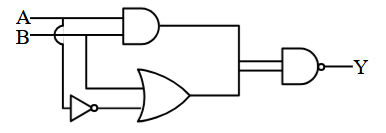
Consider the following logic circuit. The output is Y = 0 when :
The logic circuit described likely represents a logical AND operation followed by an inverter. The output Y=0 when both inputs A and B are high (A=1 and B=1). This is because the inverter flips the output of the AND gate. Hence, the correct scenario for Y=0 is when A=1 and B=1. [CORRECT_OPTION: A]
Q11JEE Main 2025MCQ4MUnits and Measurements
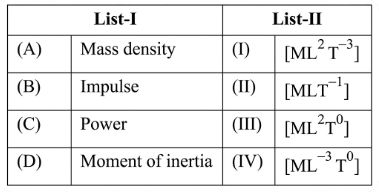
Match List-I with List-II . Choose the correct answer from the options given below :
The dimensional formula of a physical quantity is obtained from the defining equation of that quantity in terms of the fundamental mechanical quantities M (mass), L (length) and T (time). Case (A) : Mass density Mass density ρ is mass per unit volume: ρ=volumemass. Mass has dimension [M] and volume has dimension [L3], so [ρ]=[L3]$[M]=[ML−3T0]. Thus (A) corresponds to (IV). Case (B) : Impulse Impulse J is defined as force multiplied by the time interval: J=FΔt. Force has dimension [MLT−2] and time has dimension [T], so [J]=$[MLT−2]$[T]=[MLT−1]. Thus (B) corresponds to (II). Case (C) : Power Power P is work done per unit time: P=tW. Work (or energy) has dimension [ML2T−2] and time has dimension [T], hence [P]=[T][ML2T−2]$=[ML2T−3]. Thus (C) corresponds to (I). Case (D) : Moment of inertia For a point mass m at a distance r from the axis, the moment of inertia I is: I=mr2. Mass has dimension [M] and distance squared has dimension [L2], so [I]=[M]$[L2]$=[ML2T0]. Thus (D) corresponds to (III). Collecting the matches: (A) → (IV), (B) → (II), (C) → ( I ), (D) → (III). This set of matches is given in Option C. Hence the correct answer is Option C.
Q12JEE Main 2025MCQ4MWaves
The equation of a wave travelling on a string is y=sin[20πx+10πt], where x and t are in SI units. The minimum distance between two points having the same oscillating speed is :
The given transverse wave on the string is y(x,t)=sin(20πx+10πt) where x is \in metres and t is \in seconds. For any particle of the string the instantaneous transverse (oscillatory) speed is obtained by differentiating y with respect to time: Formula: vy=∂t∂y=ωcos(kx+ωt) where k is the wave-number and ω is the angular frequency. Here k=20π and ω=10π, so vy=10πcos(20πx+10πt)−(1) At a fixed instant t, two points x1 and x2 will have the same oscillatory speed magnitude when ∣vy(x1,t)∣=∣vy(x2,t)∣⟹∣cos(20πx1+10πt)∣=∣cos(20πx2+10πt)∣ Let the corresponding phase angles be ϕ1 and ϕ2: ϕ1=20πx1+10πt,ϕ2=20πx2+10πt Condition for equal absolute value of a cosine: ∣cosϕ1∣=∣cosϕ2∣⟹ϕ2=ϕ1±nπ,n∈Z (The plus/minus π shift changes the sign of the cosine but keeps its magnitude the same.) Therefore the phase difference between the two points is Δϕ=ϕ2−ϕ1=nπ Since Δϕ=kΔx, we get kΔx=nπ⟹Δx=knπ−(2) With k=20π, equation (2) becomes Δx=20πnπ=20nmetre The minimum non-zero distance corresponds to n=1: Δxmin=201m=0.05m=5.0cm Hence, the minimum separation between two points on the string having the same oscillating speed is 5.0 cm. Option A is correct.
Q13JEE Main 2025MCQ4MRay Optics and Optical Instruments
Given below are two statements : one is labelled as Assertion (A) and the other is labelled as Reason(R). Assertion (A) : Refractive index of glass is higher than that of air. Reason (R) : Optical density of a medium is directly proportionate to its mass density which results in a proportionate refractive index. In the light of the above statements, choose the most appropriate answer from the options given below :
The assertion states: "Refractive index of glass is higher than that of air." The refractive index n of a medium is defined by n=vc, where c is the speed of light \in vacuum and v is the speed of light \in the medium. For air, v is almost equal to c, so nair≈1.0003. For ordinary crown glass, v≈2×10⁸m s−1, so nglass≈1.5. Hence nglass>nair, making the assertion true. The reason claims: "Optical density of a medium is directly proportionate to its mass density which results in a proportionate refractive index." Optical density describes how much a medium slows light, i.e. its refractive index. Mass density is the ratio of mass to volume. There is no fixed proportionality between mass density and refractive index. For example, turpentine has a higher refractive index than water even though its mass density is lower. Therefore the reason is false. Conclusion: The assertion (A) is correct, but the reason (R) is not correct. Hence the appropriate choice is Option C.
Q14JEE Main 2025MCQ4MMagnetism and Matter
Given below are two statements : one is labelled as Assertion (A) and the other is labelled as Reason(R). Assertion (A) : Magnetic monopoles do not exist. Reason (R) : Magnetic field lines are continuous and form closed loops. In the light of the above statements, choose the most appropriate answer from the options given below :
For a magnetic field B, Gauss's law for magnetism states ∇⋅B=0−(1). Equation (1) means the net magnetic flux through any closed surface is zero. Hence there are no sources or sinks of the magnetic field analogous to electric charges. In other words, isolated north poles or south poles (magnetic monopoles) are absent. This validates Assertion (A). Because ∇⋅B=0 everywhere, magnetic field lines can neither start nor end; they must be continuous and form closed loops. Therefore Reason (R) is also a correct statement. Moreover, the continuity of magnetic field lines (closed loops) is the direct physical manifestation of ∇⋅B=0, which is precisely why magnetic monopoles do not exist. Thus Reason (R) correctly explains Assertion (A). So, both Assertion (A) and Reason (R) are correct and Reason (R) is the correct explanation of Assertion (A). Answer: Option C
Q15JEE Main 2025MCQ4MProperties of Matter
Which one of the following forces cannot be expressed in terms of potential energy?
Potential energy U is defined only for conservative forces. A conservative force satisfies the following statements: \bullet Work done by the force depends only on the initial and final positions, not on the actual path. \bullet For a conservative force Fc we can write Fc=−∇U, that is, the force equals the negative gradient of a scalar potential energy function U(x,y,z). Let us analyse each force \in the options. Case A: Coulomb's force between two point charges is F=kr2q1q2r^. It is inverse-square and central, hence conservative. We can define the electrostatic potential energy U=krq1q2 such that F=−drdUr^. Therefore it can be expressed \in terms of potential energy. Case B: Gravitational force between two masses is F=−Gr2m1m2r^, which is also inverse-square and conservative. The corresponding potential energy is U=−Grm1m2. Hence gravitational force is expressible through potential energy. Case C: Frictional force (kinetic or static) depends on the nature of surfaces and usually acts opposite to the direction of motion or impending motion. Work done against friction depends on the path length, not merely on initial and final positions. Therefore friction is a non-conservative force. For a non-conservative force we cannot define a single-valued scalar function U satisfying F=−∇U. So friction cannot be expressed \in terms of potential energy. Case D: A restoring force such as the spring force is F=−kxi^. It is conservative; its potential energy is the elastic potential energy U=21kx2 because F=−dxdUi^. Only the frictional force fails to meet the criteria for conservative forces. Hence the force that cannot be expressed in terms of potential energy is the frictional force → Option C (Option 3).
Q16JEE Main 2025MCQ4MThermodynamics
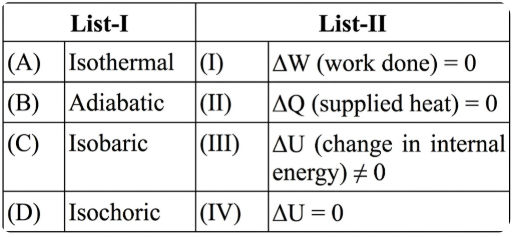
Match List-I with List-II. Choose the correct answer from the options given below :
The first law of thermodynamics gives the relation ΔQ=ΔU+ΔW where: \bullet ΔQ is the heat supplied to the system, \bullet ΔU is the change \in internal energy, \bullet ΔW is the work done by the system. For each thermodynamic process we check which of these three quantities is zero or non-zero. Case A: Isothermal process Definition: Temperature remains constant. For an ideal gas, internal energy depends only on temperature, so when temperature is constant ΔU=0. Heat supplied equals work done, but both are generally non-zero. Hence the correct description is ΔU=0, i.e. List-II item (IV). Case B: Adiabatic process Definition: No heat is exchanged with the surroundings. Therefore ΔQ=0. Neither ΔU nor ΔW is automatically zero; they are related by ΔU=−ΔW. Thus the matching statement is ΔQ=0, i.e. List-II item (II). Case C: Isobaric process Definition: Pressure remains constant. At constant pressure, the gas expands or compresses, so work is done: ΔW=0. Temperature usually changes, so internal energy changes: ΔU=0. Only ΔU=0 is listed among the four given statements, therefore we match with List-II item (III). Case D: Isochoric process Definition: Volume remains constant. Work done for a volume change is ΔW=PΔV. With ΔV=0 we get ΔW=0. Heat added goes entirely into changing internal energy: ΔQ=ΔU, so neither of them is necessarily zero. Thus the matching statement is ΔW=0, i.e. List-II item (I). Collecting the matches: (A) Isothermal \to (IV) ΔU=0 (B) Adiabatic \to (II) ΔQ=0 (C) Isobaric \to (III) ΔU=0 (D) Isochoric \to (I) ΔW=0 This corresponds to Option C. Final Answer: Option C [ (A)-(IV), (B)-(II), (C)-(III), (D)-(I) ]
Q17JEE Main 2025MCQ4MMotion in a Straight Line
A helicopter flying horizontally with a speed of 360 km/h at an altitude of 2 km, drops an object at an instant. The object hits the ground at a point O, 20 s after it is dropped. Displacement of 'O' from the position of helicopter where the object was released is : (use acceleration due to gravity g=10 m/s2and neglect air resistance)
Speed of the helicopter: v=360 km h−1=360×36001000m s−1=100m s−1 Altitude from which the object is released: h=2 km=2000 m Time taken by the object to fall through h (free-fall, neglecting air resistance) is obtained from h=21gt2⟹t=g2h Substituting h=2000 m and g=10 m s−2, t=102×2000=400=20 s Thus the object reaches the ground exactly 20 s after it is dropped. Horizontal distance travelled \in this time by either the helicopter or the object is x=vt=100m s−1×20 s=2000 m=2 km Vertical distance descended by the object is the full altitude, i.e. y=2 km downward. Hence the displacement vector of the object, measured from the point of release on the helicopter, has components horizontal 2 km and vertical 2 km. Its magnitude is (2 km)2+(2 km)2=22km Therefore, the required displacement is 22 km. Option D.
Q18JEE Main 2025MCQ4MLaws of Motion
An object with mass 500 g moves along x-axis with speed v=4x m/s. The force acting on the object is :
The speed of the object varies with its position as v=4x, where x is the coordinate (\in metres) measured along the +x-axis. First convert the mass to SI units: given mass m=500g =0.5kg. To find the force we need the acceleration. For one-dimensional motion, acceleration can be expressed \in terms of position as a=vdxdv STEP 1 - Differentiate the speed with respect to x: v=4x1/2⇒dxdv=4⋅21x−1/2=2x−1/2 STEP 2 - Use a=vdxdv: Substitute v=4x1/2 and dxdv=2x−1/2: a=(4x1/2)(2x−1/2)=8 ms−2 The acceleration turns out to be a constant 8 ms−2 (independent of x). STEP 3 - Apply Newton's second law F=ma: F=0.5×8=4 N Hence the force acting on the object is 4 N. Therefore, Option D is correct.
Q19JEE Main 2025MCQ4MRay Optics and Optical Instruments
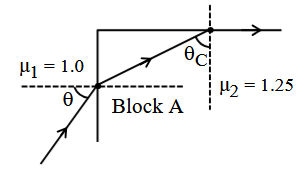
A transparent block A having refractive index μ=1.25 is surrounded by another medium of refractive index μ=1.0. A light ray is incident on the flat face of the block with incident angle θ. What is the maximum value of θ for which light suffers total internal reflection at the top surface of the block?
For total internal reflection to occur at the top surface of the block, the incident angle θ must be greater than the critical angle θC, which is defined by the formula:
sin(θC)=μ1μ2
Here, μ2=1.0 (air) and μ1=1.25 (block). Thus,
θC=sin−1(1.251.0)=sin−1(0.8)
which simplifies to:
θC=sin−1(43)
Thus, the maximum value of θ for total internal reflection is given by sin−1(3/4).
[CORRECT_OPTION: C]
Q20JEE Main 2025NAT4MElectrostatics
A parallel plate capacitor has charge 5×10⁻⁶ C. A dielectric slab is inserted between the plates and almost fills the space between the plates. If the induced charge on one face of the slab is 4×10⁻⁶ C then the dielectric constant of the slab is _____.
Let the free charge on the plates of the capacitor be Qf=5×10⁻⁶C. When a dielectric slab is inserted, the molecules of the slab polarise and create two layers of induced (bound) charge. The magnitude of the induced charge on either face of the slab is given as Qind=4×10⁻⁶C. For a parallel-plate capacitor completely (or almost completely) filled with a dielectric of relative permittivity K, the relation between the free surface charge density σf and the bound surface charge density σb is derived as follows: \bullet The electric displacement vector D inside the dielectric is D=σfn^ (since D originates from free charge only). \bullet Electric field inside the dielectric: E=Kε0σf. \bullet Polarisation P of the dielectric: P=ε0χeE=ε0(K−1)E, where χe=K−1. \bullet Surface bound charge density: σb=P=ε0(K−1)Kε0σf=KK−1σf. Therefore the ratio of the magnitudes of bound to free charge is QfQind=σfσb=KK−1. Substitute the given values: 5×10−64×10−6=KK−154=KK−1 Cross-multiplying: 5(K−1)=4K⇒5K−5=4KK=5 Hence, the dielectric constant of the slab is 5.
Q21JEE Main 2025NAT4MAlternating Current
An inductor of reactance 100 Ω, a capacitor of reactance 50 Ω, and a resistor of resistance 50 Ω are connected in series with an AC source of 10 V, 50 Hz. Average power dissipated by the circuit is _____ W.
The given components are connected in series, so the circuit is a series R-L-C combination. Resistance: R=50Ω Inductive reactance: XL=100Ω Capacitive reactance: XC=50Ω Applied rms voltage: Vrms=10 V Step 1 Find the net reactance. For a series circuit, the net reactance is the algebraic difference of the individual reactances: X=XL−XC=100−50=50Ω Step 2 Calculate the impedance. For a series R-L-C circuit, the impedance is Z=R2+X2⇒Z=502+502⇒Z=2500+2500⇒Z=5000⇒Z=70.71Ω Step 3 Find the rms current. Ohm's law for ac gives Irms=ZVrms. Irms=70.7110=0.1414 A Step 4 Determine the power factor. Power factor \in a series circuit is cosϕ=ZR. cosϕ=70.7150=0.707 Step 5 Calculate the average (true) power. Average power dissipated is P=VrmsIrmscosϕ Substitute the values: P=10×0.1414×0.707P=1.0 W Hence, the average power dissipated by the circuit is 1 W .
Q22JEE Main 2025NAT4MHeat Transfer
Two cylindrical rods A and B made of different materials, are joined in a straight line. The ratio of lengths, radii and thermal conductivities are: LBLA=21, rBrA=2 and KBKA=21. The free ends of rods A and B are maintained at 400 K, 200 K respectively. The temperature of rods interface is _____ K,when equilibrium is established.
For steady one-dimensional conduction through a rod, the heat current is Q=LKA(Thot−Tcold) When two rods are joined \in series, the same heat current Q flows through each of them \in the steady state. Let T be the interface temperature (at the junction of rods A and B). Given ratios LBLA=21⇒LA=2LBrBrA=2⇒rA=2rBKBKA=21⇒KA=2KB Cross-sectional areas: A=πr2, so AA=πrA2=π(2rB)2=4πrB2=4AB thus ABAA=4. Heat current through rod A: Q=LAKAAA(400−T) Heat current through rod B: Q=LBKBAB(T−200) Equate the two heat currents: LAKAAA(400−T)=LBKBAB(T−200) Substitute the ratio values: KA=2KB,AA=4AB,LA=2LB2LB(2KB)(4AB)(400−T)=LBKBAB(T−200) Simplify the fraction on the left: 2LB(2KB)(4AB)=2LB2KBAB=LB2KBAB⋅2=LB4KBAB Hence LB4KBAB(400−T)=LBKBAB(T−200) Cancel the common factor LBKBAB from both sides: 4(400−T)=T−200 Solve for T: 1600−4T=T−2001600+200=5T1800=5TT=360K The temperature at the interface of the two rods is 360K.
Q23JEE Main 2025NAT4MElectrostatics
The electric field in a region is given by E=(2i^+4j^+6k^)×103 N/C. The flux of the field through a rectangular surface parallel to x-z plane is 6.0 Nm2C−1. The area of the surface is _____cm2.
The electric flux ΦE is given by ΦE=E⋅A, where A is the area vector. For a surface parallel to the x-z plane, A=Aj^. The flux through the surface is 6.0 Nm²/C, thus:
ΦE=EyA=(4×10³N/C)A=6.0Nm2/C.
Solving for A gives A=4×1036.0=1.5×10⁻³m2=15cm2.
[CORRECT_OPTION: A]
Q24JEE Main 2025NAT4MRotational Motion
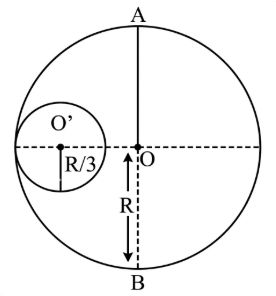
M and R be the mass and radius of a disc. A small disc of radius R/3 is removed from the bigger disc. The moment of inertia of remaining part about an axis AB passing through the centre O and perpendicular to the plane of the disc is x4MR2. The value of x is _____.
The moment of inertia of a solid disc about an axis through its center is given by I=21MR2. For the smaller disc removed, Iremoved=21Msmall(3R)2=21(9M)(9R2)=162MR2. The moment of inertia of the remaining part is Iremaining=21MR2−162MR2=(16281−1621)MR2=16280MR2=8140MR2. Setting this equal to x4MR2, we find x=9.
[CORRECT_OPTION: D]
Q25JEE Main 2025MCQ4MDual Nature of Matter and Radiation
A photo-emissive substance is illuminated with a radiation of wavelength λi so that it releases electrons with de-Broglie wavelength λe. The longest wavelength of radiation that can emit photoelectron is λ0. Expression for de-Broglie wavelength is given by : (m : mass of the electron, h : Planck's constant and c : speed of light)
For a photo-electric surface, Einstein's equation relates the energy of the incident photon, the work function of the metal and the maximum kinetic energy of the emitted electron: λihc=λ0hc+Kmax−(1) Here λi = wavelength of the incident radiation, λ0 = threshold (longest) wavelength that can just eject an electron, Kmax = maximum kinetic energy of the emitted electron. Re-arranging −(1) gives the kinetic energy: Kmax=hc(λi1−λ01)−(2) The de-Broglie wavelength λe of the emitted electron is related to its momentum p by λe=ph−(3) Momentum is obtained from kinetic energy using p=2mKmax, so with −(2)p=2mhc(λi1−λ01)−(4) Substituting −(4) \in the de-Broglie relation −(3): λe=2mhc(λi1−λ01)h Comparing with the given options, this expression matches Option A. Hence, the required expression is λe=2mhc(λi1−λ01)h and the correct choice is Option A .
Chemistry25 questions
Q26JEE Main 2025MCQ4MBiomolecules
Given below are two statements : Statement (I) : On hydrolysis, oligo peptides give rise to fewer number of α-amino acids while proteins give rise to a large number of β-amino acids. Statement (II) : Natural proteins are denatured by acids which convert the water soluble form of fibrous proteins to their water insoluble form. In the light of the above statements, choose the most appropriate answer from the options given below :
Proteins and peptides are condensation polymers of α-amino acids, that is, every constituent amino acid possesses its −NH2 group on the carbon atom next to the carboxyl group (the α-carbon). Case 1: Checking Statement I Oligopeptides contain only a few peptide (amide) linkages, so on complete hydrolysis they furnish only a small number of constituent amino acids. Full-sized proteins are very long chains, so their hydrolysis yields a large number of amino-acid units. However, \in every case the amino acids obtained are α-amino acids, never β-amino acids (where the −NH2 group would be on the second carbon away from −COOH). Hence the phrase "large number of β-amino acids" makes Statement I wrong. Case 2: Checking Statement II Acids, bases, heat, or heavy-metal ions can denature proteins. During denaturation a water-soluble globular protein loses its native three-dimensional shape and often precipitates as an insoluble fibrous mass. Fibrous proteins are themselves normally water insoluble. Therefore acid treatment converts the water-soluble form of a globular protein into an insoluble fibrous form, not "the water-soluble form of fibrous proteins". Hence Statement II is also wrong. Both statements are incorrect, so the correct choice is Option C.
Q27JEE Main 2025MCQ4MOrganic Chemistry - Some Basic Principles
Mixture of 1 g each of chlorobenzene, aniline and benzoic acid is dissolved in 50 mL ethyl acetate and placed in a separating funnel, 5 M NaOH (30 mL) was added in the same funnel. The funnel was shaken vigorously and then kept aside. The ethyl acetate layer in the funnel contains :
Ethyl acetate is an organic solvent that is immiscible with water, so two separate layers form in a separating funnel. The upper layer (lower density) is ethyl acetate, while the lower layer (higher density) is the aqueous solution of 5 M NaOH. 1. Behaviour of benzoic acid: Benzoic acid is a carboxylic acid. In the presence of the strong base NaOH it undergoes neutralisation: C6H5COOH+NaOH→C6H5COONa+H2O. Sodium benzoate (C6H5COONa) is an ionic salt, highly soluble \in water and almost insoluble \in ethyl acetate. Hence benzoic acid transfers completely to the aqueous layer as its salt. 2. Behaviour of aniline: Aniline is a weak base. In strongly basic medium (5 M NaOH) it remains \in the free-base (neutral) form C6H5NH2 because there is no proton source to convert it to the water-soluble ammonium ion C6H5NH3+. Neutral aniline is only sparingly soluble \in water but is quite soluble \in an organic solvent such as ethyl acetate. Therefore aniline stays \in the ethyl acetate layer. 3. Behaviour of chlorobenzene: Chlorobenzene is a non-polar, neutral molecule. It does not react with NaOH under these conditions and is insoluble \in water. Thus chlorobenzene also remains \in the ethyl acetate layer. Final distribution: \bullet Aqueous (lower) layer : sodium benzoate (from benzoic acid) and excess NaOH. • Organic (upper ethyl acetate) layer : chlorobenzene + aniline. Hence the ethyl acetate layer contains chlorobenzene and aniline. Correct Option D: chlorobenzene and aniline .
Q28JEE Main 2025MCQ4MIonic Equilibrium
The hydration energies of K+ and Cl− are −x and −y kJ/mol respectively. If lattice energy of KCl is −z kJ/mol, then the heat of solution of KCl is :
For an ionic solid, the heat (enthalpy) of solution, ΔHsol, is obtained \in two steps: 1. Lattice dissociation: the crystal breaks into gaseous ions. This requires the lattice dissociation energy, ΔHlattice(diss), which is numerically equal and opposite to the lattice energy of formation. 2. Hydration: the gaseous ions get surrounded by water molecules, releasing their hydration energies. Given data (sign conventions): \bullet Hydration energy of K+=−x kJ mol−1 (exothermic) \bullet Hydration energy of Cl−=−y kJ mol−1 (exothermic) \bullet Lattice energy of formation of KCl =−z kJ mol−1 (exothermic for formation from gaseous ions) Step 1: Lattice dissociation energy Lattice energy of formation is −z, so the energy required to dissociate the lattice is the opposite sign: ΔHlattice(diss)=+z kJ mol−1 Step 2: Hydration of the ions ΔHhydration=(−x)+(−y)=−(x+y) kJ mol−1 Overall heat of solution ΔHsol=ΔHlattice(diss)+ΔHhydrationΔHsol=(+z)+[−(x+y)]ΔHsol=z−(x+y) Therefore the heat of solution of KCl is z−(x+y) kJ mol−1. Hence the correct option is Option C.
Q29JEE Main 2025MCQ4MChemical Kinetics
A(g)→B(g)+C(g) is a first order reaction. The reaction was started with reactant A only. Which of the following expression is correct for rate constant k?
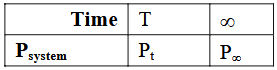
For the gas-phase decomposition A(g)→B(g)+C(g) at constant temperature and volume, the total pressure is directly proportional to the total number of moles present at any instant. Let the reaction start with a moles of A and no B or C. At time t, let x moles of A decompose. Moles present at time t: A:a−xB:xC:x Total moles at time t are nt=a−x+x+x=a+x. If f=VRT (a common proportionality factor), then initial pressure, P0=fa, pressure at time t, Pt=f(a+x)=P0+fx−(1) From (1), x=fPt−P0−(2) When the reaction goes to completion (t→∞), x=a. Total moles then are a+a=2a, so the final pressure is P∞=f(2a)=2P0⟹P0=2P∞−(3) The first-order rate law is k=t1lnconcentration of A at time tinitial concentration of A, i.e. k=t1lna−xa−(4) Using (2), a−x=fP0−fPt−P0=f2P0−Pt. Thus, a−xa=f2P0−PtfP0=2P0−PtP0−(5) Substitute P0=2P∞ from (3) into (5): a−xa=P∞−Pt2P∞=2(P∞−Pt)P∞−(6) Insert (6) into the rate law (4): k=t1ln[2(P∞−Pt)P∞] This matches Option C. Hence, the correct expression for the first-order rate constant is Case C: k=t1ln2(p∞−Pt)p∞.
Q30JEE Main 2025MCQ4MAldehydes, Ketones and Carboxylic Acids
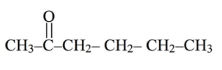
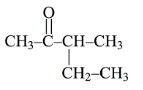
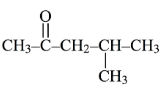
"P" is an optically active compound with molecular formula C6H12O. When "P" is treated with 2,4-dinitrophenylhydrazine, it gives a positive test. However, in presence of Tollens reagent, "P" gives a negative test. Predict the structure of "P".
The compound "P" is an optically active substance with the molecular formula C6H12O, which likely indicates a chiral center. A positive test with 2,4-dinitrophenylhydrazine suggests the presence of a carbonyl group (aldehyde or ketone), while a negative Tollens test indicates that "P" is not an aldehyde but a ketone. The structure corresponding to these characteristics is option B, specifically a ketone with a chiral center.
[CORRECT_OPTION: B]
Q31JEE Main 2025MCQ4MClassification of Elements
Choose the incorrect trend in the atomic radii (r) of the elements :
Atomic radius decreases from left to right across a period because nuclear charge increases while the principal quantum number n remains the same. Atomic radius increases down a group because a new shell is added, so the outer electrons are farther from the nucleus despite the higher nuclear charge. We now test each option one by one. Case A: rBr<rK Both Br and K lie \in the 4th period. K is \in Group 1 and Br \in Group 17. Moving from Group 1 to Group 17 \in the same period, atomic radius must decrease. Hence rBr<rK is a correct trend. Case B: rMg<rAl Mg and Al are neighbours \in the 3rd period (Mg: Group 2, Al: Group 13). Across a period, radius should decrease, so rMg>rAl \in reality. The given inequality reverses this order, so it is incorrect. Case C: rRb<rCs Rb and Cs belong to Group 1. Going down the group from Rb (5th period) to Cs (6th period), radius increases, i.e. rRb<rCs. This statement is correct. Case D: rAl<rCs Al is \in the 3rd period, Cs \in the 6th period. Down a group and also across many periods toward the left, Cs becomes much larger than Al, therefore rAl<rCs is also correct. Only Case B shows an inequality opposite to the actual periodic trend, so Case B (Option B) is the incorrect trend. Final answer: Option B.
Q32JEE Main 2025MCQ4MOrganic Chemistry - Some Basic Principles
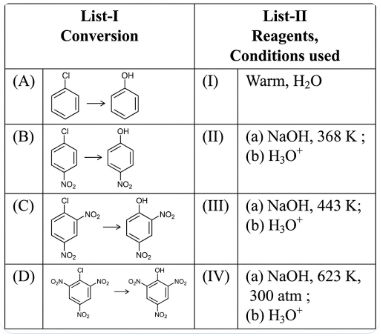
Match List-I with List-II . Choose the correct answer from the options given below :
In every conversion a chloride atom on an aromatic ring is being replaced by OH to give a phenol. This transformation proceeds by a nucleophilic aromatic substitution (SNAr) of the Cl− ion by the nucleophile OH−. Rate of SNAr increases sharply when the ring has strong −I and −M groups (such as NO2) at the ortho and/or para positions. These groups stabilise the intermediate Meisenheimer complex by delocalising the negative charge. Therefore, the more NO2 groups present, the milder the conditions required for hydrolysis. Arrange the four substrates \in increasing ease of hydrolysis: chlorobenzene < p-nitrochlorobenzene < 2,4-dinitrochlorobenzene < picryl chloride (2,4,6-trinitrochlorobenzene). Now match the reagents/conditions given \in List-II with this order: Case 1: Chlorobenzene \to phenol Very unreactive; Dow's process is used. Reagents: NaOH, 623 K, 300atm, then H3O+ \Rightarrow Item (IV). Case 2: p-Nitrochlorobenzene \to p-Nitrophenol One NO2 group activates the ring; moderate temperature is sufficient. Reagents: NaOH, 443 K, then H3O+ \Rightarrow Item (III). Case 3: 2,4-Dinitrochlorobenzene \to 2,4-Dinitrophenol Two NO2 groups give higher activation; still milder conditions than above. Reagents: NaOH, 368 K, then H3O+ \Rightarrow Item (II). Case 4: Picryl chloride (2,4,6-Trinitrochlorobenzene) \to Picric acid (2,4,6-Trinitrophenol) Three NO2 groups make the ring so activated that simple warming with water suffices. Reagent/condition: warm H2O ⇒ Item (I). Thus the correct pairing is: (A) → (IV), (B) → (III), (C) → (II), (D) → (I). Comparing with the options, this corresponds to Option C .
The standard state of a substance means the pure substance at a standard pressure of 1bar and at a specified temperature. For most thermodynamic tables this specified temperature is 298K, but any temperature can be chosen, provided it is clearly mentioned. Checking each statement one by one: Option A : The statement says the term 'standard state' implies the temperature is 0∘C (273K). Definition shows that standard state does not fix the temperature; it only fixes the pressure (1 bar). Therefore this statement is false . Option B : It claims "the standard state of a pure gas is the pure gas at a pressure of 1 bar and temperature 273 K". Again, standard pressure is indeed 1 bar, but the temperature need not be 273K. Hence this statement is also false . Option C : It states ΔfH298θ is zero for O(g). By definition, the standard enthalpy of formation ΔfHTθ of any element \in its most stable form at temperature T is taken as zero. At 298K the most stable form of oxygen is O2(g), not O(g). Therefore ΔfH298θ=0 for atomic oxygen O(g). Statement C is false . Option D : It says ΔfH500θ is zero for O2(g). Even at 500K, O2(g) remains the thermodynamically most stable form of oxygen. Hence, by the same definition, ΔfH500θ=0 for O2(g). Statement D is true . Since only Option D is correct, the given answer "4" (which corresponds to Option D) is verified.
Q34JEE Main 2025MCQ4MChemical Equilibrium
Liquid A and B form an ideal solution. The vapour pressure of pure liquids A and B are 350 and 750 mm Hg respectively at the same temperature. If xA and xB are the mole fraction of A and B \in solution while yA and yB are the mole fraction of A and B in vapour phase then :
For an ideal liquid mixture Raoult's law is valid. If PA0 and PB0 are the vapour-pressures of the pure liquids, then the partial pressures over the solution are pA=xAPA0 and pB=xBPB0−(1) The total pressure is P=pA+pB. The mole fractions of the components \in the vapour phase are defined as yA=PpA and yB=PpB−(2) Divide the two expressions \in (2): yByA=pB/PpA/P=pBpA Now use (1): yByA=xBPB0xAPA0=xBxAPB0PA0−(3) The data given are PA0=350mm Hg and PB0=750mm Hg, so PB0PA0=750350=0.467<1 Substituting into (3): yByA=xBxA(0.467) Because the multiplier 0.467 is less than 1, we obtain yByA<xBxA⟹xBxA>yByA Hence the correct relation is given in Option C. Answer - Option C
Q35JEE Main 2025MCQ4MCoordination Compounds
'X' is the number of acidic oxides among VO2, V2O3, CrO3, V2O5 and Mn2O7. The primary valency of cobalt \in [Co(H2NCH2CH2NH3)3]2(SO4)3 is Y. The value of X + Y is :
For acidic‐basic behaviour of transition metal oxides, the general trend is: basic nature at low oxidation state → amphoteric → acidic at the highest oxidation state. We first write the oxidation state of the metal \in each oxide. VO2:V+2(−2)=0⇒V+4V2O3:2V+3(−2)=0⇒V+3CrO3:Cr+3(−2)=0⇒Cr+6V2O5:2V+5(−2)=0⇒V+5Mn2O7:2Mn+7(−2)=0⇒Mn+7 Nature of these oxides: \bullet V+3 oxide (V2O3) is basic. \bullet V+4 oxide (VO2) is amphoteric. \bullet V+5 oxide (V2O5) is also amphoteric (it reacts both with acids and with alkalies). \bullet Cr+6 oxide (CrO3) is the anhydride of H2CrO4 and is strongly acidic. \bullet Mn+7 oxide (Mn2O7) is the anhydride of HMnO4 and is strongly acidic. Thus only CrO3 and Mn2O7 are counted as acidic. Therefore X=2 Primary valency (Werner) = oxidation state of the metal. The compound is [Co(H2NCH2CH2NH3)3]2(SO4)3. Each ligand (H2NCH2CH2NH3) is treated as neutral for the charge calculation (only the unprotonated NH2 donates the lone pair; the protonated NH3+ part does not donate and its positive charge is balanced internally by the non-coordinating N). Let the oxidation state of cobalt be y. Charge balance for one complex ion: y+3(0)=charge of [CoL3]n+ Overall compound is electrically neutral, so 2(charge of [CoL3]n+)+3(−2)=0−(1) From (1): 2n−6=0⇒n=+3. Hence y=+3. Therefore the primary valency of cobalt is Y=3 Finally, X+Y=2+3=5. Option A is correct.
Q36JEE Main 2025MCQ4MAmines
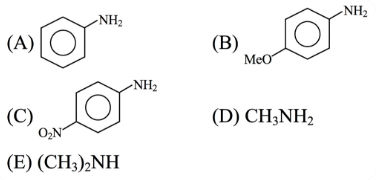
The descending order of basicity of following amines is : Choose the correct answer from the options given below :
The basicity of an amine depends on how easily the lone pair on the nitrogen can accept a proton. Greater electron density on N and better stabilization of the resulting ammonium ion both increase basicity. Important effects that decide electron density on nitrogen are: (i) Inductive effect (+I or −I) from alkyl/aryl substituents. (ii) Resonance (mesomeric) effect (+M or −M) that may delocalize or donate electron density. (iii) Hybridisation of the nitrogen (sp3 \in aliphatic > sp2 \in aromatic for basicity). Case 1: Aliphatic amines CH3NH2 (D) is a primary aliphatic amine. (CH3)2NH (E) is a secondary aliphatic amine. Alkyl groups exhibit a +I effect. Two alkyl groups \in E push more electron density toward N than one alkyl group \in D. In aqueous medium, secondary > primary for basicity (tertiary suffers from poor solvation). Hence basicity: E>D. Case 2: Aromatic amines (anilines) In aniline, the lone pair on N is partly delocalised into the benzene ring by resonance, making it less available for protonation; therefore aniline is less basic than aliphatic amines. (A) Aniline - no extra substituent. (B) p-MeO-Aniline - MeO group shows a strong +M (electron-donating) effect, increasing electron density on the ring and on N through resonance, so it is more basic than aniline. (C) p-NO2-Aniline - NO2 group shows a powerful −M (electron-withdrawing) effect, withdrawing electron density from the ring and N, thus making the amine much less basic. Therefore, among the three anilines: basicity: B>A>C. Combining both sets Overall descending basicity order becomes: (CH3)2NH(E)>CH3NH2(D)>p-MeO-Aniline(B)>Aniline(A)>p-NO2-Aniline(C) This matches Option B. Answer: Option B (E > D > B > A > C) .
Q37JEE Main 2025MCQ4MCoordination Compounds
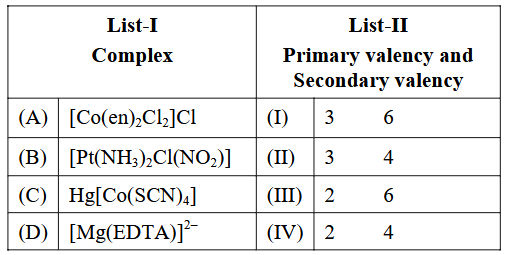
Match List-I with List-II. Choose the correct answer from the options given below :
According to Werner's theory, • the oxidation state of the central metal atom / ion gives the number of primary valencies (ionisable). • the total number of donor atoms directly linked with the metal gives the secondary valencies (coordination number). Case A: Complex : [Co(en)2Cl2]Cl Step-1 Oxidation state of Co (inside the square bracket): Let it be x. x+2(0)+2(−1)=+1 (because one Cl− is outside the bracket) x−2=+1⇒x=+3 Primary valencies = 3. Step-2 Coordination number: en is bidentate \to 2en supplies 2×2=4 donor atoms. 2Cl− supplies 2 donor atoms. Total =4+2=6. Secondary valencies = 6. Hence (A) \longrightarrow (I) (primary 3, secondary 6). Case B: Complex : [Pt(NH3)2Cl(NO2)] Step-1 Oxidation state of Pt: Let it be x. x+2(0)+(−1)+(−1)=0x−2=0⇒x=+2 Primary valencies = 2. Step-2 Coordination number: All the four ligands (NH3,NH3,Cl−,NO2−) are monodentate \to 4 donor atoms. Secondary valencies = 4. Hence (B) \longrightarrow (IV) (primary 2, secondary 4). Case C: Complex : Hg[Co(SCN)4] Step-1 Find the charge on the complex anion. Hg is present as Hg+ (monovalent mercurous ion). For electrical neutrality, the anion must carry −1 charge. Step-2 Oxidation state of Co: Let it be x. x+4(−1)=−1x−4=−1⇒x=+3 Primary valencies = 3. Step-3 Coordination number: Each SCN− is monodentate \to 4 donor atoms. Secondary valencies = 4. Hence (C) \longrightarrow (II) (primary 3, secondary 4). Case D: Complex : [Mg(EDTA)]2− Step-1 Oxidation state of Mg: Let it be x. Charge on EDTA ligand =−4. Total charge on complex =−2. x+(−4)=−2⇒x=+2 Primary valencies = 2. Step-2 Coordination number: EDTA4− is hexadentate \to 6 donor atoms. Secondary valencies = 6. Hence (D) \longrightarrow (III) (primary 2, secondary 6). Putting the four results together: (A)−(I),(B)−(IV),(C)−(II),(D)−(III) Therefore the correct choice is Option B .
Q38JEE Main 2025MCQ4MSolutions
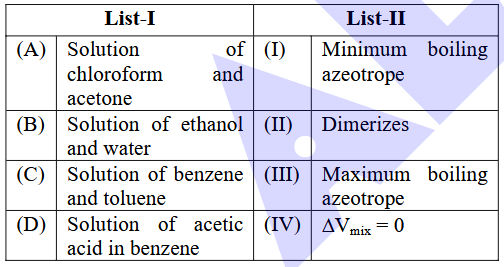
Match List-I with List-II. Choose the correct answer from the options given below :
For each pair we first decide whether the solution shows ideal behaviour, positive deviation or negative deviation from Raoult's law. Then we match the corresponding properties from List-II. Case A: Chloroform (CHCl₃) + Acetone (CH₃COCH₃) • CHCl₃ has an acidic hydrogen that forms strong hydrogen bonds with the carbonyl oxygen of acetone. • The intermolecular attraction between unlike molecules becomes stronger than that between like molecules. • Stronger attractions ↓ total vapour pressure → these mixtures show negative deviation from Raoult's law. • Negative deviation gives a solution whose boiling point is higher than either pure component, i.e. a maximum-boiling azeotrope. Thus (A) → (III). Case B: Ethanol (C₂H₅OH) + Water (H₂O) • When ethanol mixes with water, some hydrogen bonds of pure water are broken; the unlike interactions are weaker than the strong H-bond network of water. • Weaker attractions ↑ total vapour pressure → positive deviation from Raoult's law. • Positive deviation produces a minimum-boiling azeotrope. Thus (B) → (I). Case C: Benzene (C₆H₆) + Toluene (C₆H₅CH₃) • Both are non-polar aromatic liquids with very similar molecular sizes and intermolecular forces. • Their mixture obeys Raoult's law almost exactly: ΔHmix=0 and ΔVmix=0. Thus (C) \to (IV). Case D: Acetic acid (CH₃COOH) \in Benzene (C₆H₆) \bullet In a non-polar solvent like benzene, acetic acid molecules associate through hydrogen bonding to form dimers: 2CH3COOH⇌(CH3COOH)2. Thus (D) → (II). Collecting the matches: (A)-(III), (B)-(I), (C)-(IV), (D)-(II). The option having this sequence is Option A. Final answer: Option A.
Q39JEE Main 2025MCQ4MChemical Bonding and Molecular Structure
In SO2, NO2− and N3− the hybridizations at the central atom are respectively :
The hybridization of a given atom can be predicted from its steric number. Steric number = (number of σ-bonds around the atom) + (number of lone pairs on that atom). Case 1: SO2 \bullet Central atom: S. \bullet Lewis structure: O=S−O with one lone pair on S. \bullet σ-bonds on S=2 (one to each O). \bullet Lone pairs on S=1. Therefore, steric number =2+1=3. Steric number 3 corresponds to sp2 hybridization, giving a bent (V-shaped) molecule. Case 2: NO2− \bullet Central atom: N. \bullet Lewis structure: O=N−O− (resonance forms) with one lone pair on N. \bullet σ-bonds on N=2. \bullet Lone pairs on N=1. Steric number =2+1=3. Steric number 3 again implies sp2 hybridization, giving a bent ion. Case 3: N3− (azide ion) \bullet Central atom: the middle N of N−N−N. \bullet Resonance structures involve N≡N+−N− and N−−N+≡N, but the central N always has: σ-bonds = 2(to the terminal nitrogens). Lone pairs = 0 (all its electrons are \in bonds or as formal charges on terminals). Steric number =2+0=2. Steric number 2 corresponds to sp hybridization, giving a linear ion. Thus, the hybridizations are sp2 \in SO2, sp2 \in NO2− and sp \in N3−. Matching with the options, we select Option A. Answer: Option A
Q40JEE Main 2025MCQ4MCoordination Compounds
The number of unpaired electrons responsible for the paramagnetic nature of the following species are respectively : [Fe(CN)6]3−, [FeF6]3−, [CoF6]3−, [Mn(CN)6]3−
Case 1: [Fe(CN)6]3− (octahedral) Oxidation state of Fe: x+6(−1)=−3⇒x=+3 Electronic configuration of Fe3+: [Ar]3d5 (d5 system) CN− is a strong-field ligand, so Δo>P and a low-spin arrangement occurs. Filling the t2g and eg orbitals: t2g5eg0 Of the five t2g electrons, four pair up and one remains single \to unpaired electrons = 1. Case 2: [FeF6]3− (octahedral) Oxidation state of Fe is again +3, so Fe3+ has d5. F− is a weak-field ligand, therefore Δo<P and a high-spin complex forms. Filling pattern: t2g3eg2 Each of the five d electrons occupies a separate orbital \to unpaired electrons = 5. Case 3: [CoF6]3− (octahedral) Oxidation state of Co: x+6(−1)=−3⇒x=+3 Electronic configuration of Co3+: [Ar]3d6 (d6 system) With weak-field F− ligands (high-spin): Filling pattern: t2g4eg2 Diagrammatically, two t2g orbitals contain one unpaired electron each and both eg orbitals contain one unpaired electron each. Hence unpaired electrons = 4. Case 4: [Mn(CN)6]3− (octahedral) Oxidation state of Mn: x+6(−1)=−3⇒x=+3 Electronic configuration of Mn3+: [Ar]3d4 (d4 system) CN− is a strong-field ligand; the complex is low-spin: Filling pattern: t2g4eg0 The four t2g electrons produce two paired and two unpaired electrons \to unpaired electrons = 2. Therefore, the numbers of unpaired electrons are [Fe(CN)6]3−:1,[FeF6]3−:5,[CoF6]3−:4,[Mn(CN)6]3−:2. This matches Option A: 1,5,4,2.
Q41JEE Main 2025MCQ4MOrganic Chemistry - Some Basic Principles
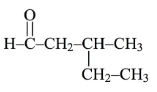
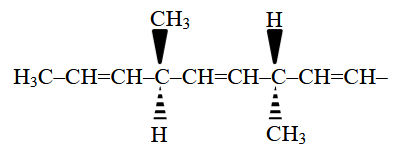
The number of optically active products obtained from the complete ozonolysis of the given compound is :
Ozonolysis of the given compound leads to the formation of carbonyl compounds. If the starting material has a symmetrical structure, the resulting carbonyl compounds will also be symmetrical, resulting in no chiral centers. Thus, no optically active products are formed.
Final correct option: [CORRECT_OPTION: B]
Q42JEE Main 2025MCQ4MHaloalkanes and Haloarenes
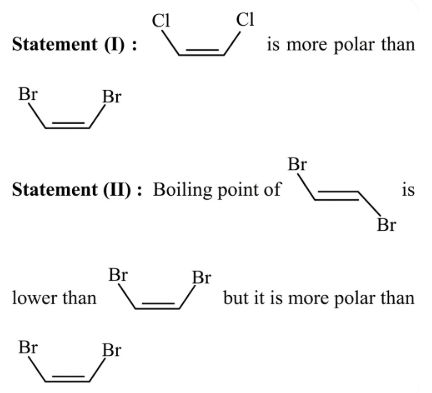
Given below are two statements : In the light of the above statements, choose the most appropriate answer from the options given below :
To evaluate the statements, we analyze the polarity of the given compounds. Chlorine (Cl) is more electronegative than bromine (Br), making the C-Cl bond more polar than the C-Br bond. Thus, Statement I is correct. For Statement II, the boiling point of a compound generally increases with polarity, indicating that the compound with the C-Cl bond should have a higher boiling point than that with the C-Br bond; hence, Statement II is incorrect.
[CORRECT_OPTION: A]
Q43JEE Main 2025MCQ4Md and f Block Elements
The extra stability of half-filled subshell is due to : (A) Symmetrical distribution of electrons (B) Smaller coulombic repulsion energy (C) The presence of electrons with the same spin in non-degenerate orbitals (D) Larger exchange energy (E) Relatively smaller shielding of electrons by one another Identify the correct statements
The concept of "extra stability of half-filled subshells" is explained by Hund's rule. According to this rule, when orbitals of equal energy (degenerate orbitals) are available, electrons occupy them singly with parallel spins before pairing begins. Three physical arguments support the added stability of a half-filled configuration. 1. Symmetrical distribution of charge For a half-filled subshell, the probability cloud of electrons is distributed as uniformly as possible around the nucleus. This symmetry lowers the potential energy of the atom. Hence Statement (A) is correct. 2. Smaller coulombic repulsion and smaller shielding When each degenerate orbital holds just one electron, there is no intra-orbital electron-electron repulsion. Inter-orbital repulsion is also reduced because the electrons tend to stay farther apart. Less repulsion means lower potential energy, and the mutual shielding of nuclear charge is also reduced. Thus both Statement (B) ("smaller coulombic repulsion energy") and Statement (E) ("relatively smaller shielding of electrons by one another") are correct. 3. Larger exchange energy If there are n electrons with parallel spins \in a set of degenerate orbitals, the number of possible exchanges between them is 2n(n−1). Each exchange lowers the energy slightly. A half-filled subshell maximises the number of such exchanges, giving the greatest lowering of energy. Therefore Statement (D) is correct. 4. Incorrect wording in Statement (C) Statement (C) talks about "presence of electrons with the same spin in non-degenerate orbitals". Hund's rule applies to degenerate orbitals (same energy), not non-degenerate ones. So Statement (C) is incorrect. Collecting the valid statements: (A), (B), (D) and (E). Hence the correct option is Option B .
Q44JEE Main 2025MCQ4Md and f Block Elements
The correct statements from the following are : (A) Tl3+ is a powerful oxidising agent (B) Al3+ does not get reduced easily (C) Both Al3+ and Tl3+ are very stable \in solution (D) Tl+ is more stable than Tl3+ (E) Al3+ and Tl+ are highly stable
The elements of Group 13 show two common oxidation states: +3 (using all three valence electrons) and +1 (arising from the inert-pair effect, where the ns2 electrons remain non-bonding). Down the group, the inert-pair effect becomes stronger, so the stability trend is for M=B,Al,Ga,In,Tl:Stability of (+3) decreases while stability of (+1) increases. Applying this to aluminium and thallium: \bullet Aluminium (Z=13) lies near the top of the group, so the inert-pair effect is weak. Hence Al3+ is highly stable and does not reduce (gain electrons) easily. \bullet Thallium (Z=81) is at the bottom, where the inert-pair effect is very strong. Therefore Tl+ is far more stable than Tl3+. Because Tl3+ tends to gain two electrons and change to the more stable Tl+ state, Tl3+ behaves as a powerful oxidising agent. Now judge each given statement: Statement (A) Tl3+ is a powerful oxidising agent. Reason: Tl3++2e−→Tl+ is highly favoured. Statement (A) is correct. Statement (B) Al3+ does not get reduced easily. Reason: Al3+ is already the most stable state for aluminium. Statement (B) is correct. Statement (C) Both Al3+ and Tl3+ are very stable \in solution. We have just seen that Tl3+ is not very stable; it readily converts to Tl+. Statement (C) is incorrect. Statement (D) Tl+ is more stable than Tl3+. Matches the inert-pair effect trend. Statement (D) is correct. Statement (E) Al3+ and Tl+ are highly stable. Both ions correspond to the preferred oxidation state of their respective elements. Statement (E) is correct. The correct set of statements is (A), (B), (D) and (E). Hence the answer is Option B .
Q45JEE Main 2025MCQ4MElectrochemistry
Given below are two statements : 1 M aqueous solution of each of Cu(NO3)2, AgNO3, Hg2(NO3)2; Mg(NO3)2 are electrolysed using inert electrodes. Given : EAg+/Agθ=0.80V,EHg22+/Hgθ=0.79V,ECu2+/Cuθ=0.24V and EMg2+/Mgθ=−2.37V Statement (I) : With increasing voltage, the sequence of deposition of metals on the cathode will be Ag, Hg and Cu Statement (II) : Magnesium will not be deposited at cathode instead oxygen gas will be evolved at the cathode. In the light of the above statement, choose the most appropriate answer from the options given below :
For electrolysis using inert electrodes we compare the standard reduction potentials E∘ of all possible cathodic reactions. The species having the highest (most positive) E∘ gets reduced (deposited) first. All solutions are 1 M, so the numerical values of E∘ may be used directly without any Nernst correction. Standard reduction potentials involved: Ag++e−→Ag;E∘=+0.80VHg22++2e−→2Hg;E∘=+0.79VCu2++2e−→Cu;E∘=+0.34V Because EAg+/Ag∘>EHg22+/Hg∘>ECu2+/Cu∘, the sequence of metal deposition on the cathode as the external voltage is increased will be Ag (first) \to Hg (second) \to Cu (third). Therefore Statement I is correct. For the magnesium salt two possible cathodic reductions are important: Mg2++2e−→Mg;E∘=−2.37V2H2O+2e−→H2+2OH−;E∘=−0.83V The reduction of water (giving hydrogen gas) requires a far smaller over-potential than the reduction of Mg2+. Hence, at the cathode hydrogen gas will evolve, and metallic magnesium will not be deposited. Oxygen gas is produced at the anode (oxidation of water), not at the cathode. Thus Statement II is incorrect. Conclusion: Statement I is correct, Statement II is incorrect → Option B.
Q46JEE Main 2025NAT4MIonic Equilibrium
Only litre buffer solution was prepared by adding 0.10 mol each of NH3 and NH4Cl \in deionised water. The change \in pH on addition of 0.05 mol of HCl to the above solution is _____ ×10−2.(Nearest integer) (Given : pKb of NH3 = 4.745 and log103=0.477)
For a basic buffer the Henderson-Hasselbalch form is pOH=pKb+log([base][salt]) Case 1: Before adding HCl Number of moles of NH3=0.10 mol, number of moles of NH4Cl=0.10 mol \in 1L, so [base]=0.10M,[salt]=0.10M[base][salt]=1⟹log1=0∴pOH1=pKb+0=4.745pH1=14−pOH1=14−4.745=9.255 Case 2: After adding 0.05 mol HCl The strong acid reacts completely: NH3+H+→NH4+ Moles after reaction: NH3:0.10−0.05=0.05molNH4+:0.10+0.05=0.15mol With total volume still 1L, [base]=0.05M,[salt]=0.15M[base][salt]=0.050.15=3,log3=0.477pOH2=pKb+0.477=4.745+0.477=5.222pH2=14−5.222=8.778 Change \in pH ΔpH=pH1−pH2=9.255−8.778=0.477≈0.48 Expressed as ΔpH=48×10−2.
Q47JEE Main 2025NAT4MSome Basic Concepts of Chemistry
In Dumas' method 292 mg of an organic compound released 50 mL of nitrogen gas (N2) at 300 K temperature and 715 mm Hg pressure. The percentage composition of 'N' in the organic compound is _____ %.(Nearest integer) (Aqueous tension at 300 K = 15 mm Hg)
Mass of organic compound taken: mcompound=292 mg=0.292 g. Volume of N2 collected: V=50 mL=0.050 L. Temperature: T=300 K. Total pressure: Ptotal=715 mm Hg. Aqueous tension (vapour pressure of water): PH2O=15 mm Hg. First remove the vapour-pressure contribution to get the pressure of dry nitrogen. PN2=Ptotal−PH2O=715−15=700 mm Hg. Convert this pressure into atmospheres (1 atm = 760 mm Hg): PN2=760700 atm=0.9211 atm. Use the ideal-gas equation PV=nRT. Take R=0.0821 L atm mol−1K−1. n=RTPV=0.0821×3000.9211×0.050 mol. n=0.00187 mol of N2. Molar mass of N2 is 28 g mol−1, so the mass of nitrogen obtained is mN=n×28=0.00187×28=0.0524 g=52.4 mg. Percentage of nitrogen \in the organic compound: %N=mcompoundmN×100=0.2920.0524×100=17.94%≈18%. Hence, the percentage composition of nitrogen in the organic compound is 18 % .
Q48JEE Main 2025NAT4MRedox Reactions
Butane reacts with oxygen to produce carbon dioxide and water following the equation given below C4H10(g)+213O2(g)→4CO2(g)+5H2O(l). If 174.0 kg of butane is mixed with 320.0 kg of O2, the volume of water formed \in litres is _____.(Nearest integer) $[Given : (a) Molar mass of C, H, O are 12, 1, 16 g mol−1 respectively, (b) Density of water = 1 g mL−1]$
Molar masses (in gmol−1): C4H10=58, O2=32, H2O=18. Moles of butane mixed nC4H10=58174.0×103=3000mol Moles of oxygen mixed nO2=32320.0×103=10000mol Balanced equation (fractional coefficients as given) : C4H10+213O2→4CO2+5H2O Stoichiometric ratios 1molC4H10:213=6.5molO21molC4H10:5molH2O Oxygen needed for the available butane 3000×6.5=19500molO2 Only 10000molO2 are present, so O2 is the limiting reagent. From the equation, 6.5molO2→5molH2O, or nH2O=nO2×6.55=10000×6.55=10000×1310=7692.3077mol Mass of water formed mH2O=7692.3077×18=1.3846×10⁵g=138.46kg Density of liquid water ≈1kg L−1, therefore VH2O=138.46kg×1kg1L≈138L Hence, the volume of water produced is about 138L.
Q49JEE Main 2025NAT4MCoordination Compounds
The number of paramagnetic metal complex species among [Co(NH3)6]3+, [Co(C2O4)3]3−, [MnCl6]3−, [Mn(CN)6]3−, [CoF6]3−, [Fe(CN)6]3− and [FeF6]3− with same number of unpaired electrons is _____.
First find the oxidation state of the metal ion and its d-electron count \in every complex. Then decide whether the ligand present is a strong-field (low-spin) or weak-field (high-spin) ligand. This gives the number of unpaired electrons, nu, \in each complex. Case 1: [Co(NH3)6]3+ Co: atomic number 27⇒[Ar]3d74s2. Oxidation state =+3⇒Co3+:d6. NH3 is an intermediate-strong field ligand for Co3+, so the complex is low spin: t2g6eg0⇒nu=0 (diamagnetic). Case 2: [Co(C2O4)3]3−C2O42− is a bidentate, moderate field ligand. For Co3+(d6) its crystal-field splitting is still large enough to give low spin: t2g6eg0⇒nu=0 (diamagnetic). Case 3: [MnCl6]3− Let the oxidation number of Mn be x: x+6(−1)=−3⇒x=+3⇒Mn3+:d4. Cl− is a weak-field ligand \Rightarrow high spin: t2g3eg1 has 4 unpaired electrons, nu=4. Case 4: [Mn(CN)6]3− Same oxidation calculation gives Mn3+:d4. CN− is a strong-field ligand \Rightarrow low spin: t2g4eg0 (two orbitals singly-filled, one paired) gives nu=2. Case 5: [CoF6]3− Charge balance: Co3+:d6. F− is weak-field \Rightarrow high spin for d6: t2g4eg2 gives nu=4. Case 6: [Fe(CN)6]3−Fe3+:d5 (since x+6(−1)=−3⇒x=+3). Strong-field CN− \Rightarrow low spin: t2g5eg0 gives nu=1. Case 7: [FeF6]3−Fe3+:d5. Weak-field F− \Rightarrow high spin: t2g3eg2 gives nu=5. Collect the results:
\begin{array}{lcl} [Co(NH_3)_6]^{3+} &:& n_u = 0 \\ [Co(C_2O_4)_3]^{3-} &:& n_u = 0 \\ [MnCl_6]^{3-} &:& n_u = 4 \\ [Mn(CN)_6]^{3-} &:& n_u = 2 \\ [CoF_6]^{3-} &:& n_u = 4 \\ [Fe(CN)_6]^{3-} &:& n_u = 1 \\ [FeF_6]^{3-} &:& n_u = 5 \end{array}$$ Remove the diamagnetic complexes ($$n_u = 0$$). The remaining paramagnetic ones and their $$n_u$$ values are: $$[MnCl_6]^{3-}: 4,\; [Mn(CN)_6]^{3-}: 2,\; [CoF_6]^{3-}: 4,\; [Fe(CN)_6]^{3-}: 1,\; [FeF_6]^{3-}: 5$$. Only $$[MnCl_6]^{3-}$$ and $$[CoF_6]^{3-}$$ share the same number of unpaired electrons ($$n_u = 4$$). Hence, the number of paramagnetic complexes having an identical count of unpaired electrons is $$\boxed{2}$$.
Q50JEE Main 2025NAT4MOrganic Chemistry - Some Basic Principles
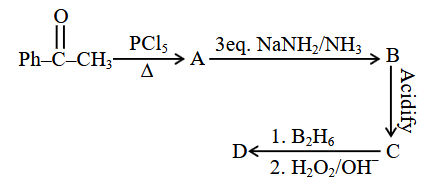
Identify the structure of the final product (D) in the following sequence of reactions: Total number of sp2 hybridised carbon atoms in product D is _____.
To determine the number of sp2 hybridized carbon atoms \in product D, we analyze the structure of compound A and its subsequent reactions. After the reactions with NaNH2 and B2H6, the resulting structure D will retain a number of carbons \in the sp2 state, typically associated with double bonds or aromatic systems. In this case, compound D will have 7 carbons that are sp2 hybridized due to the presence of benzene and additional carbon fragments formed during the reactions.
[CORRECT_OPTION: C]
Mathematics25 questions
Q51JEE Main 2025MCQ4MStraight Lines and Pair of Straight Lines
If the orthocentre of the triangle formed by the lines y=x+1, y=4x−8 and y=mx+c is at (3,−1), then m−c is :
The three sides of the triangle are L1:y=x+1(m1=1),L2:y=4x−8(m2=4),L3:y=mx+c(m3=m). Their orthocentre is given to be H(3,−1). Step 1: Find the vertex opposite to L3. Intersect L1 and L2: x+1=4x−8⟹3x=9⟹x=3,y=3+1=4. Hence C(3,4). Vertex C is opposite the side L3. Step 2: Use the orthocentre to obtain the slope of L3. Altitude through C must pass through H(3,−1). Slope of CH is 3−3−1−4=0−5⟹vertical line x=3. Therefore L3, being perpendicular to this altitude, must be horizontal: m=0⟹L3:y=c. Step 3: Express the remaining two vertices \in terms of c. Intersection of L1 with L3 gives y=c=x+1⟹B(c−1,c). Intersection of L2 with L3 gives y=c=4x−8⟹x=4c+8, so A(4c+8,c). Step 4: Use the altitude from A to determine c. Slope of side BC is 3−(c−1)4−c=4−c4−c=1. Hence the altitude from A is perpendicular to BC, so its slope is −1. Equation of the altitude passing through the orthocentre H(3,−1) is y+1=−1(x−3)⟹y=−x+2. This altitude must also pass through A: c=−4c+8+2. Multiply by 4: 4c=−(c+8)+8=−c. Therefore 5c=0⟹c=0. Step 5: Compute m−c. We have m=0 and c=0, hence m−c=0−0=0. Thus m−c=0. Option A is correct.
Q52JEE Main 2025MCQ4MVector Algebra
Let a and b be the vectors of the same magnitude such that ∣a+b∣−∣a−b∣∣a+b∣+∣a−b∣=2+1. Then ∣a∣2∣a+b∣2 is :
Let the common magnitude of the two vectors be ∣a∣=∣b∣=m and let the angle between them be θ. Using the cosine rule for vectors: ∣a+b∣=m2+m2+2m2cosθ=m2(1+cosθ)∣a−b∣=m2+m2−2m2cosθ=m2(1−cosθ) Rewrite these with the half-angle substitution θ=2x (so x=θ/2): ∣a+b∣=2mcosx∣a−b∣=2msinx The given ratio becomes ∣a+b∣−∣a−b∣∣a+b∣+∣a−b∣=2m(cosx−sinx)2m(cosx+sinx)=cosx−sinxcosx+sinx This ratio equals 2+1, hence cosx−sinxcosx+sinx=2+1−(1) Cross-multiplying \in (1): cosx+sinx=(2+1)(cosx−sinx)cosx+sinx−(2+1)cosx+(2+1)sinx=0cosx(1−2−1)+sinx(1+2+1)=0cosx(−2)+sinx(2+2)=0tanx=2+22−(2) The quantity required is ∣a∣2∣a+b∣2=m2(2mcosx)2=4cos2x−(3) From (2), set tanx=t=2+22. Then cos2x=1+t21 Compute t2: t2=(2+2)22=6+422=3+221 Hence 1+t2=1+3+221=3+224+22 Insert this into (3): 4cos2x=1+t24=4⋅4+223+22=4+2212+82=2+26+42=2+2 Therefore, ∣a∣2∣a+b∣2=2+2 The correct choice is Option C .
Q53JEE Main 2025MCQ4MSets and Relations
Let A={(α,β)∈R×R:∣α−1∣≤4 and ∣β−5∣≤6} and B={(α,β)∈R×R:16(α−2)2+9(β−6)2≤144}. Then
Set A defines a rectangle with corners at (−3,−1), (−3,11), (7,−1), and (7,11). Set B represents an ellipse centered at (2,6) with semi-major axis 3 and semi-minor axis 4. The rectangle fully encompasses the ellipse. Hence, B⊂A is incorrect, while A⊂B is also incorrect since the rectangle exceeds the ellipse bounds in multiple directions. Thus, neither A⊂B nor B⊂A holds true.
[CORRECT_OPTION: C]
Q54JEE Main 2025MCQ4MFunctions
If the range of the function f(x)=x2−3x+25−x, x=1,2, is (−∞,α]∪[β,∞), then α2+β2 is equal to :
Let the given function be y=f(x)=x2−3x+25−x, where x=1,2 because the denominator x2−3x+2=(x−1)(x−2) vanishes at these points. To find the range we eliminate x. Cross-multiply: y(x2−3x+2)=5−x Rearrange into a quadratic \in x: yx2−3yx+2y+x−5=0 Group like terms: yx2+(−3y+1)x+(2y−5)=0−(1) For a given real y to lie \in the range, equation (1) must have at least one real root x that is different from 1 and 2. The first requirement is that its discriminant is non-negative. Discriminant Δ of (1): Δ=(−3y+1)2−4y(2y−5) Simplify: Δ=9y2−6y+1−8y2+20y=y2+14y+1 Thus real roots exist when y2+14y+1≥0−(2) Factor (2) by finding its roots. Solve y2+14y+1=0 Roots: y=2−14±142−4⋅1⋅1=2−14±196−4=2−14±192=−7±43 Denote α=−7−43,β=−7+43 Since the coefficient of y2 \in (2) is positive, the inequality Δ≥0 holds outside the interval formed by these roots: y≤αory≥β Hence the range is (−∞,α]∪[β,∞) as stated. Now compute α2+β2. For the quadratic y2+14y+1=0: Sum of roots α+β=−14 Product of roots αβ=1 Use the identity α2+β2=(α+β)2−2αβ: α2+β2=(−14)2−2⋅1=196−2=194 Therefore, α2+β2=194. Answer: Option D
Q55JEE Main 2025MCQ4MProbability
A bag contains 19 unbiased coins and one coin with head on both sides. One coin drawn at random is tossed and head turns up. If the probability that the drawn coin was unbiased, is nm, gcd(m,n)=1, then n2−m2 is equal to :
Let U : the drawn coin is unbiased (ordinary coin) D : the drawn coin is double-headed H : head turns up on the toss Bayes' theorem states P(U∣H)=P(U)P(H∣U)+P(D)P(H∣D)P(U)P(H∣U)−(1) Step 1: Prior probabilities of choosing a coin There are 20 coins \in all (19 unbiased + 1 double-headed). P(U)=2019,P(D)=201 Step 2: Probabilities of getting head from each type For an unbiased coin, head appears with probability 21: P(H∣U)=21. For a double-headed coin, head always appears: P(H∣D)=1. Step 3: Use Bayes' theorem Substituting the values into (1): P(U∣H)=2019×21+201×12019×21 Simplify numerator and denominator separately: Numerator =2019×21=4019 Denominator =4019+201=4019+402=4021 Hence P(U∣H)=40214019=2119 Step 4: Identify m and n The required probability is nm=2119 with gcd(19,21)=1, so m=19 and n=21. Step 5: Compute n2−m2n2−m2=212−192=(21−19)(21+19)=2×40=80 Therefore, n2−m2=80. Option A is correct.
Q56JEE Main 2025MCQ4MProbability
Let a random variable X take values 0, 1, 2, 3 with P(X=0)=P(X=1)=p, P(X=2)=P(X=3)=q and E(X2)=2E(X). Then the value of 8p−1 is :
The random variable X can take four values, so we write its probability distribution: P(X=0)=p,P(X=1)=p,P(X=2)=q,P(X=3)=q. Step 1: Use the fact that total probability equals 1. 2p+2q=1−(1) Step 2: Compute the expected value E(X). Formula: E(X)=∑xiP(X=xi).E(X)=0⋅p+1⋅p+2⋅q+3⋅q=p+5q.−(2) Step 3: Compute the second moment E(X2). Formula: E(X2)=∑xi2P(X=xi).E(X2)=02⋅p+12⋅p+22⋅q+32⋅q=p+13q.−(3) Step 4: Apply the given condition E(X2)=2E(X). Using (2) and (3): p+13q=2(p+5q). Simplify: p+13q=2p+10q0=2p+10q−p−13q=p−3q⇒p=3q.−(4) Step 5: Solve for p and q with (1) and (4). Substitute p=3q into (1):2(3q)+2q=16q+2q=18q=1⇒q=81. Then from (4):p=3q=3×81=83. Step 6: Evaluate the required expression 8p−1./> 8p−1=8×83−1=3−1=2. Hence 8p−1=2, which corresponds to Option B.
Q57JEE Main 2025MCQ4MArea Under The Curves
If the area of the region {(x,y):1+x2≤y≤min{x+7,11−3x}} is A, then 3A is equal to
The region is defined by the inequalities 1+x2≤y≤min{x+7,11−3x} First compare the two straight lines to find which is smaller at a given x. Set x+7=11−3x to locate their intersection: 4x=4⟹x=1,y=8 Therefore Case 1: x≤1 gives x+7<11−3x, so the upper curve is y=x+7. Case 2: x≥1 gives x+7>11−3x, so the upper curve is y=11−3x. The lower curve is always y=1+x2. To obtain the x-range where the region exists, ensure 1+x2≤(upper curve) \in each case. Case 1: x≤1 Require 1+x2≤x+7⟹x2−x−6≤0⟹(x−3)(x+2)≤0⟹−2≤x≤3. Combining with x≤1 gives −2≤x≤1. Case 2: x≥1 Require 1+x2≤11−3x⟹x2+3x−10≤0⟹(x+5)(x−2)≤0⟹−5≤x≤2. Combining with x≥1 gives 1≤x≤2. Hence the complete x-interval for the region is −2≤x≤2, divided at x=1. The area A is the \sum of two integrals. For −2≤x≤1 Upper curve: x+7, lower curve: 1+x2. Area part A1: A_{1} = \int_{-2}^{1} \big\$[(x+7) - (1+x^{2})\big]\$\;dx = \int_{-2}^{1} \big(-x^{2}+x+6\big)\;dx Integrate term-by-term: ∫(−x2)dx=−3x3,∫xdx=2x2,∫6dx=6x Evaluate from x=−2 to x=1: At x=1: −31+21+6=637 At x=−2: 38+2−12=−322 Thus A1=637−(−322)=637+644=681=227 For 1≤x≤2 Upper curve: 11−3x, lower curve: 1+x2. Area part A2: A_{2} = \int_{1}^{2} \big\$[(11-3x) - (1+x^{2})\big]\$\;dx = \int_{1}^{2} \big(-x^{2}-3x+10\big)\;dx Integrate term-by-term: ∫(−x2)dx=−3x3,∫(−3x)dx=−23x2,∫10dx=10x Evaluate from x=1 to x=2: At x=2: −38−6+20=334 At x=1: −31−23+10=649 Thus A2=334−649=668−649=619 Total area: A=A1+A2=227+619=681+619=6100=350 The question asks for 3A: 3A=3×350=50 Therefore, 3A=50, which corresponds to Option A .
Q58JEE Main 2025MCQ4MApplication of Derivatives
Let f:R→R be a polynomial function of degree four having extreme values at x=4 and x=5. If limx→0x2f(x)=5, then f(2) is equal to :
The limit limx→0x2f(x)=5 means that near x=0 the polynomial behaves like 5x2. Therefore x2 must be a factor of f(x) and the remaining factor must equal 5 at x=0. Write f(x)=x2g(x) where g(x) is a quadratic: g(x)=ax2+bx+5. Hence f(x)=ax4+bx3+5x2−(1) Differentiate to locate stationary points: f′(x)=4ax3+3bx2+10x−(2) The extreme values occur at x=4 and x=5, so f′(4)=0,f′(5)=0−(3) Substitute x=4 into (2): 4a(4)3+3b(4)2+10(4)=0256a+48b+40=0−(4) Substitute x=5 into (2): 4a(5)3+3b(5)2+10(5)=0500a+75b+50=0−(5) Solve the linear system (4),(5). Multiply (4) by 75 and (5) by 48 to eliminate b: 19200a+3600b=−300024000a+3600b=−2400 Subtract the first from the second: (24000−19200)a=600⟹4800a=600⟹a=81 Insert a=81 into (4): 256(81)+48b+40=032+48b+40=048b=−72⟹b=−23 Now evaluate f(2) using (1): f(2)=22(a⋅22+b⋅2+5)=4(a⋅4+2b+5) Insert a=81,b=−23: a⋅4=21,2b=−3a⋅4+2b+5=21−3+5=25 Therefore f(2)=4(25)=10. Hence f(2)=10, which matches Option B .
Q59JEE Main 2025MCQ4MTrigonometric Ratios and Identities
The number of solutions of the equation cos2θcos2θ+cos25θ=2cos325θ \in [−2π,2π] is :
The given equation is cos2θcos2θ+cos25θ=2cos325θ,θ∈[−2π,2π]. Put t=2θ. Then θ=2t and the interval becomes t∈[−4π,4π]. The equation turns into cos4tcost+cos5t=2cos35t−(1). Use the product-to-\sum identity cosAcosB=21[cos(A+B)+cos(A−B)] on the first term: cos4tcost=21[cos(4t+t)+cos(4t−t)]=21[cos5t+cos3t]. Substitute this \in (1):21[cos5t+cos3t]+cos5t=2cos35t. Combine like terms: (21+1)cos5t+21cos3t=2cos35t,23cos5t+21cos3t=2cos35t. Multiply by 2:3cos5t+cos3t=4cos35t−(2). Recall the triple-angle identity cos3x=4cos3x−3cosx, which can be rearranged as 4cos3x=cos3x+3cosx. Putting x=5t gives 4cos35t=cos15t+3cos5t. Replace the right side of (2) with this expression: 3cos5t+cos3t=cos15t+3cos5t. The terms 3cos5t cancel, leaving the simple equation cos3t=cos15t−(3). For cosα=cosβ, the solutions are α=2kπ±β,k∈Z. Apply this to (3): Case 1: 3t=2kπ+15t⟹−12t=2kπ⟹t=−6kπ. With t∈[−4π,4π], choose integers k so that −6kπ lies \in the interval. \bullet k=0:t=0 \bullet k=1:t=−6π \bullet k=−1:t=6π Further ∣k∣≥2 gives ∣t∣>π/4, so they are rejected. Thus Case 1 contributes t=−6π,0,6π. Case 2: 3t=2kπ−15t⟹18t=2kπ⟹t=9kπ. Again keep the values inside [−4π,4π]: \bullet k=0:t=0 (already counted) \bullet k=±1:t=±9π \bullet k=±2:t=±92π \bullet ∣k∣≥3 violates the interval. Case 2 contributes t=−92π,−9π,0,9π,92π. Collecting distinct solutions of t inside the interval: t=−92π,−6π,−9π,0,9π,6π,92π. Thus there are 7 valid t values. Since θ=2t, each t gives a unique θ \in the original interval [−2π,2π], so the number of solutions for θ is also 7. Hence, the correct option is Option A (7) .
Q60JEE Main 2025MCQ4MSequences and Series
Let an be the nth term of an A.P. If Sn=a1+a2+a3+…+an=700, a6=7 and S7=7, then an is equal to :
For an arithmetic progression (A.P.) let the first term be a and the common difference be d. Then the nth term is an=a+(n−1)d and the \sum of the first n terms is Sn=2n[2a+(n−1)d]. We are given three pieces of information: \bullet a6=7 \bullet S7=7 \bullet Sn=700 for some positive integer n. Step 1: Use a6=7. a6=a+5d=7−(1) Step 2: Use S7=7. S7=27[2a+6d]=7 Divide both sides by 7: 21[2a+6d]=1⟹2a+6d=2 Simplify: a+3d=1−(2) Step 3: Solve equations (1) and (2) for a and d. Subtract (2) from (1): (a+5d)−(a+3d)=7−1⟹2d=6⟹d=3 Substitute d=3 into (1): a+5(3)=7⟹a+15=7⟹a=−8 Step 4: Find n such that Sn=700. Sn=2n[2a+(n−1)d] Insert a=−8 and d=3: Sn=2n[2(−8)+(n−1)3]=2n[−16+3n−3]=2n(3n−19) Set this equal to 700: 2n(3n−19)=700⟹n(3n−19)=1400 This is a quadratic: 3n2−19n−1400=0 Compute the discriminant: Δ=(−19)2−4(3)(−1400)=361+16800=17161 Since 17161=1312, the roots are n=2×319±131 Taking the positive root: n=6150=25 (Discard the negative root as n must be positive.) Step 5: Find a25. a25=a+24d=−8+24×3=−8+72=64 Therefore, a25=64. This matches Option C.
Q61JEE Main 2025MCQ4MCircle
If the locus of z∈C, such that Re(2z+iz−1)+Re(2zˉ−izˉ−1)=2, is a circle of radius r and center (a,b) then r215ab is equal to :
Let z=x+iy, where x,y∈R. Define w=2z+iz−1. Its complex conjugate is \overline{w}= \dfrac{\bar z-1}{2\bar z-i}\,.$ The given condition is $$$$\text{Re}!\left(w\right)+Re!\left(\overline{w}$$$$\right)=2.Foranycomplexnumberw, $$$$\text{Re}(w)=Re(w).Therefore2,Re(w)=2 ;\Longrightarrow; Re(w)=1.Henceweneedthelocusofz satisfying $$$$\text{Re}!\left(\dfrac{z-1}{2z+i}\right)=1.Writenumeratoranddenominator∈termsofx, y:z-1=(x-1)+iy,2z+i=2x+i(2y+1).Multiplybytheconjugateofthedenominatortoextracttherealpart:\dfrac{z-1}{2z+i}= \dfrac{(x-1)+iy}{2x+i(2y+1)}; ⋅\dfrac{2x-i(2y+1)}{2x-i(2y+1)}.Denominatormagnitudesquared:D=(2x)^{2+}(2y+1)^2=4x^{2+}(2y+1)^2.Numeratorproduct:;(x-1)+iy⋅2x-i(2y+1)givesRealpartR=2x(x-1)+y(2y+1)=2x^{2-}2x+2y^{2+}y. Thus $$$$\text{Re}!\left(\dfrac{z-1}{2z+i}\right)=\dfrac{R}{D}=1 ;\Longrightarrow; R=D.Equateandrearrange:2x^{2-}2x+2y^{2+}y =4x^{2+}4y^{2+}4y+1,0=2x^{2+}2y^{2+}2x+3y+1.Divideby2forsimplicity:x^{2+}y^{2+}x+\dfrac{3}{2}y+\dfrac{1}{2}=0.Completethesquares:x^{2+}x=\left(x+\dfrac{1}{2}\right)^{2-}\dfrac{1}{4},y^{2+}\dfrac{3}{2}y=\left(y+\dfrac{3}{4}\right)^{2-}\left(\dfrac{3}{4}\right)^2. Substitute: $$$$\left(x+\dfrac{1}{2}\right)^{2-}\dfrac{1}{4} +\left(y+\dfrac{3}{4}\right)^{2-}\dfrac{9}{16} +\dfrac{1}{2}=0.Combineconstants:-\dfrac{1}{4}-\dfrac{9}{16}+\dfrac{1}{2} =-\dfrac{5}{16}. Move to the right side: $$$$\left(x+\dfrac{1}{2}\right)^{2+}\left(y+\dfrac{3}{4}\right)^2 =\dfrac{5}{16}.Hencethelocusisacirclewithcenter\bigl(a,b\bigr)=\left(-\dfrac{1}{2},,-\dfrac{3}{4}\right),radiusr=\sqrt{\dfrac{5}{16}}=\dfrac{5}{4},sor^{2}=\dfrac{5}{16}.Nowevaluate\dfrac{15ab}{r^{2}}.ab=\left(-\dfrac{1}{2}\right)!\left(-\dfrac{3}{4}\right)=\dfrac{3}{8},\dfrac{15ab}{r^{2}}=\dfrac{15\cdot$$$$\frac{3}{8}}{165} =\dfrac{45}{8}⋅\dfrac{16}{5}=18.Therequiredvalueis18$$, which corresponds to Option C.
Q62JEE Main 2025MCQ4MEllipse
Let the length of a latus rectum of an ellipse a2x2+b2y2=1 be 10. If its eccentricity is the minimum value of the function f(t)=t2+t+1211, t∈R, then a2+b2 is equal to :
The standard equation of an ellipse with its major axis along the x-axis is a2x2+b2y2=1, where a>b>0 and its eccentricity is e. 1. Length of the latus-rectum (the chord through a focus perpendicular to the major axis) is Latus rectum=a2b2. 2. The eccentricity and the semi-axes satisfy the relation b2=a2(1−e2)−(1). 3. We are given that the length of the latus-rectum equals 10: a2b2=10−(2). 4. The eccentricity e is the minimum value of the quadratic function f(t)=t2+t+1211,t∈R. The minimum of a quadratic At2+Bt+C with A>0 occurs at t=−2AB. Here A=1,B=1,C=1211, so the minimising value of t is t=−21. Substituting back gives the minimum value (and hence the eccentricity): e=f(−21)=(−21)2+(−21)+1211=41−21+1211=41−42+1211=−41+1211=12−3+1211=128=32. Thus e=32 and e2=94. 5. Using equation (1): b2=a2(1−94)=a2(95)=95a2−(3). 6. Insert (3) into the latus-rectum condition (2): a2(95a2)=10⟹910a=10⟹a=1010×9=9. Therefore a2=92=81. 7. Find b2 from (3): b2=95a2=95×81=5×9=45. 8. Finally, a2+b2=81+45=126. Hence a2+b2=126. The correct option is Option B.
Q63JEE Main 2025MCQ4MDifferential Equations
Let y=y(x) be the solution of the differential equation (x2+1)y′−2xy=(x4+2x2+1)cosx, y(0)=1. Then ∫−33y(x)dx is :
The given differential equation is(x2+1)y′−2xy=(x4+2x2+1)cosx,y(0)=1 Step 1: Write it \in standard linear form y′+P(x)y=Q(x). Divide by (x2+1):y′−x2+12xy=x2+1x4+2x2+1cosx. Notice that x4+2x2+1=(x2+1)2, so the right-hand side simplifies to(x2+1)cosx. Thusy′−x2+12xy=(x2+1)cosx−(1) Step 2: Find the integrating factor (I.F.). For y′+P(x)y=Q(x), I.F. is e∫P(x)dx. Here P(x)=−x2+12x. ThereforeI.F.=e∫−x2+12xdx=e−ln(x2+1)=x2+11. Step 3: Multiply equation −(1) by the I.F. x2+11y′−(x2+1)22xy=cosx The left side is the derivative of x2+1y because dxd(x2+1y)=(x2+1)2y′(x2+1)−y(2x)=x2+11y′−(x2+1)22xy. Hencedxd(x2+1y)=cosx.(Integrate) Step 4: Integrate both sides. x2+1y=∫cosxdx=sinx+C Thereforey(x)=(x2+1)(sinx+C). Step 5: Apply the initial condition y(0)=1. At x=0, 1=(02+1)(sin0+C)=1⋅(0+C)=C. So C=1. Hence the required solution isy(x)=(x2+1)(sinx+1). Step 6: Evaluate ∫−33y(x)dx.∫−33y(x)dx=∫−33(x2+1)(sinx+1)dx=∫−33(x2+1)sinxdx+∫−33(x2+1)dx−(2) Case 1: ∫−33(x2+1)sinxdx(x2+1) is even, sinx is odd ⟹ their product is odd. The integral of an odd function over [−a,a] is 0. So this part contributes 0. Case 2: ∫−33(x2+1)dx=∫−33x2dx+∫−331dx Even function property: ∫−33x2dx=2∫03x2dx=2[3x3]03=2⋅327=18. Constant term: ∫−331dx=6. Therefore the second integral equals 18+6=24. Combining both cases \in −(2): ∫−33y(x)dx=0+24=24. Thus the value of ∫−33y(x)dx is 24, which corresponds to Option A .
Q64JEE Main 2025MCQ4MThree Dimensional Geometry
If the equation of the line passing through the point (0,−21,0) and perpendicular to the lines r=λ(i^+aj^+bk^) and r=(i^−j^−6k^)+μ(−bi^+aj^+5k^) is −2x−1=dy+4=−4z−c, then a+b+c+d is equal to :
Let the required line be denoted by L. Its symmetric form is given \in the question as −2x−1=dy+4=−4z−c. Therefore, \bullet a point on L is A(1,−4,c), \bullet its direction vector is n=(−2,d,−4). The line L is perpendicular to both of the following lines: L1:r=λ(i^+aj^+bk^)⟹direction vector v1=(1,a,b)L2:r=(i^−j^−6k^)+μ(−bi^+aj^+5k^)⟹direction vector v2=(−b,a,5) Because L is perpendicular to L1 and L2, n⋅v1=0andn⋅v2=0. Compute each dot product: 1. n⋅v1=(−2,d,−4)⋅(1,a,b)=−2+da−4b=0⟹da−4b=2−(1) 2. n⋅v2=(−2,d,−4)⋅(−b,a,5)=2b+da−20=0⟹da+2b=20−(2) The required line L must also pass through the point P(0,−21,0) given \in the statement. Let the common ratio \in the symmetric form be t. Using point A(1,−4,c) and direction n, the parametric equations of L are x=1−2t,y=−4+dt,z=c−4t. Insert point P: 1−2t=0⟹t=21−4+dt=−21⟹d(21)=27⟹d=7c−4t=0⟹c−4(21)=0⟹c=2 Substitute d=7 into equations (1) and (2): From (1):7a−4b=2 From (2):7a+2b=20 Solve the simultaneous equations: Add the two equations: (7a+2b)+(7a−4b)=20+2⟹14a−2b=22−(3) Subtract (1) from (2):(7a+2b)−(7a−4b)=20−2⟹6b=18⟹b=3 Insert b=3 into (1):7a−12=2⟹7a=14⟹a=2 Now we have a=2,b=3,c=2,d=7. Finally, a+b+c+d=2+3+2+7=14. Hence, the value of a+b+c+d is 14, which matches Option B.
Q65JEE Main 2025MCQ4MEllipse
Let p be the number of all triangles that can be formed by joining the vertices of a regular polygon P of n sides and q be the number of all quadrilaterals that can be formed by joining the vertices of P. If p+q=126, then the eccentricity of the ellipse 16x2+ny2=1 is :
The number of triangles that can be formed from the vertices of a regular n-gon is the number of ways of choosing any 3 vertices: p=nC3=6n(n−1)(n−2) The number of quadrilaterals is the number of ways of choosing any 4 vertices: q=nC4=24n(n−1)(n−2)(n−3) We are told that p+q=126 Substituting the expressions for p and q: 6n(n−1)(n−2)+24n(n−1)(n−2)(n−3)=126 Multiply every term by 24 to clear denominators: 4n(n−1)(n−2)+n(n−1)(n−2)(n−3)=3024 Factor out n(n−1)(n−2): n(n−1)(n−2)[4+(n−3)]=3024 Simplify the bracket: n(n−1)(n−2)(n+1)=3024 Try successive integer values of n≥4 until the product equals 3024. Case 6: 6⋅5⋅4⋅7=840<3024 Case 7: 7⋅6⋅5⋅8=1680<3024 Case 8: 8⋅7⋅6⋅9=3024 - match found. Hence n=8. The ellipse given is 16x2+ny2=1⟹16x2+8y2=1 because n=8. For an ellipse a2x2+b2y2=1 with a2>b2, the eccentricity is e=1−a2b2 Here a2=16,b2=8, so e=1−168=21=21 Therefore the required eccentricity is 21, which corresponds to Option D.
Q66JEE Main 2025MCQ4MThree Dimensional Geometry
Consider the lines L1:x−1=y−2=z and L2:x−2=y=z−1. Let the feet of the perpendiculars from the point P(5,1,−3) on the lines L1 and L2 be Q and R respectively. If the area of the triangle PQR is A, then 4A2 is equal to :
The symmetric form of L1 is x−1=y−2=z=λ, so a convenient point on L1 is A1(1,2,0) and the direction vector is v=⟨1,1,1⟩. For a point P(x0,y0,z0), the foot of the perpendicular Q on a line through A1 with direction v is given by Q=A1+∣v∣2(P−A1)⋅vv−(1). Here P(5,1,−3) and A1(1,2,0), so P−A1=⟨4,−1,−3⟩ and(P−A1)⋅v=4+(−1)+(−3)=0. Using (1) with numerator 0 gives Q=A1=(1,2,0). Thus Q(1,2,0). The symmetric form of L2 is x−2=y=z−1=μ, so a point on L2 is A2(2,0,1) with the same direction v=⟨1,1,1⟩. Applying −(1) to L2: P−A2=⟨3,1,−4⟩ and(P−A2)⋅v=3+1+(−4)=0. Hence R=A2=(2,0,1). Thus R(2,0,1). Compute the vectors of the sides of △PQR: PQ=Q−P=⟨−4,1,3⟩,PR=R−P=⟨−3,−1,4⟩. The area of a triangle whose sides are a and b is 21∣a×b∣. First find the cross product: PQ×PR=i−4−3j1−1k34=i(1⋅4−3⋅(−1))−j((−4)⋅4−3⋅(−3))+k((−4)⋅(−1)−1⋅(−3))=i(4+3)−j(−16+9)+k(4+3)=⟨7,7,7⟩. Magnitude of the cross product:∣⟨7,7,7⟩∣=72+72+72=147=73. Therefore, the area of △PQR is A=21(73)=273. Finally, 4A2=4(273)2=4(449⋅3)=147. Hence 4A2=147, which corresponds to Option B .
Q67JEE Main 2025MCQ4MFunctions
The number of real roots of the equation x∣x−2∣+3∣x−3∣+1=0 is :
First split the real line at the points where the absolute-value expressions change their form, i.e. at x=2 and x=3. This gives three disjoint intervals: Case 1: x<2 Here ∣x−2∣=2−x and ∣x−3∣=3−x. The equation becomes x(2−x)+3(3−x)+1=0⇒2x−x2+9−3x+1=0⇒−x2−x+10=0⇒x2+x−10=0−(1) Using the quadratic formula on (1): x=2−1±1+40=2−1±41 Numerically, 2−1−41≈−3.70 and 2−1+41≈2.70. Only the first value satisfies x<2. Hence Case 1 contributes exactly one real root: x=2−1−41. Case 2: 2≤x<3 Here ∣x−2∣=x−2 and ∣x−3∣=3−x. The equation becomes x(x−2)+3(3−x)+1=0⇒x2−2x+9−3x+1=0⇒x2−5x+10=0−(2) For (2), the discriminant is Δ=(−5)2−4(1)(10)=25−40=−15<0, so there are no real roots \in Case 2. Case 3: x≥3 Here ∣x−2∣=x−2 and ∣x−3∣=x−3. The equation becomes x(x−2)+3(x−3)+1=0⇒x2−2x+3x−9+1=0⇒x2+x−8=0−(3) For (3), the roots are x=2−1±1+32=2−1±33. The positive root is 2−1+33≈2.37, which is less than 3, and the negative root is even smaller. Hence neither root lies \in the interval x≥3, so Case 3 contributes no real roots. Combining all three cases, only one value of x satisfies the given equation. Therefore the total number of real roots is 1, corresponding to Option C .
Q68JEE Main 2025MCQ4MEllipse
Let e1 and e2 be the eccentricities of the ellipse b2x2+25y2=1 and the hyperbola 16x2−b2y2=1, respectively. If b<5 and e1e2=1, then the eccentricity of the ellipse having its axes along the coordinate axes and passing through all four foci (two of the ellipse and two of the hyperbola) is :
For the first ellipse b2x2+25y2=1 the larger denominator is 25, so the semi-major axis length is a1=5 and the semi-minor axis length is b1=b. Eccentricity of an ellipse is given by e=1−a2b2. Hence e1=1−25b2−(1) For the hyperbola 16x2−b2y2=1 the semi-transverse axis is a2=4 and the semi-conjugate axis is b2=b. Eccentricity of a hyperbola is given by e=1+a2b2. Hence e2=1+16b2−(2) Given e1e2=1. Substituting from (1) and (2): 1−25b21+16b2=1 Squaring both sides: (1−25b2)(1+16b2)=1 Expanding and simplifying: 1+16b2−25b2−400b4=116b2−25b2−400b4=0b2(161−251)−400b4=0b2(4009)−400b4=0400b2(9−b2)=0 Since b=0, we get b2=9⇒b=3(given b<5). Now compute the four focal points: Case 1: Ellipse Eccentricity e1=1−259=54. Distance of each focus from the centre: c1=a1e1=5(54)=4. Ellipse foci: (0,±4). Case 2: Hyperbola Eccentricity e2=1+169=45. Distance of each focus from the centre: c2=a2e2=4(45)=5. Hyperbola foci: (±5,0). The required ellipse has its axes along the coordinate axes and must pass through all four foci (±5,0),(0,±4). Take its equation as A2x2+B2y2=1. Substituting point (5,0):A225=1⇒A2=25⇒A=5. Substituting point (0,4):B216=1⇒B2=16⇒B=4. Thus the ellipse is 25x2+16y2=1 with semi-major axis a=5 and semi-minor axis b=4 (since 25>16). Eccentricity of this ellipse is e=1−a2b2=1−2516=259=53. Therefore, the required eccentricity is 53. Option B is correct.
Q69JEE Main 2025MCQ4MMatrices and Determinants
Let the system of equations x+5y−z=1, 4x+3y−3z=7, 24x+y+λz=μ, λ,μ∈R, have infinitely many solutions. Then the number of the solutions of this system, if x, y, z are integers and satisfy 7≤x+y+z≤77, is
$ For infinitely many solutions the three equations must be dependent, i.e. equation (3) must be a linear combination of (1) and (2) with the same combination on the right-hand sides. Let α,β be real numbers such that α(x+5y−z)+β(4x+3y−3z)=24x+y+λz−(4) Matching the coefficients of x,y,z \in (4) gives
$
α+4β5α+3β−α−3β=24−(5)=1−(6)=λ−(7)
$ Solving (5) and (6): Multiply (5) by 5 \Rightarrow 5α+20β=120. Subtract (6) \Rightarrow 17β=119⇒β=7. From (5) \Rightarrow α=24−4β=24−28=−4. Then (7) gives λ=(−α−3β)=4−21=−17. The right-hand side of (3) must also match: μ=α⋅1+β⋅7=(−4)⋅1+7⋅7=−4+49=45. Hence infinitely many solutions occur only for λ=−17,μ=45. With these values, equation (3) is redundant and the system reduces to (1)(2). Solve it parametrically. From (1): x=1−5y+z−(8). Substitute (8) \in (2): 4(1−5y+z)+3y−3z=74−20y+4z+3y−3z=74−17y+z=7⇒z=3+17y−(9). Insert (9) into (8): x=1−5y+(3+17y)=4+12y−(10). Let y=t (any integer). Then x=4+12t,y=t,z=3+17t−(11) The required condition is 7≤x+y+z≤77. Using (11): x+y+z=(4+12t)+t+(3+17t)=7+30t. So 7≤7+30t≤77⟹0≤30t≤70⇒0≤t≤3070=37. Since t is an integer, t=0,1,2. Thus there are 3 integer triples (x,y,z) satisfying all the given conditions. Hence the correct option is Option A (3) .
Q70JEE Main 2025MCQ4MSequences and Series
If the sum of the second, fourth and sixth terms of a G.P. of positive terms is 21 and the sum of its eighth, tenth and twelfth terms is 15309, then the sum of its first nine terms is :
Let the first term of the G.P. be a and the common ratio be r, where a>0 and r>0. The nth term is Tn=arn−1. The second, fourth and sixth terms are T2=ar,T4=ar3,T6=ar5. Their \sum is given to be 21, so ar+ar3+ar5=21. Factor out ar: ar(1+r2+r4)=21−(1) The eighth, tenth and twelfth terms are T8=ar7,T10=ar9,T12=ar11. Their \sum is given to be 15309, so ar7+ar9+ar11=15309. Factor out ar7: ar7(1+r2+r4)=15309−(2) Both (1) and (2) contain the common factor (1+r2+r4). Divide (2) by (1): ar(1+r2+r4)ar7(1+r2+r4)=2115309r6=729 Since 729=36 and r>0, we obtain r=3. Compute 1+r2+r4: 1+32+34=1+9+81=91. Substitute r=3 into (1) to find a: a(3)(91)=21273a=21a=27321=131. The \sum of the first nine terms of a G.P. with r=1 is S9=ar−1r9−1. Substitute a=131 and r=3: S9=1313−139−1. Calculate 39: 39=19683. Therefore S9=131219683−1=131219682=2619682=757. Hence, the \sum of the first nine terms is 757. Option D is correct.
Q71JEE Main 2025NAT4MFunctions
If the function f(x)=tanx−sinxtan(tanx)−sin(sinx) is continuous at x=0, then f(0) is equal to _____.
We have to evaluate the limit limx→0tanx−sinxtan(tanx)−sin(sinx) because, for continuity at x=0, the value f(0) must equal this limit. Step 1: Expand tanx and sinx about x=0 up to the order x3. tanx=x+3x3+O(x5)sinx=x−6x3+O(x5) Step 2: Denote A=tanx,B=sinx. Using the results from Step 1, A−B=(x+3x3)−(x−6x3)+O(x5)=2x3+O(x5). Step 3: Expand tanA and sinB for small arguments A,B. For any small y, tany=y+3y3+O(y5),siny=y−6y3+O(y5). Applying these with y=A and y=B: tan(tanx)=tanA=A+3A3+O(x5),sin(sinx)=sinB=B−6B3+O(x5). Step 4: Form the numerator. tanA−sinB=(A−B)+(3A3+6B3)+O(x5). Because A=x+O(x3) and B=x+O(x3), we have A3=x3+O(x5) and B3=x3+O(x5). Hence 3A3+6B3=3x3+6x3+O(x5)=2x3+O(x5). Therefore tanA−sinB=(2x3)+(2x3)+O(x5)=x3+O(x5). Step 5: Form the denominator (already obtained \in Step 2): tanx−sinx=2x3+O(x5). Step 6: Take the ratio and pass to the limit: tanx−sinxtan(tanx)−sin(sinx)=2x3+O(x5)x3+O(x5)=2x3[1+O(x2)]$x3[1+O(x2)]$=2⋅1+O(x2)1+O(x2). As x→0, the terms O(x2) vanish, giving limx→0tanx−sinxtan(tanx)−sin(sinx)=2. Hence, to make f(x) continuous at x=0, we must define f(0)=2. Answer: f(0)=2.
Q72JEE Main 2025NAT4MIndefinite Integrals
If ∫(x1+x31)(233x−24+x−26)dx=−3(α+1)α(3xβ+xγ)αα+1+C, x>0, (α,β,γ∈Z), where C is the constant of integration, then α+β+γ is equal to _____.
We begin with the given integrand I=(x1+x31)(3x−24+x−26)231,x>0. The powers inside the radical differ by 2, so take out the larger common power x−23 from the second bracket: 3x−24+x−26=x−23(3x−1+x−3). Using (x−23)231=x−1, the radical becomes (3x−24+x−26)231=x−1(3x−1+x−3)231. Substituting this back \in I gives I=(x1+x31)x−1(3x−1+x−3)231=(x21+x41)(3x−1+x−3)231. Now observe the derivative of the inner expression: dxd(3x−1+x−3)=−3x−2−3x−4=−3(x21+x41). Hence, apart from the constant factor −3, the term x21+x41 \in I is the derivative of 3x−1+x−3. Rewrite I accordingly: I=−31dxd(3x−1+x−3)(3x−1+x−3)231. This is of the standard form f′(x)f(x)λ with f(x)=3x−1+x−3 and λ=231. Integrating directly, ∫Idx=−31∫f′(x)f(x)231dx=−31231+1f(x)231+1+C=−3(23+1)23(3x−1+x−3)2324+C. Comparing with the form provided \in the question, −3(α+1)α(3xβ+xγ)αα+1+C, we identify α=23,β=−1,γ=−3. Finally, α+β+γ=23+(−1)+(−3)=19. Therefore, the required value is 19.
Q73JEE Main 2025NAT4MQuadratic Equation and Inequalities
For t>−1, let αt and βt be the roots of the equation ((t+2)1/7−1)x2+((t+2)1/6−1)x+((t+2)1/21−1)=0. If limt→−1+αt=a and limt→−1+βt=b, then 72(a+b)2 is equal to _____.
Let A(t)=(t+2)1/7−1,B(t)=(t+2)1/6−1,C(t)=(t+2)1/21−1. For t>−1 the quadratic \in x is A(t)x2+B(t)x+C(t)=0 Put t=−1+ε with ε→0+, so t+2=1+ε. Using the first-order binomial approximation (1+ε)k=1+kε+O(ε2) as ε→0, we get A(t)=(1+ε)1/7−1=71ε+O(ε2),B(t)=(1+ε)1/6−1=61ε+O(ε2),C(t)=(1+ε)1/21−1=211ε+O(ε2). Hence the quadratic becomes (71ε+O(ε2))x2+(61ε+O(ε2))x+(211ε+O(ε2))=0. Because ε=0, divide by ε and then let ε→0+: 71x2+61x+211=0. This limiting quadratic has roots a=limt→−1+αt and b=limt→−1+βt. For a quadratic px2+qx+r=0, the \sum of the roots is −pq. Here p=71,q=61, so a+b=−7161=−67. Therefore 72(a+b)2=72(−67)2=72⋅3649=2⋅49=98. Hence the required value is 98.
Q74JEE Main 2025NAT4MHyperbola
Let the lengths of the transverse and conjugate axes of a hyperbola in standard form be 2a and 2b, respectively, and one focus and the corresponding directrix of this hyperbola be (−5,0) and 5x+9=0, respectively. If the product of the focal distances of a point (α,25) on the hyperbola is p, then 4p is equal to _____.
The standard horizontal hyperbola with centre at the origin is written as a2x2−b2y2=1. Its basic facts are: \bullet Foci (±c,0) where c2=a2+b2. \bullet Eccentricity e=ac(e>1). \bullet Directrices x=±ea (each focus has the nearer directrix). We are told that one focus is (−5,0) and the corresponding directrix is 5x+9=0, i.e. x=−59. Hence c=5,−ea=−59⟹ea=59−(1) Using e=ac, substitute c=5 into e=a5 and then into (1): ea=a(5a)=5a2=59⟹a2=9⟹a=3. Now compute b2 using c2=a2+b2: 25=9+b2⟹b2=16⟹b=4. Therefore the hyperbola is 9x2−16y2=1. The given point (α,25) lies on the curve, so substitute it: 9α2−16(25)2=1⟹9α2−1620=1. Simplify: 9α2−45=1⟹9α2=49⟹α2=481⟹α=±29. Let P(α,25) be the point; its distances to the two foci F1(5,0) and F2(−5,0) are PF1=(α−5)2+(25)2,PF2=(α+5)2+(25)2. The required product is p=PF_{1}\,PF_{2}=\sqrt{\bigl\$[(\alpha-5)^{2}+20\bigr]\$\bigl\$[(\alpha+5)^{2}+20\bigr]\$}. Case 1: α=29=4.5\bigl\$[(\alpha-5)^{2}+20\bigr]\$=(4.5-5)^{2}+20=0.25+20=20.25,\bigl\$[(\alpha+5)^{2}+20\bigr]\$=(4.5+5)^{2}+20=90.25+20=110.25. Product inside the root: 20.25×110.25=2232.5625, hence p=2232.5625=47.25. Case 2: α=−29=−4.5 This merely interchanges the two factors, giving the same product p=47.25. Finally, 4p=4×47.25=189. Hence, 4p=189.
Q75JEE Main 2025NAT4MSequences and Series
The sum of the series 2×1×20C4−3×2×20C5+4×3×20C6−5×4×20C7+…+18×17×20C20, is equal to
Write a general term for the given series. For the term containing 20Cr (where 4≤r≤20) we have term=(−1)r(r−2)(r−3)20Cr because the sign alternates starting with + for r=4, and (r−2)(r−3)=2⋅1,3⋅2,4⋅3,… exactly as \in the question. Denote the required \sum by S: S=∑r=420(−1)r(r−2)(r−3)20Cr−(1) First evaluate the easier \sum running from r=0 to 20 and then subtract the unwanted first four terms. Define T=∑r=020(−1)r(r−2)(r−3)20Cr−(2) Expand (r−2)(r−3) so that each part can be handled by standard binomial identities: (r−2)(r−3)=r(r−1)−5r+6 Therefore T=∑r=020(−1)rr(r−1)20Cr−5∑r=020(−1)rr20Cr+6∑r=020(−1)r20Cr−(3) Each of the three sums \in (3) can be evaluated by differentiating (1+x)20 at x=−1. 1. r=0∑20(−1)r20Cr=(1−1)20=0 2. Differentiate once: 20(1+x)19=∑r=020r20Crxr−1 Multiply by x and put x=−1: ∑r=020(−1)rr20Cr=−20(1−1)19=0 3. Differentiate twice: 20⋅19(1+x)18=∑r=020r(r−1)20Crxr−2 Multiply by x2 and put x=−1: ∑r=020(−1)rr(r−1)20Cr=20⋅19(1−1)18=0 Hence every \sum \in (3) equals 0, so T=0−(4) We now remove the terms for r=0,1,2,3 to obtain S. Compute the four omitted terms: For r=0: (−1)0(0−2)(0−3)20C0=6 For r=1: (−1)1(1−2)(1−3)20C1=−2×20=−40 For r=2: (−1)2(0)(−1)20C2=0 For r=3: (−1)3(1)(0)20C3=0 The total of the excluded terms is 6−40=−34. Because T=0 from (4), we have S=T−(excluded terms)=0−(−34)=34 Thus, the value of the given series is 34.