Q1JEE Main 2023MCQ4MMagnetism and MatterA bar magnet with a magnetic moment 5.0Am25.0 {\text{Am}}^25.0Am2 is placed in parallel position relative to a magnetic field of 0.4T0.4 {\text{T}}0.4T. The amount of required work done in turning the magnet form parallel to antiparallel position relative to the field direction is ________. [31-Jan-2023 Shift 1]A. 4J4 {\text{J}}4JB. 1J1 {\text{J}}1JC. 2J2 {\text{J}}2JD. ZeroShow Answer🚀 Solve in Practice Mode📖 Explanation u=−MBcosθ\; {\text{u}}=- {\text{MB}} \cos \thetau=−MBcosθ W=Δu\; {\text{W}}=\Delta {\text{u}}W=Δu W=−MBcos180∘(−mBcos0∘)\; {\text{W}}=- {\text{MB}} \cos 180^{\circ} (- {\text{mB}} \cos 0^{\circ})W=−MBcos180∘(−mBcos0∘) W=2MB=2×5×0.4=4J\; {\text{W}}=2 {\text{MB}}=2 \times 5 \times 0.4=4 {\text{J}}W=2MB=2×5×0.4=4JOption 1
Q2JEE Main 2023MCQ4MDual Nature of Matter and RadiationIf a source of electromagnetic radiation having power 15kW15 {\text{kW}}15kW produces 101610^{16}1016 photons per second, the radiation belongs to a part of spectrum is.(Take Planck constant h=6×10⁻³⁴Js{\text{h}}=6 \times 10^{-34} {\text{Js}}h=6×10⁻³⁴Js ) [31-Jan-2023 Shift 1]A. Micro wavesB. Ultraviolet raysC. Gamma raysD. Radio wavesShow Answer🚀 Solve in Practice Mode📖 Explanation Energy of one photon = Power Photon frequency \;\;\text{ Energy of one photon }\;=\;\frac{\;\text{ Power }\;}{\;\text{ Photon frequency }\;} Energy of one photon = Photon frequency Power E=hv= 15×1031016\;E=h v=\;\frac{15 \times 10^3}{10^{16}}E=hv=101615×103 v= 15×10−136×10−34=2.5×10²¹\;v=\;\frac{15 \times 10^{-13}}{6 \times 10^{-34}}=2.5 \times 10^{21}v=6×10−3415×10−13=2.5×10²¹So gamma Rays. Option 3
Q3JEE Main 2023MCQ4MElectromagnetic WavesThe amplitude of 15sin (1000πt)15 sin \;(1000 \pi {\text{t}})15sin(1000πt) is modulated by 10sin (4πt)10 sin \;(4 \pi {\text{t}})10sin(4πt) signal. The amplitude modulated signal contains frequency(ies) of(A) 500Hz500 {\text{Hz}}500Hz(B) 2Hz2 {\text{Hz}}2Hz(C) 250Hz250 {\text{Hz}}250Hz(D) 498Hz498 {\text{Hz}}498Hz(E) 502Hz502 {\text{Hz}}502Hz Choose the correct answer from the options given below: [31-Jan-2023 Shift 1]A. A onlyB. A,DA, DA,D and E onlyC. B onlyD. AAA and BBB onlyShow Answer🚀 Solve in Practice Mode📖 ExplanationCarrier wave frequencyVC= 100π2π=500Hz{\text{V}}_{ {\text{C}}}=\;\frac{100 \pi}{2 \pi}=500 {\text{Hz}}VC=2π100π=500HzModulating wave frequency Vm= 4π2π=2Hz\; {\text{V}}_{ {\text{m}}}=\;\frac{4 \pi}{2 \pi}=2 {\text{Hz}}Vm=2π4π=2Hz ∴ VC−Vm,VC,VC+Vm\; \therefore \;\; {\text{V}}_{ {\text{C}}}- {\text{V}}_{ {\text{m}}}, {\text{V}}_{ {\text{C}}}, {\text{V}}_{ {\text{C}}}+ {\text{V}}_{ {\text{m}}}∴VC−Vm,VC,VC+Vm =498Hz.500Hz,502Hz\; \;\; =498 {\text{Hz}} .500 {\text{Hz}}, 502 {\text{Hz}}=498Hz.500Hz,502Hz
Q4JEE Main 2023MCQ4MLaws of MotionAs shown in figure, a 70kg70 {\text{kg}}70kg garden roller is pushed with a force of { \vec{\text{F}}=200 {\text{N}} at an angle of 30∘30^{\circ}30∘ with horizontal. The normal reaction on the roller is (Given g=10m s−2{\text{g}}=10 {\text{m}} {\ s}^{-2}g=10m s−2 ) [31-Jan-2023 Shift 1]A. 8002N800 {\sqrt{2}} {\text{N}}8002NB. 600N600 {\text{N}}600NC. 800N800 {\text{N}}800ND. 2003N200 {\sqrt{3}} {\text{N}}2003NShow Answer🚀 Solve in Practice Mode📖 ExplanationN =mg+Fsin 30∘{\text{N}}\;= {\text{mg}}+ {\text{F}} sin \;30^{\circ}N=mg+Fsin30∘ =700+200× 12=800 newton. \;=700+200 \times \;\frac{1}{2}=800 \;\text{ newton. }\;=700+200×21=800 newton.
Q5JEE Main 2023MCQ4MMotion in a PlaneThe initial speed of a projectile fired from ground is u{\text{u}}u. At the highest point during its motion, the speed of projectile is 3/2u\;{{\sqrt{3}}}/{2} {\text{u}}3/2u. The time of flight of the projectile is: [31-Jan-2023 Shift 1]A. u/2g\;{ {\text{u}}}/{2 {\text{g}}}u/2gB. u/g\;{ {\text{u}}}/{ {\text{g}}}u/gC. 2u/g\;{2 {\text{u}}}/{ {\text{g}}}2u/gD. 3u/g\;{{\sqrt{3}} u}/{g}3u/gShow Answer🚀 Solve in Practice Mode📖 Explanation ucosθ= 3u/2⇒cosθ= 3/2\; {\text{u}} \cos \theta=\;{{\sqrt{3}} {\text{u}}}/{2} \Rightarrow \cos \theta=\;{{\sqrt{3}}}/{2}ucosθ=3u/2⇒cosθ=3/2 ⇒θ=30∘\;\Rightarrow \theta=30^{\circ}⇒θ=30∘ T= 2usin 30∘/g= u/g\; {\text{T}}=\;{2 {\text{u}} sin \;30^{\circ}}/{ {\text{g}}}=\;{ {\text{u}}}/{ {\text{g}}}T=2usin30∘/g=u/gOption 2.
Q6JEE Main 2023MCQ4MMotion in a Straight LineSpherical insulating ball and a spherical metallic ball of same size and mass are dropped from the same height. Choose the correct statement out of the following {Assume negligible air friction} [31-Jan-2023 Shift 1]A. Time taken by them to reach the earth's surface will be independent of the properties of their materialsB. Insulating ball will reach the earth's surface earlier than the metal ballC. Both will reach the earth's surface simultaneouslyD. Metal ball will reach the earth's surface earlier than the insulating ball.Show Answer🚀 Solve in Practice Mode📖 ExplanationWhen metal is passing through magnetic field, eddy current will produce and it will oppose the motion, so it will take more time.
Q7JEE Main 2023MCQ4MAtoms and NucleiA free neutron decays into a proton but a free proton does not decay into neutron. This is because [31-Jan-2023 Shift 1]A. neutron is an uncharged particleB. proton is a charged particleC. neutron is a composite particle made of a proton and an electronD. neutron has larger rest mass than protonShow Answer🚀 Solve in Practice Mode📖 ExplanationAs neutron has more rest mass than proton it will require energy to decay proton into neutron. Option 4.
Q8JEE Main 2023MCQ4MSemiconductor ElectronicsThe effect of increase in temperature on the number of electrons in conduction band (ne)(n_e)(ne) and resistance of a semiconductor will be as: [31-Jan-2023 Shift 1]A. Both ne{\text{n}}_{ {\text{e}}}ne and resistance decreaseB. Both ne{\text{n}}_{ {\text{e}}}ne and resistance increaseC. nen_ene increases, resistance decreasesD. nen_ene decreases, resistance increasesShow Answer🚀 Solve in Practice Mode📖 ExplanationAs temperature increases, more electron excite to conduction band and hence conductivity increases, therefore resistance decreases.
Q9JEE Main 2023MCQ4MOscillationsThe maximum potential energy of a block executing simple harmonic motion is 25 J. A is amplitude of oscillation. At A /2/ 2/2, the kinetic energy of the block is [31-Jan-2023 Shift 1]A. 37.5J37.5 {\text{J}}37.5JB. 9.75J9.75 {\text{J}}9.75JC. 18.75J18.75 {\text{J}}18.75JD. 12.5J12.5 {\text{J}}12.5JShow Answer🚀 Solve in Practice Mode📖 Explanation umax= 12mω2A2=25J\; {\text{u}}_{\max }=\;\frac{1}{2} {\text{m}} \omega ^2 {\text{A}}^2=25 {\text{J}}umax=21mω2A2=25J KE at A/2= 12mv12= 12mω2(A2− A2/4)\; {\text{KE}} \;\text{ at }\; \;{ {\text{A}}}/{2}=\;\frac{1}{2} {\text{m}} {\text{v}}_1^2=\;\frac{1}{2} {\text{m}} \omega ^2 ( {\text{A}}^{2-}\;{ {\text{A}}^2}/{4})KE at A/2=21mv12=21mω2(A2−A2/4) KE= 12mω2 3A2/4= 34( 12mω2A2)\; {\text{KE}}=\;\frac{1}{2} {\text{m}} \omega ^2 \;{3 {\text{A}}^2}/{4}=\;\frac{3}{4} (\;\frac{1}{2} {\text{m}} \omega ^2 {\text{A}}^2)KE=21mω23A2/4=43(21mω2A2) KE= 34×25=18.75J\; {\text{KE}}=\;\frac{3}{4} \times 25=18.75 {\text{J}}KE=43×25=18.75J
Q10JEE Main 2023MCQ4MThermodynamicsThe pressure of a gas changes linearly with volume from A to B as shown in figure. If no heat is supplied to or extracted from the gas then change in the internal energy of the gas will be [31-Jan-2023 Shift 1]A. 6J6 {\text{J}}6JB. ZeroC. −4.5J-4.5 {\text{J}}−4.5JD. 4.5J4.5 {\text{J}}4.5JShow Answer🚀 Solve in Practice Mode📖 ExplanationAs Δq=0\Delta {\text{q}}=0Δq=0 Δu =−W\Delta {\text{u}}\;=- {\text{W}}Δu=−W W =∫PdV{\text{W}}\;=\int {\text{PdV}}W=∫PdV Δu =−W=30×103×150×10−6\Delta {\text{u}}\;=- {\text{W}}=30 \times 10^3 \times 150 \times 10^{-6}Δu=−W=30×103×150×10−6 =4500×10−3\;=4500 \times 10^{-3}=4500×10−3 =4.5J\;=4.5 {\text{J}}=4.5J
Q11JEE Main 2023MCQ4MElectrostatic Potential and CapacitanceWhich of the following correctly represents the variation of electric potential (V) of a charged spherical conductor of radius (R) with radial distance (r) from the centre? [31-Jan-2023 Shift 1]A.B.C.D.Show Answer🚀 Solve in Practice Mode📖 ExplanationConceptual
Q12JEE Main 2023MCQ4MDual Nature of Matter and RadiationGiven below are two statements: One is labelled as Assertion boA\text{bo} {A}boA and the other is labelled as Reason boR\text{bo} {R}boR Assertion A: The beam of electrons shows wave nature and exhibit interference and diffraction. Reason R : Davisson Germer Experimentally verified the wave nature of electrons.In the light of the above statements. Choose the most appropriate answer from the options given below : [31-Jan-2023 Shift 1]A. AAA is correct but RRR is not correctB. A{\text{A}}A is not correct but R{\text{R}}R is correctC. Both A{\text{A}}A and R{\text{R}}R are correct but R{\text{R}}R is Not the correct explanation of A{\text{A}}AD. Both A{\text{A}}A and R{\text{R}}R are correct and R{\text{R}}R is the correct explanation of A{\text{A}}AShow Answer🚀 Solve in Practice Mode📖 ExplanationConceptual
Q13JEE Main 2023MCQ4MCurrent ElectricityThe drift velocity of electrons for a conductor connected in an electrical circuit is Vd{\text{V}}_{ {\text{d}}}Vd. The conductor in now replaced by another conductor with same material and same length but double the area of cross section. The applied voltage remains same. The new drift velocity of electrons will be [31-Jan-2023 Shift 1]A. Vd{\text{V}}_{ {\text{d}}}VdB. Vd2\;\frac{V_d}{2}2VdC. Vd4\;\frac{V_d}{4}4VdD. 2Vd2 {\text{V}}_{ {\text{d}}}2VdShow Answer🚀 Solve in Practice Mode📖 ExplanationVd= eE/mτ{\text{V}}_{ {\text{d}}}=\;{ {\text{eE}}}/{ {\text{m}}} \tau Vd=eE/mτ that is independent of area
Q14JEE Main 2023MCQ4MGravitationAt a certain depth "d" below surface of earth. value of acceleration due to gravity becomes four times that of its value at a height 3R3 R3R above earth surface. Where R{\text{R}}R is Radius of earth (Take R=6400km{\text{R}}=6400 {\text{km}}R=6400km ). The depth d{\text{d}}d is equal to [31-Jan-2023 Shift 1]A. 5260km5260 {\text{km}}5260kmB. 640km640 {\text{km}}640kmC. 2560km2560 {\text{km}}2560kmD. 4800km4800 {\text{km}}4800kmShow Answer🚀 Solve in Practice Mode📖 Explanation GM/R2[1− d/R]= 4×GM/(4R)2\;\;{ {\text{GM}}}/{ {\text{R}}^2} [1-\;{ {\text{d}}}/{ {\text{R}}}] =\;{4 \times {\text{GM}}}/{(4 {\text{R}})^2}GM/R2[1−d/R]=4×GM/(4R)2 1− d/R= 14⇒ d/R= 34⇒d 34R\;1-\;{ {\text{d}}}/{ {\text{R}}}=\;\frac{1}{4} \Rightarrow \;{ {\text{d}}}/{ {\text{R}}}=\;\frac{3}{4} \Rightarrow {\text{d}} \;\frac{3}{4} {\text{R}}1−d/R=41⇒d/R=43⇒d43R d=4800km\; {\text{d}}=4800 {\text{km}}d=4800km
Q15JEE Main 2023MCQ4MProperties of MatterIf 1000 droplets of water of surface tension 0.07N/m0.07 {\text{N}} / {\text{m}}0.07N/m. having same radius 1mm1 {\text{mm}}1mm each, combine to from a single drop. In the process the released surface energy is-(.(.(. Take π= 227)\pi=\;\frac{22}{7})π=722) [31-Jan-2023 Shift 1]A. 7.92×10⁻⁶J7.92 \times 10^{-6} {\text{J}}7.92×10⁻⁶JB. 7.92×10⁻⁴J7.92 \times 10^{-4} {\text{J}}7.92×10⁻⁴JC. 9.68×10⁻⁴J9.68 \times 10^{-4} {\text{J}}9.68×10⁻⁴JD. 8.8×10⁻⁵J8.8 \times 10^{-5} {\text{J}}8.8×10⁻⁵JShow Answer🚀 Solve in Practice Mode📖 Explanation 1000× 4π3(1)3= 4π3R3\;1000 \times \;\frac{4 \pi}{3}(1)^3=\;\frac{4 \pi}{3} {\text{R}}^31000×34π(1)3=34πR3 R=10mm\; {\text{R}}=10 {\text{mm}}R=10mm T×1000×4π(10−3)2−T×4π(10×10−3)2=ΔE\; {\text{T}} \times 1000 \times 4 \pi (10^{-3}) ^{2-} {\text{T}} \times 4 \pi (10 \times 10^{-3}) ^2=\Delta {\text{E}}T×1000×4π(10−3)2−T×4π(10×10−3)2=ΔE ΔE=4×π×7×10⁻²[1000−100]×10−6\;\Delta {\text{E}}=4 \times \pi \times 7 \times 10^{-2}[1000-100] \times 10^{-6}ΔE=4×π×7×10⁻²[1000−100]×10−6 ΔE=7.92×10⁻⁴J\;\Delta {\text{E}}=7.92 \times 10^{-4} {\text{J}}ΔE=7.92×10⁻⁴JOption 2.
Q16JEE Main 2023MCQ4MMagnetism and MatterA rod with circular cross-section area 2cm22 {\text{cm}}^22cm2 and length 40cm40 {\text{cm}}40cm is wound uniformly with 400 turns of an insulated wire. If a current of 0.4A0.4 {\text{A}}0.4A flows in the wire windings, the total magnetic flux produced inside windings is 4π×10−6Wb4 \pi \times 10^{-6} {\text{Wb}}4π×10−6Wb. The relative permeability of the rod is(Given : Permeability of vacuumμ0=4π×10−7NA−2 ) \mu _0=4 \pi \times 10^{-7} {\text{NA}}^{-2} \;\text{ ) }\;μ0=4π×10−7NA−2 ) [31-Jan-2023 Shift 1]A. 12.512.512.5B. 325\;\frac{32}{5}532C. 125D. 516\;\frac{5}{16}165Show Answer🚀 Solve in Practice Mode📖 Explanation φ=μrμ0 N/ℓIxA\;\varphi =\mu _{ {\text{r}}} \mu _0 \;{ {\text{N}}}/{ℓ} {\text{I}} {\text{xA}}φ=μrμ0N/ℓIxA μr=125\;\mu _{ {\text{r}}}=125μr=125Option 3.
Q17JEE Main 2023MCQ4MThermodynamicsThe correct relation between γ= Cp/cv\gamma =\;{ {\text{C}}_{ {\text{p}}}}/{ {\text{c}}_{ {\text{v}}}}γ=Cp/cv and temperature TTT is: [31-Jan-2023 Shift 1]A. γ∝ 1/T\gamma \propto \;{1}/{\sqrt{ {\text{T}}}}γ∝1/TB. γ∝T∘\gamma \propto T^{\circ}γ∝T∘C. γ∝ 1/T\gamma \propto \;{1}/{ {\text{T}}}γ∝1/TD. γ∝T\gamma \propto {\text{T}}γ∝TShow Answer🚀 Solve in Practice Mode📖 Explanationγ\gamma γ is independent of temperatureOption 2
Q18JEE Main 2023MCQ4MWave OpticsTwo polaroide A{\text{A}}A and B{\text{B}}B are placed in such a way that the pass-axis of polaroids are perpendicular to each other. Now, another polaroid C{\text{C}}C is placed between A{\text{A}}A and B{\text{B}}B bisecting angle between them. If intensity of unpolarised light is I0{\text{I}}_0I0 then intensity of transmitted light after passing through polaroid B will be : [31-Jan-2023 Shift 1]A. I04\;\frac{I_0}{4}4I0B. I02\;\frac{I_0}{2}2I0C. I08\;\frac{I_0}{8}8I0D. ZeroShow Answer🚀 Solve in Practice Mode📖 Explanation IA= Io2\;I_A=\;\frac{I_o}{2}IA=2Io IC= I∘2cos245= Io4\;I C=\;\frac{I_{\circ }}{2} \cos ^2 45=\;\frac{I_o}{4}IC=2I∘cos245=4Io IB=ICcos245= Io8\;I_B=I_C \cos ^2 45=\;\frac{I_o}{8}IB=ICcos245=8IoOption 3.
Q19JEE Main 2023MCQ4MAlternating CurrentIf R,XL{\text{R}}, {\text{X}}_{ {\text{L}}}R,XL and XC{\text{X}}_{ {\text{C}}}XC represent resistance, inductive reactance and capacitive reactance. Then which of the following is dimensionless: [31-Jan-2023 Shift 1]A. RXLXC{\text{RX}}_{ {\text{L}}} {\text{X}}_{ {\text{C}}}RXLXCB. R/XLXC\;{ {\text{R}}}/{\sqrt{ {\text{X}}_{ {\text{L}}} {\text{X}}_{ {\text{C}}}}}R/XLXCC. RXLXC\;\frac{R}{X_L X_C}XLXCRD. R XLXCR \;\frac{X_L}{X_C}RXCXLShow Answer🚀 Solve in Practice Mode📖 ExplanationAll three have same dimension therefore R/XLXC\;{ {\text{R}}}/{\sqrt{ {\text{X}}_{ {\text{L}}} {\text{X}}_{ {\text{C}}}}}R/XLXC is dimensionless.Option 2
Q20JEE Main 2023MCQ4MCentre of Mass and Collision100 balls each of mass m{\text{m}}m moving with speed v{\text{v}}v simultaneously strike a wall normally and reflected back with same speed, in time t st {\ s}t s. The total force exerted by the balls on the wall is [31-Jan-2023 Shift 1]A. 100 mv/t\;{100 {\ mv}}/{ {\text{t}}}100 mv/tB. 200 mv/t\;{200 {\ mv}}/{ {\text{t}}}200 mv/tC. 200 mvt200 {\ mvt}200 mvtD. mv/100t\;{ {\ mv}}/{100 {\text{t}}} mv/100tShow Answer🚀 Solve in Practice Mode📖 Explanation{\text{P}}_{ {\text{i}}}= {\text{Nm}} ∪ \;{ {\text{i}}}^{\^} \;\; { \vec{\text{P}}_{ {\text{f}}}=- {\text{Nm}} v \;{ {\text{i}}}^{\^} N{\text{N}}N is Number of balls strikes with wall N=100\; {\text{N}}=100N=100 \;\Delta { \vec{\text{p}}={ \vec{\text{P}}_{ {\text{f}}}-{ \vec{\text{P}}_{ {\text{i}}}=-2 {\text{Nm}} v \;{ {\text{i}}}^{\^} \;=-200 {\text{Nm}} \;{\;\hat{i}^{\^} \;{ \vec{\text{F}}_{\;\text{Total }\;}=\;{\Delta { \vec{\text{P}}}/{\Delta {\text{t}}}=-\;{200 {\ mvt}}/{ {\text{t}}} \;|{ \vec{\text{F}}|=\;{200 {\ mv}}/{ {\text{t}}} \;
Q21JEE Main 2023NAT4MProperties of MatterA thin rod having a length of 1m1 {\text{m}}1m and area of cross-section 3×10⁻⁶m23 \times 10^{-6} {\text{m}}^23×10−6m2 is suspended vertically from one end. The rod is cooled from 210∘C210^{\circ} {\text{C}}210∘C to 160∘C160^{\circ} {\text{C}}160∘C. After cooling, a mass M{\text{M}}M is attached at the lower end of the rod such that the length of rod again becomes 1m1 {\text{m}}1m. Young's modulus and coefficient of linear expansion of the rod are 2×10¹¹Nm−22 \times 10^{11} {\text{Nm}}^{-2}2×10¹¹Nm−2 and 2×10⁻⁵K−12 \times 10^{-5} {\text{K}}^{-1}2×10⁻⁵K−1, respectively. The value of MMM is _______ kg{\text{kg}}kg. (Take g=10m s−2{\text{g}}=10 {\text{m}} {\ s}^{-2}g=10m s−2 ) [31-Jan-2023 Shift 1]Show Answer🚀 Solve in Practice Mode📖 ExplanationIf Δℓ\Delta ℓΔℓ is decease in length of rod due to decease in temperature Δℓ=ℓαΔT\;\Delta ℓ=ℓ \alpha \Delta {\text{T}}Δℓ=ℓαΔT α=2×10⁻⁵K−1,ΔT=(210−160)\;\alpha=2 \times 10^{-5} {\text{K}}^{-1}, \Delta {\text{T}}=(210-160)α=2×10⁻⁵K−1,ΔT=(210−160) =50K\;=50 {\text{K}}=50K Δℓ=1×2×10−5×50=10−3m\;\Delta ℓ=1 \times 2 \times 10^{-5} \times 50=10^{-3} {\text{m}}Δℓ=1×2×10−5×50=10−3m Young Modulus =Y= F/A/Δℓ/ℓ A=3×10⁻⁶m2\;\;\text{ Young Modulus }\;= {\text{Y}}=\;{ {\text{F}} / {\text{A}}}/{\Delta ℓ / ℓ} \;\; {\text{A}}=3 \times 10^{-6} {\text{m}}^2 Young Modulus =Y=F/A/Δℓ/ℓA=3×10−6m2 2×1011= Mg/3×10−6/10−3/1\;2 \times 10^{11}=\;{ {\text{Mg}} / 3 \times 10^{-6}}/{10^{-3} / 1}2×1011=Mg/3×10−6/10−3/1 Mg=2×1011×3×10−9=6×10⁻²\; {\text{Mg}}=2 \times 10^{11} \times 3 \times 10^{-9}=6 \times 10^{-2}Mg=2×1011×3×10−9=6×10⁻² M=60kg\;M=60 {\text{kg}}M=60kg \;Ans is 60 .
Q22JEE Main 2023NAT4MMotion in a PlaneThe speed of a swimmer is 4kmh−14 {\text{km}} {\text{h}}^{-1}4kmh−1 in still water. If the swimmer makes his strokes normal to the flow of river of width 1km1 {\text{km}}1km, he reaches a point 750m750 {\text{m}}750m down the stream on the opposite bank.The speed of the river water is _______ kmh−1{\text{km}} {\text{h}}^{-1}kmh−1. [31-Jan-2023 Shift 1]Show Answer🚀 Solve in Practice Mode📖 Explanationtime to cross the River width ω=1000m\omega =1000 {\text{m}}ω=1000m is = 1km/4km/h\;\text{ is }\;=\;{1 {\text{km}}}/{4 {\text{km}} / {\text{h}}} is =1km/4km/hDrift x=Vm/g×t{\text{x}}= {\text{Vm}} / {\text{g}} \times {\text{t}}x=Vm/g×tWhere Vm/g{\text{Vm}} / {\text{g}}Vm/g is velocity of River w.r. to ground. x=Vm/g× 14=750m= 34km\; {\text{x}}= {\text{Vm}} / {\text{g}} \times \;\frac{1}{4}=750 {\text{m}}=\;\frac{3}{4} {\text{km}}x=Vm/g×41=750m=43km Vm/g=3km/hr\; {\text{Vm}} / {\text{g}}=3 {\text{km}} / {\text{hr}}Vm/g=3km/hrAns is 3km/hr3 {\text{km}} / {\text{hr}}3km/hr.
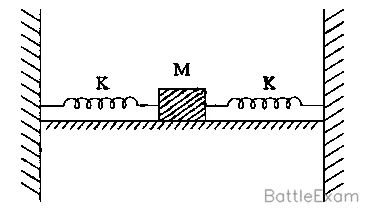
Q23JEE Main 2023NAT4MOscillationsIn the figure given below. a block of mass M=490g{\text{M}}=490 {\text{g}}M=490g placed on a frictionless table is connected with two springs having same spring constant (K=2Nm−1)( {\text{K}}=2 {\text{N}} {\text{m}}^{-1})(K=2Nm−1). If the block is horizontally displaced through ' X{\text{X}}X 'm then the number of complete oscillations it will make in 14π14 \pi14π seconds will be _______ [31-Jan-2023 Shift 1]Show Answer🚀 Solve in Practice Mode📖 ExplanationKeff=K+K\text{Keff}=\text{K}+\text{K}Keff=K+K as both springs are in use in parallel=2k =2 {\text{k}}\;=2k =2×2=4N/m m =490gm=2 \times 2=4 {\text{N}} / {\text{m}} \;\; {\text{m}}\;=490 {\text{gm}}=2×2=4N/mm=490gm =0.49kg\;=0.49 {\text{kg}}=0.49kg T =2π m/Keff=2π 0.49kg/4T\;=2 \pi \sqrt{\;{ {\text{m}}}/{ {\text{Keff}}}}=2 \pi \sqrt{\;{0.49 {\text{kg}}}/{4}}T=2πm/Keff=2π0.49kg/4 =2π 49400=2π 720= 7π10\;=2 \pi \sqrt{\;\frac{49}{400}}=2 \pi \;\frac{7}{20}=\;\frac{7 \pi}{10}=2π40049=2π207=107πNo. of oscillation in the 14π14 \pi14π isN= time /T= 14π7π/10=20{\text{N}}=\;{\;\text{ time }\;}/{ {\text{T}}}=\;\frac{14 \pi}{7 \pi / 10}=20N= time /T=7π/1014π=20Ans in 20 .
Q24JEE Main 2023NAT4MElectromagnetic WavesIn a medium the speed of light wave decreases to 0.20.20.2 times to its speed in free space The ratio of relative permittivity to the refractive index of the medium is x:1x: 1x:1. The value of xxx is _______.(Given speed of light in free space =3×10⁸m s−1=3 \times 10^8 {\text{m}} {\ s}^{-1}=3×10⁸m s−1 and for the given medium μr=1\mu _{ {\text{r}}}=1μr=1 ) [31-Jan-2023 Shift 1]Show Answer🚀 Solve in Practice Mode📖 Explanation V= C/μ⇒μ= C/V= C/0.2C\; {\text{V}}=\;{ {\text{C}}}/{\mu } \Rightarrow \mu =\;{ {\text{C}}}/{ {\text{V}}}=\;{ {\text{C}}}/{0.2 {\text{C}}}V=C/μ⇒μ=C/V=C/0.2C μ=5\;\mu =5μ=5 μ=Erμr\;\mu =\sqrt{E_{ {\text{r}}} \mu _{ {\text{r}}}}μ=Erμr ⇒Er= μ2/μr\;\Rightarrow E_{ {\text{r}}}=\;{\mu ^2}/{\mu _{ {\text{r}}}}⇒Er=μ2/μr ∴ Er/μ= μ/μr=5\; \therefore \;{E_{ {\text{r}}}}/{\mu }=\;{\mu }/{\mu _{ {\text{r}}}}=5∴Er/μ=μ/μr=5
Q25JEE Main 2023NAT4MRotational MotionA solid sphere of mass 1kg1 {\text{kg}}1kg rolls without slipping on a plane surface. Its kinetic energy is 7×10⁻³J7 \times 10^{-3} {\text{J}}7×10⁻³J. The speed of the centre of mass of the sphere is _______ cm s−1{\text{cm}} {\ s}^{-1}cm s−1. [31-Jan-2023 Shift 1]Show Answer🚀 Solve in Practice Mode📖 Explanation 12 mv2+ 12I2=7×10⁻³\;\;\frac{1}{2} {\ mv}^{2+}\;\frac{1}{2} {\text{I}}^2=7 \times 10^{-3}21 mv2+21I2=7×10⁻³ 12 mv2+ 12( 25MR2)( V/R)2=7×10−3\;\;\frac{1}{2} {\ mv}^{2+}\;\frac{1}{2} (\;\frac{2}{5} {\text{MR}}^2) (\;{ {\text{V}}}/{ {\text{R}}}) ^2=7 \times 10^{-3}21 mv2+21(52MR2)(V/R)2=7×10−3 12MV2[1+ 25]=7×10⁻³\;\;\frac{1}{2} {\text{MV}}^2 [1+\;\frac{2}{5}] =7 \times 10^{-3}21MV2[1+52]=7×10⁻³ 12(1)(V2)( 75)=7×10⁻³\;\;\frac{1}{2}(1) ( {\text{V}}^2) (\;\frac{7}{5}) =7 \times 10^{-3}21(1)(V2)(57)=7×10⁻³ V2=10−2\; {\text{V}}^2=10^{-2}V2=10−2 V=10−1=0.1m/ s=10cm/ s\; {\text{V}}=10^{-1}=0.1 {\text{m}} / {\ s}=10 {\text{cm}} / {\ s}V=10−1=0.1m/ s=10cm/ s Ans: 10\;\;\text{ Ans: }\; 10 Ans: 10
Q26JEE Main 2023NAT4MAlternating CurrentAn inductor of 0.5mH0.5 {\text{mH}}0.5mH, a capacitor of 20μF20 \mu {\text{F}}20μF and resistance of 20Ω20 Ω20Ω are connected in series with a 220V220 {\text{V}}220V ac source. If the current is in phase with the emf, the amplitude of current of the circuit is xA\sqrt{ {\text{x}}} {\text{A}}xA. The value of x{\text{x}}x is - [31-Jan-2023 Shift 1]Show Answer🚀 Solve in Practice Mode📖 Explanation XL=XC\; {\text{X}}_{ {\text{L}}}= {\text{X}}_{ {\text{C}}}XL=XC So, Z=R=20Ω\;\;\text{ So, }\; Z=R=20 Ω So, Z=R=20Ω ims= 22020=11\; {\text{i}}_{ {\text{ms}}}=\;\frac{220}{20}=11ims=20220=11 imax=112=242\; {\text{i}}_{\max }=11 {\sqrt{2}}={\sqrt{242}}imax=112=242Ans: 242
Q27JEE Main 2023NAT4MElectrostaticsExpression for an electric field is given by{ \vec{\text{E}}=4000 x^2 \;{ {\text{i}}}^{\^} \;{ {\text{V}}}/{ {\text{m}}}. The electric flux through the cube of side 20cm20 {\text{cm}}20cm when placed in electric field (as shown in the figure) is ________ Vcm{\text{V}} {\text{cm}}Vcm. [31-Jan-2023 Shift 1]Show Answer🚀 Solve in Practice Mode📖 Explanation\;\text{ Flux }\;\;={ \vec{\text{E}} \cdot { \vec{\text{A}} =4000(0⋅2)2 V/m⋅(0⋅2)2m2\;=4000(0 \cdot 2)^2 \;{ {\text{V}}}/{ {\text{m}}} \cdot (0 \cdot 2)^2 {\text{m}}^2=4000(0⋅2)2V/m⋅(0⋅2)2m2 =4000×16×10−4Vm\;=4000 \times 16 \times 10^{-4} {\text{Vm}}=4000×16×10−4Vm =640Vcm\;=640 {\text{Vcm}}=640VcmAns. 640
Q28JEE Main 2023NAT4MWork, Power and EnergyA lift of mass M=500kg{\text{M}}=500 {\text{kg}}M=500kg is descending with speed of 2ms−12 {\text{ms}}^{-1}2ms−1. Its supporting cable begins to slip thus allowing it to fall with a constant acceleration of 2ms−22 {\text{ms}}^{-2}2ms−2. The kinetic energy of the lift at the end of fall through to a distance of 6m6 {\text{m}}6m will be _______ kJ{\text{kJ}}kJ. [31-Jan-2023 Shift 1]Show Answer🚀 Solve in Practice Mode📖 Explanationv2 =u2+2as{\text{v}}^2\;= {\text{u}}^{2+}2 {\text{as}}v2=u2+2as =22+2(2)(6)\;=2^{2+}2(2)(6)=22+2(2)(6) =4+24=28\;=4+24=28=4+24=28 KE = 12 mv2{\text{KE}}\;=\;\frac{1}{2} {\ mv}^2KE=21 mv2 = 12(500)28\;=\;\frac{1}{2}(500) 28=21(500)28 =7000J\;=7000 {\text{J}}=7000J =7kJ\;=7 {\text{kJ}}=7kJAns. 7
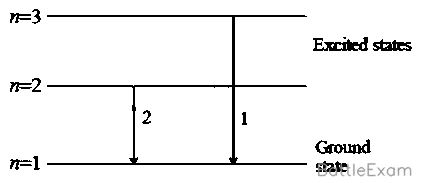
Q29JEE Main 2023NAT4MAtoms and NucleiFor hydrogen atom, λ1\lambda _1λ1 and λ2\lambda _2λ2 are the wavelengths corresponding to the transitions 1 and 2 respectively as shown in figure. The ratio of λ1\lambda _1λ1 and λ2\lambda _2λ2 is x32\;\frac{x}{32}32x. The value of xxx is _______. [31-Jan-2023 Shift 1]Show Answer🚀 Solve in Practice Mode📖 Explanation 1λ=Rz2[ 1/n12− 1/n22]\;\;\frac{1}{\lambda }= {\text{Rz}}^2 [\;{1}/{ {\text{n}}_1^2}-\;{1}/{ {\text{n}}_2^2}]λ1=Rz2[1/n12−1/n22] \;\;\frac{1}{\lambda _1}= {\text{Rz}}^2 \[;\frac{1}{1^2}-;\frac{1}{3^2}]$ =;\frac{8}{9} {\text{Rz}}^2...(1) . . . (1)...(1);;\frac{1}{\lambda _2}= {\text{Rz}}^2 $[;\frac{1}{1^2}-;\frac{1}{2^2}]$ =;\frac{3}{4} {\text{Rz}}^2...(2). . . (2)...(2)1 / 2 \Rightarrow ;\frac{\lambda _2}{\lambda _1}=;\frac{8}{9} \times ;\frac{4}{3}=;\frac{32}{27} ;\frac{\lambda _1}{\lambda _2}=;\frac{27}{32}$Ans. 27
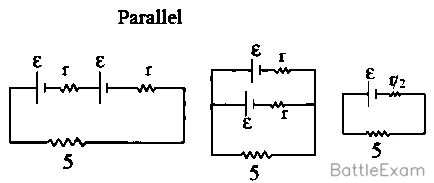
Q30JEE Main 2023NAT4MCurrent ElectricityTwo identical cells, when connected either in parallel or in series gives same current in an external resistance 5Ω5 Ω5Ω. The internal resistance of each cell will be ________ ΩΩΩ. [31-Jan-2023 Shift 1]Show Answer🚀 Solve in Practice Mode📖 Explanationi= 2ϵ5+2ri=\;\frac{2 \epsilon}{5+2 r}i=5+2r2ϵ(1) \;\; i = ϵ/r/2+5=\;{\epsilon}/{{ {\text{r}}}/{2}+5}=ϵ/r/2+5 . . . (2)Equating (1) and (2) 2ϵ/5+2r= ϵ/r/2+5⇒r+10=5+2r\;\;{2 \epsilon}/{5+2 {\text{r}}}=\;{\epsilon}/{{ {\text{r}}}/{2}+5} \Rightarrow {\text{r}}+10=5+2 {\text{r}}2ϵ/5+2r=ϵ/r/2+5⇒r+10=5+2r r=5 Ans. 5\; {\text{r}}=5 \;\text{ Ans. }\; 5r=5 Ans. 5
Q31JEE Main 2023MCQ4Md and f Block ElementsNd2+={\text{Nd}}^{2+}=Nd2+= _______ [31-Jan-2023 Shift 1]A. 4f26 s24 {\text{f}}^2 6 {\ s}^24f26 s2B. 4f44 f^44f4C. 4f34 f^34f3D. 4f46s24 f^4 6 s^24f46s2Show Answer🚀 Solve in Practice Mode📖 Explanation Nd(60)=[Xe]4f45d06 s2\; {\text{Nd}}(60)=[ {\text{Xe}}] 4 {\text{f}}^4 5 {\text{d}}^0 6 {\ s}^2Nd(60)=[Xe]4f45d06 s2 Nd2+=[Xe]4f45d05 s0\; {\text{Nd}}^{2+}=[ {\text{Xe}}] 4 {\text{f}}^4 5 {\text{d}}^0 5 {\ s}^0Nd2+=[Xe]4f45d05 s0
Q32JEE Main 2023MCQ4Md and f Block ElementsThe methods NOT involved in concentration of ore are(A) Liquation(B) Leaching(C) Electrolysis(D) Hydraulic washing(E) Froth floatationChoose the correct answer from the options given below : [31-Jan-2023 Shift 1]A. B, D and C onlyB. C, D and E onlyC. A and C onlyD. B, D and E onlyShow Answer🚀 Solve in Practice Mode📖 ExplanationMethods involved in concentration of one are(i) Hydraulic Washing(ii) Froth Flotation(iii) Magnetic Separation(iv) Leaching
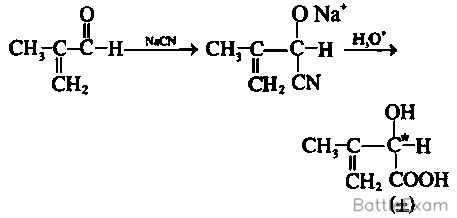
Q33JEE Main 2023MCQ4MAldehydes, Ketones and Carboxylic AcidsConsider the following reactionPropanal +++ Methanal = {\to }^{\;\text{ (i)dil. }\; {\text{NaOH}}}_{(\text{ii})\Delta }_{(\text{iii})\text{NaCN}}_{(\text{iv})\text{H}_3\text{O}^+} {\text{Product} \text{B}}_{(\text{C}_5\text{H}_8\text{O}_3)} The correct statement for product B{\text{B}}B is. It is [31-Jan-2023 Shift 1]A. optically active and adds one mole of bromineB. racemic mixture and is neutralC. racemic mixture and gives a gas with saturated NaHCO3{\text{NaHCO}}_3NaHCO3 solutionD. optically active alcohol and is neutrallShow Answer🚀 Solve in Practice Mode📖 ExplanationCH3−CH2−CHO+HCHO →ΔOH−{\text{CH}}_3- {\text{CH}}_2- {\text{CHO}}+ {\text{HCHO}} \; {\to }^{\text{OH}^{-}}_{\Delta }CH3−CH2−CHO+HCHO→ΔOH−Carboxylic acid will give CO2{\text{CO}}_2CO2 gas, with NaHCO3{\text{NaHCO}}_3NaHCO3 solution
Q34JEE Main 2023MCQ4Md and f Block ElementsThe correct order of basicity of oxides of vanadium is [31-Jan-2023 Shift 1]A. V2O3>V2O4>V2O5{\text{V}}_2 {\text{O}}_3 > {\text{V}}_2 {\text{O}}_4 > {\text{V}}_2 {\text{O}}_5V2O3>V2O4>V2O5B. V2O3>V2O5>V2O4{\text{V}}_2 {\text{O}}_3 > {\text{V}}_2 {\text{O}}_5 > {\text{V}}_2 {\text{O}}_4V2O3>V2O5>V2O4C. V2O5>V2O4>V2O3{\text{V}}_2 {\text{O}}_5 > {\text{V}}_2 {\text{O}}_4 > {\text{V}}_2 {\text{O}}_3V2O5>V2O4>V2O3D. V2O4>V2O3>V2O5{\text{V}}_2 {\text{O}}_4 > {\text{V}}_2 {\text{O}}_3 > {\text{V}}_2 {\text{O}}_5V2O4>V2O3>V2O5Show Answer🚀 Solve in Practice Mode📖 ExplanationWith increase in %\%% of oxygen acidic nature of oxide of an element increase and basic nature decreases
Q35JEE Main 2023MCQ4Md and f Block ElementsWhen Cu2+{\text{Cu}}^{2+}Cu2+ ion is treated with KI{\text{KI}}KI, a white precipitate, X{\text{X}}X appears in solution. The solution is titrated with sodium thiosulphate, the compound Y{\text{Y}}Y is formed. X{\text{X}}X and Y{\text{Y}}Y respectively are [31-Jan-2023 Shift 1]A. X=Cu2I2{\text{X}}= {\text{Cu}}_2 {\text{I}}_2X=Cu2I2 Y=Na2S4O5{\text{Y}}= {\text{Na}}_2 {\text{S}}_4 {\text{O}}_5Y=Na2S4O5B. X=Cu2I2{\text{X}}= {\text{Cu}}_2 {\text{I}}_2X=Cu2I2 Y=Na2S4O6{\text{Y}}= {\text{Na}}_2 {\text{S}}_4 {\text{O}}_6Y=Na2S4O6C. X=CuI2{\text{X}}= {\text{CuI}}_2X=CuI2 Y=Na2S4O3{\text{Y}}= {\text{Na}}_2 {\text{S}}_4 {\text{O}}_3Y=Na2S4O3D. X=CuI2 Y=Na2S4O6{\text{X}}= {\text{CuI}}_2 \;\; {\text{Y}}= {\text{Na}}_2 {\text{S}}_4 {\text{O}}_6X=CuI2Y=Na2S4O6Show Answer🚀 Solve in Practice Mode📖 ExplanationCu2++2KI→ CuI2 Unstable ↓+2K+{\text{Cu}}^{2+}+2 {\text{KI}} \to \;{ {\text{CuI}}_2}_{\;\text{ Unstable }\;} ↓+2 {\text{K}}^{+}Cu2++2KI→CuI2 Unstable ↓+2K+ Γ−Γ^{-}Γ−is strong R.A it reduces Cu2+{\text{Cu}}^{2+}Cu2+ to Cu+{\text{Cu}}^{+}Cu+ 2CuI2→ Cu2I2↓(White)′X′+I22 {\text{CuI}}_2 \to \ { {\text{Cu}}_2 {\text{I}}_2 ↓}_{(\text{White}) '\text{X}'}+ {\text{I}}_22CuI2→ Cu2I2↓(White)′X′+I2 KI+I2→K+I3− (Brown solution) {\text{KI}}+ {\text{I}}_2 \to {\text{K}}^{+} {\text{I}}_3^{-} \;\text{(Brown solution) }\;KI+I2→K+I3−(Brown solution) I3−⇌I2+I−{\text{I}}_3^{-} ⇌ {\text{I}}_2+ {\text{I}}^{-}I3−⇌I2+I− KI3+Na2S2O3→KI+Na2S4O6(Y){\text{KI}}_3+ {\text{Na}}_2 {\text{S}}_2 {\text{O}}_3 \to {\text{KI}}+{ {\text{Na}}_2 {\text{S}}_4 {\text{O}}_6}_{(\text{Y})}KI3+Na2S2O3→KI+Na2S4O6(Y)
Q36JEE Main 2023MCQ4MAmines→C2H5OHH2/Pd[A]→Pyridine(CH3CO)2O→[B]{\to }^ {{\text{H}}_2 / {\text{Pd}}}_{\text{C}_2\text{H}_5\text{OH}}[\text{A}] {\to }^ {( {\text{CH}}_3 {\text{CO}}) _2 {\text{O}} }_{\text{Pyridine}}\to [ {\text{B}}]→C2H5OHH2/Pd[A]→Pyridine(CH3CO)2O→[B] [31-Jan-2023 Shift 1]A.B.C.D.Show Answer🚀 Solve in Practice Mode📖 Explanation
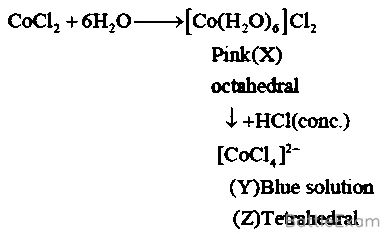
Q37JEE Main 2023MCQ4MCoordination CompoundsCobalt chloride when dissolved in water forms pink colored complex X{\text{X}}X which has octahedral geometry. This solution on treating with cone HCl{\text{HCl}}HCl forms deep blue complex, YYY which has a ZZZ geometry. X,Y{\text{X}}, {\text{Y}}X,Y and Z{\text{Z}}Z, respectively, are [31-Jan-2023 Shift 1]A. X=[Co(H2O)6]2+,Y=[CoCl4]2−,Z={\text{X}}= [ {\text{Co}} ( {\text{H}}_2 {\text{O}}) _6] ^{2+}, {\text{Y}}= [ {\text{CoCl}}_4] ^{2-}, {\text{Z}}=X=[Co(H2O)6]2+,Y=[CoCl4]2−,Z= TetrahedralB. X=[Co(H2O6)]2+,Y=[CoCl6]3−,Z={\text{X}}= [ {\text{Co}} ( {\text{H}}_2 {\text{O}}_6) ] ^{2+}, {\text{Y}}= [ {\text{CoCl}}_6] ^{3-}, {\text{Z}}=X=[Co(H2O6)]2+,Y=[CoCl6]3−,Z= OctahedralC. X=[Co(H2O)6]3+,Y=[CoCl6]3−,Z={\text{X}}= [ {\text{Co}} ( {\text{H}}_2 {\text{O}}) _6] ^{3+}, {\text{Y}}= [ {\text{CoCl}}_6] ^{3-}, {\text{Z}}=X=[Co(H2O)6]3+,Y=[CoCl6]3−,Z= OctahedralD. X=[Co(H2O)4Cl2]+,Y=[CoCl4]2−,Z={\text{X}}= [ {\text{Co}} ( {\text{H}}_2 {\text{O}}) _4 {\text{Cl}}_2] ^{+}, {\text{Y}}= [ {\text{CoCl}}_4] ^{2-}, {\text{Z}}=X=[Co(H2O)4Cl2]+,Y=[CoCl4]2−,Z= TetrahedralShow Answer🚀 Solve in Practice Mode📖 Explanation
Q38JEE Main 2023MCQ4Mp Block ElementsIdentify X,Y{\text{X}}, {\text{Y}}X,Y and Z{\text{Z}}Z in the following reaction. (Equation not balanced)Cl˙O+NO2→xX→H2OxY+xZ{\text{Cl}} ˙{ {\text{O}}}+ {\text{NO}}_2 \to x{ {\text{X}}} {\to }^{ {\text{H}}_2 {\text{O}}} x{ {\text{Y}}}+x{ {\text{Z}}}Cl˙O+NO2→xX→H2OxY+xZ [31-Jan-2023 Shift 1]A. X=ClONO2,Y=HOCl,Z=NO2{\text{X}}= {\text{ClONO}}_2, {\text{Y}}= {\text{HOCl}}, {\text{Z}}= {\text{NO}}_2X=ClONO2,Y=HOCl,Z=NO2B. X=ClNO2,Y=HCl,Z=HNO3{\text{X}}= {\text{ClNO}}_2, {\text{Y}}= {\text{HCl}}, {\text{Z}}= {\text{HNO}}_3X=ClNO2,Y=HCl,Z=HNO3C. X=ClONO2,Y=HOCl,Z=HNO3{\text{X}}= {\text{ClONO}}_2, {\text{Y}}= {\text{HOCl}}, {\text{Z}}= {\text{HNO}}_3X=ClONO2,Y=HOCl,Z=HNO3D. X=ClNO3,Y=Cl2,Z=NO2{\text{X}}= {\text{ClNO}}_3, {\text{Y}}= {\text{Cl}}_2, {\text{Z}}= {\text{NO}}_2X=ClNO3,Y=Cl2,Z=NO2Show Answer🚀 Solve in Practice Mode📖 ExplanationCl˙O+NO2→ClONO2(X)→+H,OHOCl(Y)+HNO3(Z){\text{Cl}} ˙{ {\text{O}}}+ {\text{NO}}_2 \to {{\text{ClONO}}_2 }_{(\text{X})} {\to }^{+ {\text{H}}, {\text{O}}} {\text{HOCl}}_{(\text{Y})}+ {{\text{HNO}}_3}_{(\text{Z})}Cl˙O+NO2→ClONO2(X)→+H,OHOCl(Y)+HNO3(Z)
Q39JEE Main 2023MCQ4MHaloalkanes and HaloarenesThe correct order of melting point of dichlorobenzenes is [31-Jan-2023 Shift 1]A.B.C.D.Show Answer🚀 Solve in Practice Mode📖 Explanation
Q40JEE Main 2023MCQ4MBiomoleculesA protein ' X{\text{X}}X ' with molecular weight of 70,000u70,000 {\text{u}}70,000u, on hydrolysis gives amino acids. One of these amino acid is [31-Jan-2023 Shift 1]A. {\text{NH}}_2- {\text{CH}}_2- {\text{CH}}_{|}_{\text{CH}_3}- {\text{CH}}_2 {\text{CH}}_2 {\text{COOH}}B. {\text{CH}}_3- {\text{CH}}^{|}^{\text{CH}_3}- {\text{CH}}_2- {\text{CH}}_{|}_{\text{NH}_2}- {\text{COOH}}C. {\text{CH}}_3- {\text{CH}}^{|}^{\text{CH}_3}- {\text{CH}}_{|}_{\text{NH}_2}- {\text{CH}}_2 {\text{COOH}}D. {\text{CH}}_3- {\text{C}}^{|}^{\text{CH}_3}_{|}_{\text{NH}_2}- {\text{CH}}_2- {\text{CH}}_2 {\text{COOH}}Show Answer🚀 Solve in Practice Mode📖 ExplanationOnly in option (2) α\alphaα-Amino acid is given all the other options are not α\alphaα-Amino acids.
Q41JEE Main 2023MCQ4MStructure of AtomWhich transition in the hydrogen spectrum would have the same wavelength as the Balmer type transition from n=4{\text{n}}=4n=4 to n=2{\text{n}}=2n=2 of He+{\text{He}}^{+}He+spectrum [31-Jan-2023 Shift 1]A. n=2{\text{n}}=2n=2 to n=1{\text{n}}=1n=1B. n=1{\text{n}}=1n=1 to n=3{\text{n}}=3n=3C. n=1{\text{n}}=1n=1 to n=2{\text{n}}=2n=2D. n=3{\text{n}}=3n=3 to n=4{\text{n}}=4n=4Show Answer🚀 Solve in Practice Mode📖 ExplanationHe+{\text{He}}^{+}He+ion: 1/λ(H)=R(1)2[ 1/n12− 1/n22]\;\;{1}/{\lambda ( {\text{H}})}= {\text{R}}(1)^2 [\;{1}/{ {\text{n}}_1^2}-\;{1}/{ {\text{n}}_2^2}]1/λ(H)=R(1)2[1/n12−1/n22] 1/λ(He+)=R(2)2[ 122− 142]\;\;{1}/{\lambda ( {\text{He}}^{+}) }= {\text{R}}(2)^2 [\;\frac{1}{2^2}-\;\frac{1}{4^2}]1/λ(He+)=R(2)2[221−421]Given λ(H)=λ(He+)\lambda ( {\text{H}})=\lambda ( {\text{He}}^{+})λ(H)=λ(He+) \; {\text{R}}(1)^2 \[;{1}/{ {\text{n}}_1^2}-;{1}/{ {\text{n}}_2^2}]$ = {\text{R}}(4) [;\frac{1}{2^2}-;\frac{1}{4^2}] ;;{1}/{ {\text{n}}_1^2}-;{1}/{ {\text{n}}_2^2}=;\frac{1}{1^2}-;\frac{1}{2^2}OncomparingOn comparing Oncomparing{\text{n}}_1=1 & {\text{n}}_2=2$Ans. 1
Q42JEE Main 2023MCQ4MPractical Organic ChemistryMatch items of column I and II Column I (Mixture of compounds) Column II (Separation Technique) A. H2O/CH2Cl2{\text{H}}_2 {\text{O}} / {\text{CH}}_2 {\text{Cl}}_2H2O/CH2Cl2 i. Crystallization ii. Differential solvent extraction C. Kerosene/Naphthalene iii. Column chromatography D. C6H12O6/NaCl{\text{C}}_6 {\text{H}}_{12} {\text{O}}_6 / {\text{NaCl}}C6H12O6/NaCl iv. Fractional DistillationCorrect match is: [31-Jan-2023 Shift 1]A. A-(iii), B-(iv), C-(ii), D-(i)B. A-(i), B-(iii), C-(ii), D-(iv)C. A-(ii), B-(iii), C-(iv), D-(i)D. A-(ii), B-(iv), C-(i), D-(iii)Show Answer🚀 Solve in Practice Mode📖 ExplanationA. H2O/CH2Cl2→{\text{H}}_2 {\text{O}} / {\text{CH}}_2 {\text{Cl}}_2 \to H2O/CH2Cl2→ ii, CH2Cl2>H2O{\text{CH}}_2 {\text{Cl}}_2 > {\text{H}}_2 {\text{O}}CH2Cl2>H2O (density) so they can be separated by differential solvent extraction.B.iii. columnchromatography Due to H{\text{H}}H-bonding in it can be separated fromby column chromatography. C. Kerosene / Naphthalene →\to → iv. Fractional distillation.Due to different B.P. of kerosene and Naphthalene it can be separated by fractional distillation.D. C6H12O6/NaCl→{\text{C}}_6 {\text{H}}_{12} {\text{O}}_6 / {\text{NaCl}} \to C6H12O6/NaCl→ i. Crystallization.NaCl{\text{NaCl}}NaCl (ionic compound) can be crystallized.
Q43JEE Main 2023MCQ4MClassification of ElementsThe correct increasing order of the ionic radii is [31-Jan-2023 Shift 1]A. Cl−<Ca2+<K+<S2−{\text{Cl}}^{-} < {\text{Ca}}^{2+} < {\text{K}}^{+} < {\text{S}}^{2-}Cl−<Ca2+<K+<S2−B. K+<S2−<Ca2+<Cl−{\text{K}}^{+} < {\text{S}}^{2-} < {\text{Ca}}^{2+} < {\text{Cl}}^{-}K+<S2−<Ca2+<Cl−C. S2−<Cl−<Ca2+<K+{\text{S}}^{2-} < {\text{Cl}}^{-} < {\text{Ca}}^{2+} < {\text{K}}^{+}S2−<Cl−<Ca2+<K+D. Ca2+<K+<Cl−<S2−{\text{Ca}}^{2+} < {\text{K}}^{+} < {\text{Cl}}^{-} < {\text{S}}^{2-}Ca2+<K+<Cl−<S2−Show Answer🚀 Solve in Practice Mode📖 ExplanationIn isoelectronic species size ∝ 1Z\propto \;\frac{1}{Z}∝Z1 _{}_{\text{Z}:} { {\text{Ca}}^{2+}}_{}_{20} { < {\text{K}}^{+} }_{}_{19}{ < {\text{Cl}}^{-}}_{}_{17}{ < {\text{S}}^{2-}}_{}_{18}: \;\text{ Size }\; Z:20Z: 20Z:20191718
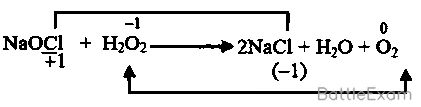
Q44JEE Main 2023MCQ4MRedox ReactionsH2O2{\text{H}}_2 {\text{O}}_2H2O2 acts as a reducing agent in [31-Jan-2023 Shift 1]A. 2NaOCl+H2O2→2NaCl+H2O+O22 {\text{NaOCl}}+ {\text{H}}_2 {\text{O}}_2 \to 2 {\text{NaCl}}+ {\text{H}}_2 {\text{O}}+ {\text{O}}_22NaOCl+H2O2→2NaCl+H2O+O2B. 2Fe2++2H++H2O2→2Fe3++2H2O2 {\text{Fe}}^{2+}+2 {\text{H}}^{+}+ {\text{H}}_2 {\text{O}}_2 \to 2 {\text{Fe}}^{3+}+2 {\text{H}}_2 {\text{O}}2Fe2++2H++H2O2→2Fe3++2H2OC. Mn2++2H2O2→MnO2+2H2O{\text{Mn}}^{2+}+2 {\text{H}}_2 {\text{O}}_2 \to {\text{MnO}}_2+2 {\text{H}}_2 {\text{O}}Mn2++2H2O2→MnO2+2H2OD. Na2S+4H2O2→Na2SO4+4H2O{\text{Na}}_2 {\text{S}}+4 {\text{H}}_2 {\text{O}}_2 \to {\text{Na}}_2 {\text{SO}}_4+4 {\text{H}}_2 {\text{O}}Na2S+4H2O2→Na2SO4+4H2OShow Answer🚀 Solve in Practice Mode📖 Explanation
Q45JEE Main 2023MCQ4MBiomoleculesWhich of the following artificial sweeteners has the highest sweetness value in comparison to cane sugar? [31-Jan-2023 Shift 1]A. AspartameB. SucraloseC. AlitameD. SaccharinShow Answer🚀 Solve in Practice Mode📖 ExplanationSweetness value order wrt cane sugar Alitame >>> Sucralose >>> Saccharin >>> Aspartame
Q46JEE Main 2023MCQ4MChemical Bonding and Molecular StructureMatch List I with List II List I List II A. XeF4{\text{XeF}}_4XeF4 I. See - saw B. SF4{\text{SF}}_4SF4 II. Square planar C. NH4+{\text{NH}}_4^{+}NH4+ III. Bent T−{\text{T}}-T− shaped D. BrF3{\text{BrF}}_3BrF3 IV. TetrahedralChoose the correct answer from the options given below : [31-Jan-2023 Shift 1]A. A-IV, B-III, C-II, D-IB. A-II, B-I, C-III, D-IVC. A-IV, B-I, C-II, D-IIID. A-II, B-I, C-IV, D-IIIShow Answer🚀 Solve in Practice Mode📖 Explanation
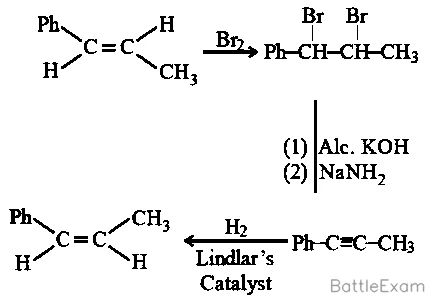
Q47JEE Main 2023MCQ4MHydrocarbonsChoose the correct set of reagents for the following conversion trans (Ph−CH=CH−CH3)→cis(Ph−CH=CH−CH3)( {\text{Ph}}- {\text{CH}}= {\text{CH}}- {\text{CH}}_3) \to {\text{cis}} ( {\text{Ph}}- {\text{CH}}= {\text{CH}}- {\text{CH}}_3)(Ph−CH=CH−CH3)→cis(Ph−CH=CH−CH3) [31-Jan-2023 Shift 1]A. Br2{\text{Br}}_2Br2, alc KOH,NaNH2,Na(LiqNH3){\text{KOH}}, {\text{NaNH}}_2, {\text{Na}} ( {\text{Liq}} {\text{NH}}_3)KOH,NaNH2,Na(LiqNH3)B. Br2{\text{Br}}_2Br2, alc KOH,NaNH2,H2{\text{KOH}}, {\text{NaNH}}_2, {\text{H}}_2KOH,NaNH2,H2 Lindlar CatalystC. Br2,aqKOH,NaNH2,H2{\text{Br}}_2, {\text{aq}} {\text{KOH}}, {\text{NaNH}}_2, {\text{H}}_2Br2,aqKOH,NaNH2,H2 Lindlar CatalystD. Br2,aqKOH,NaNH2,Na(LiqNH3){\text{Br}}_2, {\text{aq}} {\text{KOH}}, {\text{NaNH}}_2, {\text{Na}} ( {\text{Liq}} {\text{NH}}_3)Br2,aqKOH,NaNH2,Na(LiqNH3)Show Answer🚀 Solve in Practice Mode📖 Explanation
Q48JEE Main 2023MCQ4MSolutionsAdding surfactants in non polar solvent, the micelles structure will look [31-Jan-2023 Shift 1]A. bB. cC. aD. dShow Answer🚀 Solve in Practice Mode📖 ExplanationNon-Polar tail towards non-polar solvent Ans. 3
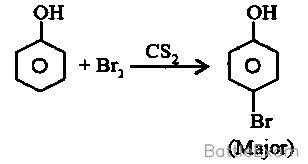
Q49JEE Main 2023MCQ4MAlcohols, Phenols and EthersAn organic compound ' AAA ' with empirical formula C6H6O{\text{C}}_6 {\text{H}}_6 {\text{O}}C6H6O gives sooty flame on burning. Its reaction with bromine solution in low polarity solvent results in high yield of B.BB . BB.B is [31-Jan-2023 Shift 1]A.B.C.D.Show Answer🚀 Solve in Practice Mode📖 ExplanationAromatic compounds burns with sooty flame
Q50JEE Main 2023MCQ4MElectrochemistryWhich one of the following statements is correct for electrolysis of brine solution? [31-Jan-2023 Shift 1]A. Cl2{\text{Cl}}_2Cl2 is formed at cathodeB. O2{\text{O}}_2O2 is formed at cathodeC. H2{\text{H}}_2H2 is formed at anodeD. OH−{\text{OH}}^{-}OH−is formed at cathodeShow Answer🚀 Solve in Practice Mode📖 ExplanationElectrolysis of brine solutionNaCl (aq.) →Na (aq) ++Cl (aq) +{\text{NaCl}} \;\text{ (aq.) }\; \to {\text{Na}}_{\;\text{(aq) }\;}^{+}+ {\text{Cl}}_{\;\text{(aq) }\;}^{+}NaCl (aq.) →Na(aq) ++Cl(aq) +At anode : 2Cl(aq.)+→Cl2(g)Major+2e−2 {\text{Cl}}_{( {\text{aq}} .)}^{+} \to {{\text{Cl}}_2( {\text{g}})}_{\text{Major}}+2 {\text{e}}^{-}2Cl(aq.)+→Cl2(g)Major+2e− 2H2O(ℓ)→O2(g)Minor+4H(aq)++4e−2 {\text{H}}_2 {\text{O}}_{(ℓ)} \to {{\text{O}}_{2( {\text{g}})}}_{\text{Minor}}+4 {\text{H}}_{( {\text{aq}})}^{+}+4 {\text{e}}^{-}2H2O(ℓ)→O2(g)Minor+4H(aq)++4e− At Cathode : 2H2O(ℓ)+2e−→H2(g)↑+2OH (aq) −2 {\text{H}}_2 {\text{O}}_{(ℓ)}+2 {\text{e}}^{-} \to {\text{H}}_{2( {\text{g}})} ↑+2 {\text{OH}}_{\;\text{(aq) }\;}^{-}2H2O(ℓ)+2e−→H2(g)↑+2OH(aq) − 2Na++2OH−→2NaOH2 {\text{Na}}^{+}+2 {\text{OH}}^{-} \to 2 {\text{NaOH}}2Na++2OH−→2NaOH
Q51JEE Main 2023NAT4MElectrochemistryThe logarithm of equilibrium constant for the reaction Pd2++4Cl−⇌PdCl42−{\text{Pd}}^{2+}+4 {\text{Cl}}^{-} ⇌ {\text{PdCl}}_4^{2-}Pd2++4Cl−⇌PdCl42− is _______ (Nearest integer) Given : 2.303RT/F=0.06V\;\;\text{ Given }\;: \;{2.303 {\text{RT}}}/{ {\text{F}}}=0.06 {\text{V}} Given :2.303RT/F=0.06V Pd(aq)2++2e−⇌Pd( s) E∘=0.83V\; {\text{Pd}}_{( {\text{aq}})}^{2+}+2 {\text{e}}^{-} ⇌ {\text{Pd}}( {\ s}) \;\; {\text{E}}^{\circ}=0.83 {\text{V}}Pd(aq)2++2e−⇌Pd( s)E∘=0.83V PdCl42−(aq)+2e−⇌Pd( s)+4Cl−(aq)\; {\text{PdCl}}_4^{2-}( {\text{aq}})+2 {\text{e}}^{-} ⇌ {\text{Pd}}( {\ s})+4 {\text{Cl}}^{-}( {\text{aq}})PdCl42−(aq)+2e−⇌Pd( s)+4Cl−(aq) E∘=0.65V\; {\text{E}}^{\circ}=0.65 {\text{V}}E∘=0.65V [31-Jan-2023 Shift 1]Show Answer🚀 Solve in Practice Mode📖 Explanation Sol. ΔG∘=−RTℓnK\;\;\text{ Sol. }\; \;\; \Delta {\text{G}}^{\circ}=- {\text{RT}} ℓ {\text{n}} K Sol. ΔG∘=−RTℓnK −nFE cell 0=−RT×2.303(log10K)\;- {\text{nFE}}_{\;\text{cell }\;}^0=- {\text{RT}} \times 2.303 (\log _{10} {\text{K}})−nFEcell 0=−RT×2.303(log10K) E Cell 0/0.06×n=logK\;\;{ {\text{E}}_{\;\text{Cell }\;}^0}/{0.06} \times {\text{n}}=\log {\text{K}}ECell 0/0.06×n=logK . . . (1) Pd+2 (aq.) +notLe−⇌Pd( s),E cat,red ∘=0.83\; {\text{Pd}}^{+2} \;\text{ (aq.) }\;+\text{not} \mathcal{L e}^{-} ⇌ {\text{Pd}}( {\ s}), {\text{E}}_{\;\text{cat,red }\;}^{\circ}=0.83Pd+2 (aq.) +notLe−⇌Pd( s),Ecat,red ∘=0.83 Pd( s)+4Cl− (aq.) ⇌PdCl42−,(aq)+2e−,E mat.ouir 0=0.65\; {\text{Pd}}( {\ s})+4 {\text{Cl}}^{-} \;\text{(aq.) }\; ⇌ {\text{PdCl}}_4^{2-},( {\text{aq}})+2 {\text{e}}^{-}, {\text{E}}_{\;\text{mat.ouir }\;}^0=0.65Pd( s)+4Cl−(aq.) ⇌PdCl42−,(aq)+2e−,Emat.ouir 0=0.65 Net Reaction →Pd2+ (aq.) +4Cl− (aq.) ⇌PdCl42− (aq.) \;\;\text{ Net Reaction }\; \to {\text{Pd}}^{2+} \;\text{ (aq.) }\;+4 {\text{Cl}}^{-} \;\text{(aq.) }\; ⇌ {\text{PdCl}}_4{ }^{2-} \;\text{ (aq.) }\; Net Reaction →Pd2+ (aq.) +4Cl−(aq.) ⇌PdCl42− (aq.) E cell ∘=E cat,red ∘−E Alode ,0cda∘\; {\text{E}}_{\;\text{cell }\;}^{\circ}= {\text{E}}_{\;\text{cat,red }\;}^{\circ}- {\text{E}}_{\;\text{Alode }\;, 0 {\text{c}} {\text{d}}^{ {\text{a}}}}^{\circ}Ecell ∘=Ecat,red ∘−EAlode ,0cda∘ E cell ∘=0.83−0.65\; {\text{E}}_{\;\text{cell }\;}^{\circ}=0.83-0.65Ecell ∘=0.83−0.65 E cell ∘=0.18\; {\text{E}}_{\;\text{cell }\;}^{\circ}=0.18Ecell ∘=0.18 . . . (2) Also n=2\;\;\text{ Also }\; {\text{n}}=2 Also n=2 . . . (3)\;\;\text{ Using equation (1), (2) & (3) }\; logK=6\;\log K=6logK=6 \;
Q52JEE Main 2023NAT4MChemical KineticsA→B{\text{A}} \to {\text{B}}A→BThe rate constants of the above reaction at 200K200 {\text{K}}200K and 300K300 {\text{K}}300K are 0.03min−10.03 {\min}^{-1}0.03min−1 and 0.05min−10.05 {\min}^{-1}0.05min−1 respectively. The activation energy for the reaction is ________ J{\text{J}}J (Nearest integer)(Given : In 10=2.310=2.310=2.3 R=8.3JK−1mol−1\; {\text{R}}=8.3 {\text{J}} {\text{K}}^{-1} {\text{mol}}^{-1}R=8.3JK−1mol−1 log5=0.70\;\log 5=0.70log5=0.70 log3=0.48\;\log 3=0.48log3=0.48 log2=0.30\;\log 2=0.30log2=0.30 [31-Jan-2023 Shift 1]Show Answer🚀 Solve in Practice Mode📖 Explanation log K300/K200= Ea/2.3×8.314( 1/T1− 1/T2)\;\log \;{ {\text{K}}_{300}}/{ {\text{K}}_{200}}=\;{ {\text{E}}_{ {\text{a}}}}/{2.3 \times 8.314} (\;{1}/{ {\text{T}}_1}-\;{1}/{ {\text{T}}_2})logK300/K200=Ea/2.3×8.314(1/T1−1/T2) log 0.050.03= Ea/2.305×8.314×[ 1200− 1300]\;\log \;\frac{0.05}{0.03}=\;{ {\text{Ea}}}/{2.305 \times 8.314} \times [\;\frac{1}{200}-\;\frac{1}{300}]log0.030.05=Ea/2.305×8.314×[2001−3001] Ea=2519.88J⇒Ea=2520J\; {\text{E}}_{ {\text{a}}}=2519.88 {\text{J}} \Rightarrow {\text{E}}_{ {\text{a}}}=2520 {\text{J}}Ea=2519.88J⇒Ea=2520J
Q53JEE Main 2023NAT4MChemical ThermodynamicsThe enthalpy change for the conversion of 12Cl2(g) to Cl−(aq) is (−)\;\;\frac{1}{2} {\text{Cl}}_2( {\text{g}}) \;\text{ to }\; {\text{Cl}}^{-}( {\text{aq}}) \;\text{ is }\;(-)21Cl2(g) to Cl−(aq) is (−) ________ kJmol−1(Nearest−. integer) \; {\text{kJ}} {\text{mol}}^{-1} ( {\text{Nearest}}^{-}. \;\text{integer) }\;kJmol−1(Nearest−.integer) Given : ΔdisHCl2(g)∘∘=240kJmol−1\;\;\text{ Given : }\; \Delta _{ {\text{dis}}} {\text{H}}_{ {\text{Cl}}_{2( {\text{g}})}^{\circ}}^{\circ}=240 {\text{kJmol}}^{-1} Given : ΔdisHCl2(g)∘∘=240kJmol−1 ΔegHCl(g)∘=−350kJmol−1\;\Delta _{ {\text{eg}}} {\text{H}}_{ {\text{Cl}}_{( {\text{g}})}}^{\circ}=-350 {\text{kJmol}}^{-1}ΔegHCl(g)∘=−350kJmol−1 ΔhydHCl(g)∘∘=−380kJmol−1\;\Delta _{ {\text{hyd}}} {\text{H}}_{ {\text{Cl}}_{( {\text{g}})}^{\circ}}^{\circ}=-380 {\text{kJmol}}^{-1}ΔhydHCl(g)∘∘=−380kJmol−1 [31-Jan-2023 Shift 1]Show Answer🚀 Solve in Practice Mode📖 Explanation 12Cl2(g)→Cl(g)→Cl(g)−→Cl(aq.)−\;\;\frac{1}{2} {\text{Cl}}_{2( {\text{g}})} \to {\text{Cl}}_{( {\text{g}})} \to {\text{Cl}}_{( {\text{g}})}^{-} \to {\text{Cl}}_{( {\text{aq}} .)}^{-}21Cl2(g)→Cl(g)→Cl(g)−→Cl(aq.)− ΔH∘= 12×240+(−350)+(−380)\;\Delta {\text{H}}^{\circ}=\;\frac{1}{2} \times 240+(-350)+(-380)ΔH∘=21×240+(−350)+(−380) =−610 ans. \;=-610 \;\text{ ans. }\;=−610 ans.
Q54JEE Main 2023NAT4MOrganic Chemistry - Some Basic PrinciplesOn complete combustion, 0.492g0.492 {\text{g}}0.492g of an organic compound gave 0.792g0.792 {\text{g}}0.792g of CO2{\text{CO}}_2CO2.The %\%% of carbon in the organic compound is _______ (Nearest integer) [31-Jan-2023 Shift 1]Show Answer🚀 Solve in Practice Mode📖 Explanationweight of C{\text{C}}C in 0.792gmCO20.792 {\text{gm}} {\text{CO}}_20.792gmCO2 = 1244×0.792=0.216\;=\;\frac{12}{44} \times 0.792=0.216=4412×0.792=0.216 % of C \incompound = 0.2160.492×100\;\% \;\text{ of }\; {\text{C}} \;\text{ \in compound }\;=\;\frac{0.216}{0.492} \times 100% of C \incompound =0.4920.216×100 =43.90%\;=43.90 \%=43.90%Ans: 44
Q55JEE Main 2023NAT4MSolutionsAt 27∘C27^{\circ} {\text{C}}27∘C, a solution containing 2.5g2.5 {\text{g}}2.5g of solute in 250.0mL250.0 {\text{mL}}250.0mL of solution exerts an osmotic pressure of 400Pa400 {\text{Pa}}400Pa. The molar mass of the solute is _______ g{\text{g}}g mol−1{\text{mol}}^{-1}mol−1 (Nearest integer)(Given : {\text{R}}=0.083 {\text{L}} {\bar} {\text{K}}^{-1} {\text{mol}}^{-1}) [31-Jan-2023 Shift 1]Show Answer🚀 Solve in Practice Mode📖 Explanationπ=\pi=π= CRT \;{400 {\text{Pa}}}/{10^5}=\;{\;{2.5 {\text{g}}}/{ {\text{M}}_{\circ }}}/{250 / 1000 {\text{L}}} \times 0.83 \;{ {\text{L}}- {\bar}}/{ {\text{K}} \cdot {\text{mol}}} \times 300 {\text{K}} M0=62250M_0=62250M0=62250
Q56JEE Main 2023NAT4MSome Basic Concepts of ChemistryZinc reacts with hydrochloric acid to give hydrogen and zinc chloride. The volume of hydrogen gas produced at STP from the reaction of 11.5g11.5 {\text{g}}11.5g of zinc with excess HCl{\text{HCl}}HCl is _______ L{\text{L}}L (Nearest integer)(Given : Molar mass of Zn{\text{Zn}}Zn is 65.4gmol−165.4 {\text{g}} {\text{mol}}^{-1}65.4gmol−1 and Molar volume of H2{\text{H}}_2H2 at STP=22.7L{\text{STP}}=22.7 {\text{L}}STP=22.7L ) [31-Jan-2023 Shift 1]Show Answer🚀 Solve in Practice Mode📖 ExplanationZn+2HCl→ZnCl2+H2↑{\text{Zn}}+2 {\text{HCl}} \to {\text{ZnCl}}_2+ {\text{H}}_2 ↑Zn+2HCl→ZnCl2+H2↑Moles of Zn{\text{Zn}}Zn used = 11.565.4==\;\frac{11.5}{65.4}==65.411.5= Moles of H2{\text{H}}_2H2 evolvedVolume of H2= 11.565.4×22.7L=3.99L{\text{H}}_2=\;\frac{11.5}{65.4} \times 22.7 {\text{L}}=3.99 {\text{L}}H2=65.411.5×22.7L=3.99L
Q57JEE Main 2023MCQ4MAminesHow many of the transformation given below would result in aromatic amines? [31-Jan-2023 Shift 1]A.B.C.D.Show Answer🚀 Solve in Practice Mode📖 ExplanationProduct in the given reactions are as follow-2. No reactions will be observed as in Gabriel phthalimide synthesisis poor substrate for SN2{\text{SN}}^2SN2 3. 4. +CH3COOH+ {\text{CH}}_3 {\text{COOH}}+CH3COOH Aromatic amines will he formed in 1,3 & 4 Ans: 3
Q58JEE Main 2023NAT4MChemical EquilibriumFor reaction: SO2(g)+ 12O2(g)⇌SO3(g){\text{SO}}_2( {\text{g}})+\;\frac{1}{2} {\text{O}}_2( {\text{g}}) ⇌ {\text{SO}}_3( {\text{g}})SO2(g)+21O2(g)⇌SO3(g) KP=2×10¹²K_P=2 \times 10^{12}KP=2×10¹² at 27∘C27^{\circ} {\text{C}}27∘C and 1 atm pressure. The Kc{\text{K}}_{ {\text{c}}}Kc for the same reaction is _______ ×1013\times 10^{13}×1013. (Nearest integer)(Given R=0.082LatmK−1mol−1{\text{R}}=0.082 {\text{L}} {\text{atm}} {\text{K}}^{-1} {\text{mol}}^{-1}R=0.082LatmK−1mol−1 ) [31-Jan-2023 Shift 1]Show Answer🚀 Solve in Practice Mode📖 Explanation SO2(g)+ 12O2(g)⇌SO3(g)\; {\text{SO}}_{2( {\text{g}})}+\;\frac{1}{2} {\text{O}}_{2( {\text{g}})} ⇌ {\text{SO}}_{3( {\text{g}})}SO2(g)+21O2(g)⇌SO3(g) Kp=2×10¹² at 300K\; {\text{K}}_{ {\text{p}}}=2 \times 10^{12} \;\text{ at }\; 300 {\text{K}}Kp=2×10¹² at 300K KP=KC×(RT)Δng\; {\text{K}}_{ {\text{P}}}= {\text{K}}_{ {\text{C}}} \times ( {\text{RT}})^{\Delta n_{ {\text{g}}}}KP=KC×(RT)Δng 2×1012=Kc×(0.082×300)−1/2\;2 \times 10^{12}= {\text{K}}_{ {\text{c}}} \times (0.082 \times 300)^{-1 / 2}2×1012=Kc×(0.082×300)−1/2 KC=9.92×10¹²\; {\text{K}}_{ {\text{C}}}=9.92 \times 10^{12}KC=9.92×10¹² KC=0.992×10¹³\; {\text{K}}_{ {\text{C}}}=0.992 \times 10^{13}KC=0.992×10¹³Ans. 1
Q59JEE Main 2023NAT4Mp Block ElementsThe oxidation sate of phosphorus in hypophosphoric acid is + ________.. [31-Jan-2023 Shift 1]Show Answer🚀 Solve in Practice Mode📖 ExplanationH4P2O6{\text{H}}_4 {\text{P}}_2 {\text{O}}_6H4P2O6 {\text{HO}}- {\text{P}}_{|}_{\text{O}}_{\text{H}}^{||}^{\text{O}}- {\text{P}}_{|}_{\text{O}}_{\text{H}}^{||}^{\text{O}}- {\text{OH}} O.S. of PPP is +4+4+4
Q60JEE Main 2023NAT4MStates of MatterThe total pressure of a mixture of non-reacting gases X(0.6g)X(0.6 {\text{g}})X(0.6g) and Y(0.45g)Y(0.45 {\text{g}})Y(0.45g) in a vessel is 740 mm{\text{mm}}mm of Hg{\text{Hg}}Hg. The partial pressure of the gas XXX is mm{\text{mm}}mm of Hg{\text{Hg}}Hg. (Nearest Integer)(Given : molar mass X=20{\text{X}}=20X=20 and Y=45gmol−1{\text{Y}}=45 {\text{g}} {\text{mol}}^{-1}Y=45gmol−1 ) [31-Jan-2023 Shift 1]Show Answer🚀 Solve in Practice Mode📖 Explanation PX=χXPT\; {\text{P}}_{ {\text{X}}}=χ_{ {\text{X}}}{ }^{P_T}PX=χXPT = 0.6200.620+ 0.4545×740\;=\;\frac{\;\frac{0.6}{20}}{\frac{0.6}{20}+\;\frac{0.45}{45}} \times 740=200.6+450.45200.6×740 PX=555mmHg\; {\text{P}}_{ {\text{X}}}=555 {\text{mm}} {\text{Hg}}PX=555mmHg
Q61JEE Main 2023MCQ4MEllipseIf the maximum distance of normal to the ellipse x2/4+ y2/b2=1,b<2\;{ {\text{x}}^2}/{4}+\;{ {\text{y}}^2}/{ {\text{b}}^2}=1, {\text{b}}< 2x2/4+y2/b2=1,b<2, from the origin is 1 , then the eccentricity of the ellipse is: [31-Jan-2023 Shift 1]A. 1/2\;{1}/{{\sqrt{2}}}1/2B. 3/2\;{{\sqrt{3}}}/{2}3/2C. 12\;\frac{1}{2}21D. 3/4\;{{\sqrt{3}}}/{4}3/4Show Answer🚀 Solve in Practice Mode📖 ExplanationEquation of normal is2x secθ−bycosecθ=4−b22 x \ sec \theta-b y {\text{cosec}} \theta=4-b^22x secθ−bycosecθ=4−b2Distance from (0,0)= 4−b2/4 sec2θ+b2cosec2θ(0,0)=\;{4- {\text{b}}^2}/{\sqrt{4 \ sec ^2 \theta+ {\text{b}}^2 {\text{cosec}}^2 \theta}}(0,0)=4−b2/4 sec2θ+b2cosec2θDistance is maximum if4 sec2θ+b2cosec2θ4 \ sec ^2 \theta+b^2 {\text{cosec}}^2 \theta4 sec2θ+b2cosec2θ is minimum⇒tan2θ= b/2\Rightarrow \tan ^2 \theta=\;{ {\text{b}}}/{2}⇒tan2θ=b/2 ⇒ 4−b2/4⋅ b+22+b2⋅ b+2b=1\Rightarrow \;{4-b^2}/{\sqrt{4 \cdot \;\frac{b+2}{2}+b^2 \cdot \;\frac{b+2}{b}}}=1⇒4−b2/4⋅2b+2+b2⋅bb+2=1 ⇒4−b2=b+2⇒b=1⇒e= 3/2\Rightarrow 4-b^2=b+2 \Rightarrow b=1 \Rightarrow {\text{e}}=\;{{\sqrt{3}}}/{2}⇒4−b2=b+2⇒b=1⇒e=3/2
Q62JEE Main 2023MCQ4MComplex NumbersFor all z∈C{\text{z}} \in {\text{C}}z∈C on the curve C1:∣z∣=4C_1: |{\text{z}}|=4C1:∣z∣=4, let the locus of the point z+ 1zz+\;\frac{1}{z}z+z1 be the curve C2C_2C2. Then [31-Jan-2023 Shift 1]A. the curves C1C_1C1 and C2C_2C2 intersect at 4 pointsB. the curves C1{\text{C}}_1C1 lies inside C2{\text{C}}_2C2C. the curves C1C_1C1 and C2C_2C2 intersect at 2 pointsD. the curves C2{\text{C}}_2C2 lies inside C1{\text{C}}_1C1Show Answer🚀 Solve in Practice Mode📖 ExplanationLet w=z+ 1z=4eiθ+ 14e−iθw=z+\;\frac{1}{z}=4 e^{i \theta}+\;\frac{1}{4} {\text{e}}^{- {\text{i}} \theta}w=z+z1=4eiθ+41e−iθ ⇒w= 174cosθ+i 154sin θ\Rightarrow {\text{w}}=\;\frac{17}{4} \cos \theta+ {\text{i}} \;\frac{15}{4} sin \;\theta⇒w=417cosθ+i415sinθSo locus of www is ellipse x2( 174)2+ y2( 154)2=1\;\frac{x^2}{ (\;\frac{17}{4}) ^2}+\;\frac{y^2}{ (\;\frac{15}{4}) ^2}=1(417)2x2+(415)2y2=1Locus of z{\text{z}}z is circle x2+y2=16{\text{x}}^{2+} {\text{y}}^2=16x2+y2=16So intersect at 4 points
Q63JEE Main 2023MCQ4MApplication of DerivativesA wire of length 20m20 {\text{m}}20m is to be cut into two pieces.A piece of length ℓ1ℓ_1ℓ1 is bent to make a square of area A1{\text{A}}_1A1 and the other piece of length ℓ2ℓ_2ℓ2 is made into a circle of area A2{\text{A}}_2A2. If 2A1+3A22 {\text{A}}_1+3 {\text{A}}_22A1+3A2 is minimum then (πℓ1):ℓ2(\pi ℓ_1) : ℓ_2(πℓ1):ℓ2 is equal to: [31-Jan-2023 Shift 1]A. 6:16: 16:1B. 3:13: 13:1C. 1:61: 61:6D. 4:14: 14:1Show Answer🚀 Solve in Practice Mode📖 Explanation ℓ1+ℓ2=20⇒ dℓ2/dℓ1=−1\;ℓ_1+ℓ_2=20 \Rightarrow \;{ {\text{d}} ℓ_2}/{ {\text{d}} ℓ_1}=-1ℓ1+ℓ2=20⇒dℓ2/dℓ1=−1 A1=( ℓ14)2 and A2=π( ℓ22π)2\; {\text{A}}_1= (\;\frac{ℓ_1}{4}) ^2 \;\text{ and }\; {\text{A}}_2=\pi (\;\frac{ℓ_2}{2 \pi}) ^2A1=(4ℓ1)2 and A2=π(2πℓ2)2 Let S=2A1+3A2= ℓ128+ 3ℓ224π{\text{S}}=2 {\text{A}}_1+3 {\text{A}}_2=\;\frac{ℓ_1^2}{8}+\;\frac{3 ℓ_2^2}{4 \pi}S=2A1+3A2=8ℓ12+4π3ℓ22 ⇒ ℓ14= 6ℓ24π⇒ πℓ1ℓ2=6\;\Rightarrow \;\frac{ℓ_1}{4}=\;\frac{6 ℓ_2}{4 \pi} \Rightarrow \;\frac{\pi ℓ_1}{ℓ_2}=6⇒4ℓ1=4π6ℓ2⇒ℓ2πℓ1=6
Q64JEE Main 2023MCQ4MMatrices and DeterminantsFor the system of linear equations x+y+z=6\;x+y+z=6x+y+z=6 αx+βy+7z=3\;\alpha x+\beta y+7 z=3αx+βy+7z=3 x+2y+3z=14\;x+2 y+3 z=14x+2y+3z=14which of the following is NOT true? [31-Jan-2023 Shift 1]A. If α=β=7\alpha=\beta=7α=β=7, then the system has no solutionB. If α=β\alpha=\betaα=β and α≠7\alpha \ne 7α=7 then the system has a unique solution.C. There is a unique point (α,β)(\alpha, \beta)(α,β) on the line x+2y+18=0x+2 y+18=0x+2y+18=0 for which the system has infinitely many solutionsD. For every point (α,β)≠(7,7)(\alpha, \beta) \ne (7,7)(α,β)=(7,7) on the line x−2y+7=0{\text{x}}-2 {\text{y}}+7=0x−2y+7=0, the system has infinitely many solutions.Show Answer🚀 Solve in Practice Mode📖 ExplanationBy equation 1 and 3 y+2z=8\;y+2 z=8y+2z=8 y=8−2z\;y=8-2 zy=8−2z And x=−2+z\;\text{ And }\; \;\; {\text{x}}=-2+ {\text{z}} And x=−2+zNow putting in equation 2 α(z−2)+β(−2z+8)+7z=3\;\alpha(z-2)+\beta(-2 z+8)+7 z=3α(z−2)+β(−2z+8)+7z=3 ⇒(α−2β+7)z=2α−8β+3\;\Rightarrow (\alpha-2 \beta+7) z=2 \alpha-8 \beta+3⇒(α−2β+7)z=2α−8β+3So equations have unique solution if α−2β+7≠0\alpha-2 \beta+7 \ne 0α−2β+7=0And equations have no solution if α−2β+7=0\alpha-2 \beta+7=0α−2β+7=0 and 2α−8β+3≠02 \alpha-8 \beta+3 \ne 02α−8β+3=0And equations have infinite solution if α−2β+7=0\alpha-2 \beta+7=0α−2β+7=0 and 2α−8β+3=02 \alpha-8 \beta+3=02α−8β+3=0
Q65JEE Main 2023MCQ4MThree Dimensional GeometryLet the shortest distance between the lines L: x−5/−2= y−λ/0= z+λ/1,λ≥0{\text{L}}: \;{ {\text{x}}-5}/{-2}=\;{ {\text{y}}-\lambda }/{0}=\;{ {\text{z}}+\lambda }/{1}, \lambda \ge 0L:x−5/−2=y−λ/0=z+λ/1,λ≥0 and L1:x+1=y−{\text{L}}_1: {\text{x}}+1= {\text{y}}-L1:x+1=y− 1=4−z1=4-z1=4−z be 262 {\sqrt{6}}26. If (α,β,γ)(\alpha, \beta, \gamma )(α,β,γ) lies on LLL, then which of the following is NOT possible? [31-Jan-2023 Shift 1]A. α+2γ=24\alpha+2 \gamma =24α+2γ=24B. 2α+γ=72 \alpha+\gamma =72α+γ=7C. 2α−γ=92 \alpha-\gamma =92α−γ=9D. α−2γ=19\alpha-2 \gamma =19α−2γ=19Show Answer🚀 Solve in Practice Mode📖 Explanation\;{ {\text{b}}_1}^{\to } \times { {\text{b}}_2}^{\to }={\begin{vmatrix}{\text{bo} \hat{i}} & {\text{bo} \hat{j}} & {\text{bo} \hat{k}} \\ -2 & 0 & 1 \\ 1 & 1 & -1\end{vmatrix}}=-\;{ {\text{i}}}^{\^}-\;{ {\text{j}}}^{\^}-2 \;{ {\text{k}}}^{\^} \;{ {\text{a}}_2}-{ {\text{a}}_1}=6 \;{ {\text{i}}^{\^}+(\lambda -1) \;{ {\text{j}}}^{\^}+(-\lambda -4) \;{ {\text{k}}}^{\^} 26=∣ −6−λ+1+2λ+8/1+1+4∣\;2 {\sqrt{6}}= |\;{-6-\lambda +1+2 \lambda +8}/{{\sqrt{1+1+4}}}|26=∣−6−λ+1+2λ+8/1+1+4∣ ∣λ+3∣=12⇒λ=9,−15\;|\lambda +3|=12 \Rightarrow \lambda =9,-15∣λ+3∣=12⇒λ=9,−15 α=−2k+5,γ=k−λ where k∈R\;\alpha=-2 {\text{k}}+5, \gamma = {\text{k}}-\lambda \;\text{ where }\; {\text{k}} \in {\text{R}}α=−2k+5,γ=k−λ where k∈R ⇒α+2γ=5−2λ=−13,35\;\Rightarrow \alpha+2 \gamma =5-2 \lambda =-13,35⇒α+2γ=5−2λ=−13,35
Q66JEE Main 2023MCQ4MInverse Trigonometric FunctionsLet y=f(x)y=f(x)y=f(x) represent a parabola with focus (− 12,0)(-\;\frac{1}{2}, 0)(−21,0) and directrix y=− 12{\text{y}}=-\;\frac{1}{2}y=−21.ThenS={x∈R:tan−1(f(x)+sin −1(f(x)+1))= π2}:S= \{x \in R: \tan ^{-1} ({\sqrt{f(x)}}+ sin \;^{-1}({\sqrt{f(x)+1}})) =\;\frac{\pi}{2}\} :S={x∈R:tan−1(f(x)+sin−1(f(x)+1))=2π}: [31-Jan-2023 Shift 1]A. contains exactly two elementsB. contains exactly one elementC. is an infinite setD. is an empty setShow Answer🚀 Solve in Practice Mode📖 Explanation (x+ 12)2=(y+ 14)\; (x+\;\frac{1}{2}) ^2= (y+\;\frac{1}{4})(x+21)2=(y+41) y=(x2+x)\;y= (x^{2+}x)y=(x2+x) tan−1x(x+1)+sin −1x2+x+1=π/2\;\tan ^{-1} {\sqrt{x(x+1)}}+ sin \;^{-1} {\sqrt{x^{2+}x+1}}=\pi / 2tan−1x(x+1)+sin−1x2+x+1=π/2 0≤x2+x+1≤1\;0 \le x^{2+}x+1 \le 10≤x2+x+1≤1 x2+x≤0\;x^{2+}x \le 0x2+x≤0 . . . (1) Also x2+x≥0\;\;\text{ Also }\; x^{2+}x \ge 0 Also x2+x≥0 . . . (2) ∴x2+x=0⇒x=0,−1\; \therefore x^{2+}x=0 \Rightarrow x=0,-1∴x2+x=0⇒x=0,−1 S{\text{S}}S contains 2 element.
Q67JEE Main 2023MCQ4MMatrices and DeterminantsLet A=(table1,0,0;0,4,−1;0,12,−3)A={(\text{table} 1 , 0 , 0 ; 0 , 4 , -1 ; 0 , 12 , -3)}A=(table1,0,0;0,4,−1;0,12,−3). Then the sum of the diagonal elements of the matrix (A+I)11( {\text{A}}+ {\text{I}})^{11}(A+I)11 is equal to: [31-Jan-2023 Shift 1]A. 6144B. 4094C. 4097D. 2050Show Answer🚀 Solve in Practice Mode📖 Explanation A2=[10004−1012−3][10004−1012−3]\;A^2={\begin{bmatrix}1 & 0 & 0 \\ 0 & 4 & -1 \\ 0 & 12 & -3\end{bmatrix}}{\begin{bmatrix}1 & 0 & 0 \\ 0 & 4 & -1 \\ 0 & 12 & -3\end{bmatrix}}A2=10004120−1−310004120−1−3 =[10004−1012−3]=A\;\; ={\begin{bmatrix}1 & 0 & 0 \\ 0 & 4 & -1 \\ 0 & 12 & -3\end{bmatrix}}= {\text{A}}=10004120−1−3=A ⇒A3=A4=......=A\;\Rightarrow {\text{A}}^3= {\text{A}}^4=. . . . . .= {\text{A}}⇒A3=A4=......=A (A+I)11=11C0A11+11C1A10+....11C10A+11C11I\;( {\text{A}}+ {\text{I}})^{11}={ }^{11} {\text{C}}_0 {\text{A}}^{11}+{ }^{11} {\text{C}}_1 {\text{A}}^{10}+. . . .{ }^{11} {\text{C}}_{10} {\text{A}}+{ }^{11} {\text{C}}_{11} {\text{I}}(A+I)11=11C0A11+11C1A10+....11C10A+11C11I =(11C0+11C1+....11C10)A+I\;= ({ }^{11} {\text{C}}_0+{ }^{11} {\text{C}}_1+. . . .{ }^{11} {\text{C}}_{10}) {\text{A}}+ {\text{I}}=(11C0+11C1+....11C10)A+I =(211−1)A+I=2047A+I\;= (2^{11}-1) {\text{A}}+ {\text{I}}=2047 {\text{A}}+ {\text{I}}=(211−1)A+I=2047A+I ∴ Sum of diagonal elements =2047(1+4−3)+3\; \therefore \;\text{ Sum of diagonal elements }\;=2047(1+4-3)+3∴ Sum of diagonal elements =2047(1+4−3)+3 =4094+3=4097\;=4094+3=4097=4094+3=4097
Q68JEE Main 2023MCQ4MSets and RelationsLet RRR be a relation on N×N{\text{N}} \times {\text{N}}N×N defined by (a,b)R( {\text{a}}, {\text{b}}) {\text{R}}(a,b)R (c,d)(c, d)(c,d) if and only if ad (b−c)=bc(a−d)(b-c)=b c(a-d)(b−c)=bc(a−d). Then RRR is [31-Jan-2023 Shift 1]A. symmetric but neither reflexive nor transitiveB. transitive but neither reflexive nor symmetricC. reflexive and symmetric but not transitiveD. symmetric and transitive but not reflexiveShow Answer🚀 Solve in Practice Mode📖 Explanation(a,b)R(c,d)⇒ad(b−c)=bc(a−d)(a, b) R(c, d) \Rightarrow a d(b-c)=b c(a-d)(a,b)R(c,d)⇒ad(b−c)=bc(a−d)Symmetric:(c,d)R(a,b)⇒cb(d−a)=da(c−b)⇒(c, d) R(a, b) \Rightarrow {\text{cb}}( {\text{d}}- {\text{a}})= {\text{da}}( {\text{c}}- {\text{b}}) \Rightarrow (c,d)R(a,b)⇒cb(d−a)=da(c−b)⇒SymmetricReflexive:(a, b) R(a,b)⇒ab(b−a)≠ba(a−b)⇒R(a, b) \Rightarrow a b(b-a) \ne b a(a-b) \Rightarrow R(a,b)⇒ab(b−a)=ba(a−b)⇒Not reflexiveTransitive: (2,3)R(3,2)(2,3) {\text{R}}(3,2)(2,3)R(3,2) and (3,2)R(5,30)(3,2) {\text{R}}(5,30)(3,2)R(5,30) but((2,3),(5,30))∉R⇒((2,3),(5,30)) ∉ R \Rightarrow ((2,3),(5,30))∈/R⇒ Not transitive
Q69JEE Main 2023MCQ4MDifferentiationLety=f(x)=sin 3( π3(cos( π/32(−4x3+5x2+1) 32)))y=f(x)= sin \;^3 (\;\frac{\pi}{3} (\cos (\;{\pi}/{3 {\sqrt{2}}} (-4 x^{3+}5 x^{2+}1) ^{\;\frac{3}{2}}) ) )y=f(x)=sin3(3π(cos(π/32(−4x3+5x2+1)23)))Then, at x=1{\text{x}}=1x=1, [31-Jan-2023 Shift 1]A. 2y′+3π2y=02 y^{'}+{\sqrt{3}} \pi^2 y=02y′+3π2y=0B. 2y′+3π2y=02 y^{'}+3 \pi^2 y=02y′+3π2y=0C. 2y′−3π2y=0{\sqrt{2}} y^{'}-3 \pi^2 y=02y′−3π2y=0D. y′+3π2y=0y^{'}+3 \pi^2 y=0y′+3π2y=0Show Answer🚀 Solve in Practice Mode📖 Explanation y=sin 3(π/3cosg(x))\;y= sin \;^3(\pi / 3 \cos g(x))y=sin3(π/3cosg(x)) g(x)= π/32(−4x3+5x2+1)3/2\;g(x)=\;{\pi}/{3 {\sqrt{2}}} (-4 x^{3+}5 x^{2+}1) ^{3 / 2}g(x)=π/32(−4x3+5x2+1)3/2 g(1)=2π/3\;g(1)=2 \pi / 3g(1)=2π/3 y′=3sin 2( π3cosg(x))×cos( π3cosg(x))\;y^{'}=3 sin \;^2 (\;\frac{\pi}{3} \cos g(x)) \times \cos (\;\frac{\pi}{3} \cos g(x))y′=3sin2(3πcosg(x))×cos(3πcosg(x)) y′(1)=3sin 2(− π6)⋅cos( π6)⋅ π3(−sin 2π3)g′(1)\;y^{'}(1)=3 sin \;^2 (-\;\frac{\pi}{6}) \cdot \cos (\;\frac{\pi}{6}) \cdot \;\frac{\pi}{3} (- sin \;\;\frac{2 \pi}{3}) g^{'}(1)y′(1)=3sin2(−6π)⋅cos(6π)⋅3π(−sin32π)g′(1) g′(x)= π/32(−4x3+5x2+1)1/2(−12x2+10x)\;g^{'}(x)=\;{\pi}/{3 {\sqrt{2}}} (-4 x^{3+}5 x^{2+}1) ^{1 / 2} (-12 x^{2+}10 x)g′(x)=π/32(−4x3+5x2+1)1/2(−12x2+10x) g′(1)= π/22(2)(−2)=−π\;g^{'}(1)=\;{\pi}/{2 {\sqrt{2}}}({\sqrt{2}})(-2)=-\pig′(1)=π/22(2)(−2)=−π y′(1)= not64⋅ 3/2⋅ πnot( −3/2)(−π)= 3π216\;y^{'}(1)=\;\frac{\text{not} 6}{4} \cdot \;{{\sqrt{3}}}/{2} \cdot \;\frac{\pi}{\text{not}} (\;{-{\sqrt{3}}}/{2}) (-\pi)=\;\frac{3 \pi^2}{16}y′(1)=4not6⋅3/2⋅notπ(−3/2)(−π)=163π2 y′(1)=sin 3(π/3cos2π/3)=− 18\;y^{'}(1)= sin \;^3(\pi / 3 \cos 2 \pi / 3)=-\;\frac{1}{8}y′(1)=sin3(π/3cos2π/3)=−81 2y′(1)+3π2y(1)=0\;2 y^{'}(1)+3 \pi^2 y(1)=02y′(1)+3π2y(1)=0
Q70JEE Main 2023MCQ4MSequences and SeriesIf the sum and product of four positive consecutive terms of a G.P., are 126 and 1296, respectively, then the sum of common ratios of all such GPs is [31-Jan-2023 Shift 1]A. 7B. 92\;\frac{9}{2}29C. 3D. 14Show Answer🚀 Solve in Practice Mode📖 Explanation a,ar,ar2,ar3(a,r>0)\;a, a r, a r^2, a r^3(a, r > 0)a,ar,ar2,ar3(a,r>0) a4r6=1296\;a^4 r^6=1296a4r6=1296 a2r3=36\;a^2 r^3=36a2r3=36 a= 6r3/2\;a=\;\frac{6}{r^{3 / 2}}a=r3/26 a+ar+ar2+ar3=126\;a+a r+a r^{2+}a r^3=126a+ar+ar2+ar3=126 1r3/2+ rr3/2+ r2r3/2+ r3r3/2= 1266=21\;\;\frac{1}{r^{3 / 2}}+\;\frac{r}{r^{3 / 2}}+\;\frac{r^2}{r^{3 / 2}}+\;\frac{r^3}{r^{3 / 2}}=\;\frac{126}{6}=21r3/21+r3/2r+r3/2r2+r3/2r3=6126=21 (r−3/2+r3/2)+(r1/2+r−1/2)=21\; (r^{-3 / 2}+r^{3 / 2}) + (r^{1 / 2}+r^{-1 / 2}) =21(r−3/2+r3/2)+(r1/2+r−1/2)=21 r1/2+r−1/2=A\;r^{1 / 2}+r^{-1 / 2}=Ar1/2+r−1/2=A r−3/2+r3/2+3A=A3\;r^{-3 / 2}+r^{3 / 2}+3 A=A^3r−3/2+r3/2+3A=A3 A3−3A+A=21\;A^{3-}3 A+A=21A3−3A+A=21 A3−2A=21\;A^{3-}2 A=21A3−2A=21 A=3\;A=3A=3 r+ 1/r=3\;{\sqrt{r}}+\;{1}/{{\sqrt{r}}}=3r+1/r=3 rr+1=3r\;r_r+1=3 {\sqrt{r}}rr+1=3r r2+2r+1=9r\;r^{2+}2 r+1=9 rr2+2r+1=9r r2−7r+1=0\;r^{2-}7 r+1=0r2−7r+1=0
Q71JEE Main 2023MCQ4MQuadratic Equation and InequalitiesThe number of real roots of the equation x2−4x+3+x2−9=4x2−14x+6{\sqrt{x^{2-}4 x+3}}+{\sqrt{x^{2-}9}}={\sqrt{4 x^{2-}14 x+6}}x2−4x+3+x2−9=4x2−14x+6, is: [31-Jan-2023 Shift 1]A. 0B. 1C. 3D. 2Show Answer🚀 Solve in Practice Mode📖 Explanation (x−1)(x−3)+(x−3)(x+3)\;{\sqrt{(x-1)(x-3)}}+{\sqrt{(x-3)(x+3)}}(x−1)(x−3)+(x−3)(x+3) =4(x− 124)(x− 24)\;=\sqrt{4 (x-\;\frac{12}{4}) (x-\;\frac{2}{4}) }=4(x−412)(x−42) ⇒x−3=0⇒x=3 which is \indomain \;\Rightarrow {\sqrt{x-3}}=0 \Rightarrow x=3 \;\text{ which is \in domain }\;⇒x−3=0⇒x=3 which is \indomain x−1+x+3=4x−2\;{\sqrt{x-1}}+{\sqrt{x+3}}={\sqrt{4 x-2}}x−1+x+3=4x−2 2(x−1)(x+3)=2x−4\;2 {\sqrt{(x-1)(x+3)}}=2 x-42(x−1)(x+3)=2x−4 x2+2x−3=x2−4x+4\;x^{2+}2 x-3=x^{2-}4 x+4x2+2x−3=x2−4x+4 6x=7\;6 x=76x=7 x=7/6 or \;x=7 / 6 \;\text{ or }\;x=7/6 or
Q72JEE Main 2023MCQ4MDifferential EquationsLet a differentiable function fff satisfy f(x)+int3x f(t)tdt=x+1,x≥3f(x)+int_{3}^{x} \;\frac{f(t)}{t} \text{dt}={\sqrt{x+1}}, x \ge 3f(x)+int3xtf(t)dt=x+1,x≥3. Then 12f(8)12 f(8)12f(8) is equal to: [31-Jan-2023 Shift 1]A. 34B. 19C. 17D. 1Show Answer🚀 Solve in Practice Mode📖 ExplanationDifferentiate w.r.t. x f′(x)+ f(x)x= 1/2x+1\;f^{'}(x)+\;\frac{f(x)}{x}=\;{1}/{2 {\sqrt{x+1}}}f′(x)+xf(x)=1/2x+1 I.F. =e∫ 1xdx=elnx=x\;\;\text{ I.F. }\;=e^{\int \;\frac{1}{x} \text{dx}}=e^{\ln x}=x I.F. =e∫x1dx=elnx=x xf(x)=∫ x/2x+1dx\;x f(x)=\int \;{x}/{2 {\sqrt{x+1}}} \text{dx}xf(x)=∫x/2x+1dx x+1=t2\;x+1=t^2x+1=t2 =∫ t2−12t2tdt\;=\int \;\frac{t^{2-}1}{2 t} 2 t \text{dt}=∫2tt2−12tdt xf(x)= t33−t+c\;x f(x)=\;\frac{t^3}{3}-t+cxf(x)=3t3−t+c xf(x)= (x+1)3/23−x+1+c\;x f(x)=\;\frac{(x+1)^{3 / 2}}{3}-{\sqrt{x+1}}+cxf(x)=3(x+1)3/2−x+1+cAlso putting x=3{\text{x}}=3x=3 in given equation f(3)+0=4{\text{f}}(3)+0={\sqrt{4}}f(3)+0=4 f(3)=2f(3)=2f(3)=2 ⇒C=8− 83= 163\;\Rightarrow C=8-\;\frac{8}{3}=\;\frac{16}{3}⇒C=8−38=316 f(x)= (x+1)3/23−x+1+163/x\;f(x)=\;{\;\frac{(x+1)^{3 / 2}}{3}-{\sqrt{x+1}}+\frac{16}{3}}/{x}f(x)=3(x+1)3/2−x+1+316/x f(8)= 9−3+1638= 3424\;f(8)=\;\frac{9-3+\frac{16}{3}}{8}=\;\frac{34}{24}f(8)=89−3+316=2434 ⇒12f(8)=17\;\Rightarrow 12 f(8)=17⇒12f(8)=17
Q73JEE Main 2023MCQ4MFunctionsIf the domain of the function f(x)= [x]1+x2f(x)=\;\frac{[x]}{1+x^2}f(x)=1+x2[x], where [x][x][x] is greatest integer ≤x\le x≤x, is [2,6)[2,6)[2,6), then its range is [31-Jan-2023 Shift 1]A. ( 526, 25]−{ 929, 27109, 1889, 953}(\;\frac{5}{26}, \;\frac{2}{5}] - \{\;\frac{9}{29}, \;\frac{27}{109}, \;\frac{18}{89}, \;\frac{9}{53}\}(265,52]−{299,10927,8918,539}B. ( 526, 25](\;\frac{5}{26}, \;\frac{2}{5}](265,52]C. ( 537, 25]−{ 929, 27109, 1889, 953}(\;\frac{5}{37}, \;\frac{2}{5}] - \{\;\frac{9}{29}, \;\frac{27}{109}, \;\frac{18}{89}, \;\frac{9}{53}\}(375,52]−{299,10927,8918,539}D. ( 537, 25](\;\frac{5}{37}, \;\frac{2}{5}](375,52]Show Answer🚀 Solve in Practice Mode📖 Explanationf(x)= 21+x2 x∈[2,3)f(x)=\;\frac{2}{1+x^2}\;x \in [2,3)f(x)=1+x22x∈[2,3) f(x)= 31+x2 x∈[3,4)f(x)=\;\frac{3}{1+x^2}\;x \in [3,4)f(x)=1+x23x∈[3,4) f(x)= 41+x2 x∈[4,5)f(x)=\;\frac{4}{1+x^2}\;x \in [4,5)f(x)=1+x24x∈[4,5) f(x)= 51+x2 x∈[5,6)f(x)=\;\frac{5}{1+x^2}\;x \in [5,6)f(x)=1+x25x∈[5,6) ( 537, 25](\;\frac{5}{37}, \;\frac{2}{5}](375,52]
Q74JEE Main 2023MCQ4MVector AlgebraLet { \vec{\text{a}}=2 \;{ {\text{i}}}^{\^}+\;{ {\text{j}}}^{\^}+\;{ {\text{k}}}^{\^}, and { \vec{\text{b}} and { \vec{\text{c}} be two nonzero vectors such that ∣a⃗+b⃗+c⃗∣=∣a⃗+b⃗−c⃗∣|\vec{a}+\vec{b}+\vec{c}|=|\vec{a}+\vec{b}-\vec{c}|∣a+b+c∣=∣a+b−c∣ and b⃗.c⃗=0\vec{b} . \vec{c}=0b.c=0. Consider the following two statement:(A) |{ \vec{\text{a}}+\lambda { \vec{\text{c}}| \ge |{ \vec{\text{a}}| for all λ∈R\lambda \in ℝλ∈R.(B) a⃗\vec{a}a and c⃗\vec{c}c are always parallel [31-Jan-2023 Shift 1]A. only (B) is correctB. neither (A)( {\text{A}})(A) nor (B)( {\text{B}})(B) is correctC. only (A) is correctD. both (A) and (B) are correct.Show Answer🚀 Solve in Practice Mode📖 Explanation ∣a⃗+b⃗+c⃗∣2=∣a⃗+b⃗−c⃗∣2\;|\vec{a}+\vec{b}+\vec{c}|^2=|\vec{a}+\vec{b}-\vec{c}|^2∣a+b+c∣2=∣a+b−c∣2 2a⃗⋅b⃗+2b⃗⋅c⃗+2c⃗⋅a⃗=2a⃗⋅b⃗−2b⃗⋅c⃗−2c⃗⋅a⃗\;2 \vec{a} \cdot \vec{b}+2 \vec{b} \cdot \vec{c}+2 \vec{c} \cdot \vec{a}=2 \vec{a} \cdot \vec{b}-2 \vec{b} \cdot \vec{c}-2 \vec{c} \cdot \vec{a}2a⋅b+2b⋅c+2c⋅a=2a⋅b−2b⋅c−2c⋅a 4a⃗⋅c⃗=0\;4 \vec{a} \cdot \vec{c}=04a⋅c=0B is incorrect\;|{ \vec{\text{a}}+\lambda { \vec{\text{c}}|^2 \ge |{ \vec{\text{a}}|^2 λ2c2≥0\;\lambda ^2 {\text{c}}^2 \ge 0λ2c2≥0True ∀λ∈R∀ \lambda \in {\text{R}}∀λ∈R (A) is correct.
Q75JEE Main 2023MCQ4MDefinite IntegralsLet α∈(0,1)\alpha \in (0,1)α∈(0,1) and β=loge(1−α)\beta=\log _e(1-\alpha)β=loge(1−α). Let Pn(x)=x+ x22+ x33+.....+ xnn,x∈(0,1)P_n(x)=x+\;\frac{x^2}{2}+\;\frac{x^3}{3}+. . . . .+\;\frac{x^n}{n}, x \in (0,1)Pn(x)=x+2x2+3x3+.....+nxn,x∈(0,1).Then the integral int0α t50/1−tdtint_{0}^{\alpha} \;{t^{50}}/{1- {\text{t}}} {\text{dt}}int0αt50/1−tdt is equal to [31-Jan-2023 Shift 1]A. β−P50(α)\beta-P_{50}(\alpha)β−P50(α)B. −(β+P50(α))- (\beta+ {\text{P}}_{50}(\alpha))−(β+P50(α))C. P50(α)−βP_{50}(\alpha)-\betaP50(α)−βD. β+P50(α)\beta+P_{50}(\alpha)β+P50(α)Show Answer🚀 Solve in Practice Mode📖 Explanation int0α t50−1+1/1−t=−int0α(1+t+.....+t49)+int0α 1/1−tdt\;int_{0}^{\alpha} \;{t^{50}-1+1}/{1- {\text{t}}}=-int_{0}^{\alpha} (1+ {\text{t}}+. . . . .+ {\text{t}}^{49}) +int_{0}^{\alpha} \;{1}/{1- {\text{t}}} {\text{dt}}int0αt50−1+1/1−t=−int0α(1+t+.....+t49)+int0α1/1−tdt =−( α5050+ α4949+.....+ α11)+( ln(1−f)/−1)0α\;=- (\;\frac{\alpha^{50}}{50}+\;\frac{\alpha^{49}}{49}+. . . . .+\;\frac{\alpha^1}{1}) + (\;{\ln (1- {\text{f}})}/{-1}) _0^\alpha=−(50α50+49α49+.....+1α1)+(ln(1−f)/−1)0α =−P50(α)−ln(1−α)\;=- {\text{P}}_{50}(\alpha)-\ln (1-\alpha)=−P50(α)−ln(1−α) =−P50(α)−β\;=- {\text{P}}_{50}(\alpha)-\beta=−P50(α)−β
Q76JEE Main 2023MCQ4MInverse Trigonometric FunctionsIf sin −1 α17+cos−1 45−tan−1 7736=0,0<α<13sin \;^{-1} \;\frac{\alpha}{17}+\cos ^{-1} \;\frac{4}{5}-\tan ^{-1} \;\frac{77}{36}=0,0 < \alpha < 13sin−117α+cos−154−tan−13677=0,0<α<13, then sin −1(sin α)+cos−1(cosα)sin \;^{-1}( sin \;\alpha)+\cos ^{-1}(\cos \alpha)sin−1(sinα)+cos−1(cosα) is equal to [31-Jan-2023 Shift 1]A. π\piπB. 16C. 0D. 16−5π16-5 \pi16−5πShow Answer🚀 Solve in Practice Mode📖 Explanation cos−1 45=tan−1 34\;\cos ^{-1} \;\frac{4}{5}=\tan ^{-1} \;\frac{3}{4}cos−154=tan−143 ∴sin −1 α17=tan−1 7736−tan−1 34=tan−1( 7736−341+ 7736⋅ 34)\; \therefore sin \;^{-1} \;\frac{\alpha}{17}=\tan ^{-1} \;\frac{77}{36}-\tan ^{-1} \;\frac{3}{4}=\tan ^{-1} (\;\frac{\;\frac{77}{36}-\frac{3}{4}}{1+\;\frac{77}{36} \cdot \;\frac{3}{4}})∴sin−117α=tan−13677−tan−143=tan−1(1+3677⋅433677−43) sin −1 α17=tan−1 815=sin −1 817\; sin \;-1 \;\frac{\alpha}{17}=\tan ^{-1} \;\frac{8}{15}= sin \;^{-1} \;\frac{8}{17}sin−117α=tan−1158=sin−1178 ⇒ α17= 817⇒α=8\;\Rightarrow \;\frac{\alpha}{17}=\;\frac{8}{17} \Rightarrow \alpha=8⇒17α=178⇒α=8 ∴sin −1(sin 8)+cos−1(cos8)\; \therefore sin \;^{-1}( sin \;8)+\cos ^{-1}(\cos 8)∴sin−1(sin8)+cos−1(cos8) =3π−8+8−2π\;=3 \pi-8+8-2 \pi=3π−8+8−2π =π\;=\pi=π
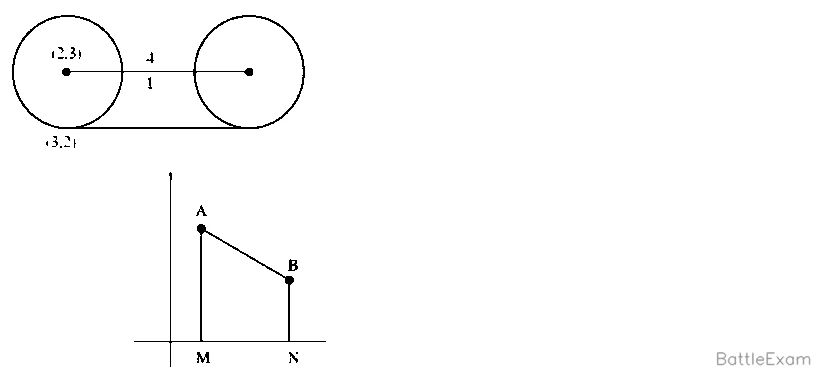
Q77JEE Main 2023MCQ4MCirclesLet a circle C1C_1C1 be obtained on rolling the circle x2+y2−4x−6y+11=0x^{2+}y^{2-}4 x-6 y+11=0x2+y2−4x−6y+11=0 upwards 4 units on the tangent T{\text{T}}T to it at the point (3,2)(3,2)(3,2). Let C2{\text{C}}_2C2 be the image of C1C_1C1 in TTT. Let AAA and BBB be the centers of circles C1{\text{C}}_1C1 and C2{\text{C}}_2C2 respectively, and M{\text{M}}M and N{\text{N}}N be respectively the feet of perpendiculars drawn from A{\text{A}}A and B{\text{B}}B on the x{\text{x}}x-axis. Then the area of the trapezium AMNB is : [31-Jan-2023 Shift 1]A. 2(2+2)2(2+{\sqrt{2}})2(2+2)B. 4(1+2)4(1+{\sqrt{2}})4(1+2)C. 3+223+2 {\sqrt{2}}3+22D. 2(1+2)2(1+{\sqrt{2}})2(1+2)Show Answer🚀 Solve in Practice Mode📖 Explanation C=(2,3),r=2\; {\text{C}}=(2,3), {\text{r}}={\sqrt{2}}C=(2,3),r=2 Centre of G=A=2+4 1/2,\;\;\text{ Centre of }\; {\text{G}}= {\text{A}}=2+4 \;{1}/{{\sqrt{2}}}, Centre of G=A=2+41/2, 3+ 4/2=(2+22,3+22)\;3+\;{4}/{{\sqrt{2}}}=(2+2 {\sqrt{2}}, 3+2 {\sqrt{2}})3+4/2=(2+22,3+22) A(2+22,3+22)\; {\text{A}}(2+2 {\sqrt{2}}, 3+2 {\sqrt{2}})A(2+22,3+22) B(4+22,1+22)\; {\text{B}}(4+2 {\sqrt{2}}, 1+2 {\sqrt{2}})B(4+22,1+22) x−(2+22)/1= y−(3+22)/−1=2\;\;{ {\text{x}}-(2+2 {\sqrt{2}})}/{1}=\;{ {\text{y}}-(3+2 {\sqrt{2}})}/{-1}=2x−(2+22)/1=y−(3+22)/−1=2 ∴ area of trapezium: \; \therefore \;\text{ area of trapezium: }\;∴ area of trapezium: 12(4+42)2=4(1+2)\;\;\frac{1}{2}(4+4 {\sqrt{2}}) 2=4(1+{\sqrt{2}})21(4+42)2=4(1+2)
Q78JEE Main 2023MCQ4MSets and Relations(S1)(p⇒q)∨(p∧(∼q))( {\text{S}} 1)( {\text{p}} \Rightarrow {\text{q}}) ∨( {\text{p}} ∧(∼ {\text{q}}))(S1)(p⇒q)∨(p∧(∼q)) is a tautology(S2)((∼p)⇒(∼q))∧((∼p)∨q)( {\text{S}} 2)((∼ {\text{p}}) \Rightarrow (∼ {\text{q}})) ∧((∼ {\text{p}}) ∨ {\text{q}})(S2)((∼p)⇒(∼q))∧((∼p)∨q) is aContradiction. Then [31-Jan-2023 Shift 1]A. only (S2) is correctB. both (S1) and (S2) are correctC. both (S1) and (S2) are wrongD. only (S1) is correctShow Answer🚀 Solve in Practice Mode📖 Explanationp q p⇒q{\text{p}} \Rightarrow {\text{q}}p⇒q ∼q∼ q∼q p∧∼qp ∧ ∼ qp∧∼q (p=q)∨(p∧∼q)( {\text{p}}= {\text{q}}) ∨( {\text{p}} ∧ ∼ {\text{q}})(p=q)∨(p∧∼q) T T T F F T T F F T T T F T T F F T F F T T F T ∼p∼ p∼p ∼q∼ q∼q ∼p⇒∼q∼ {\text{p}} \Rightarrow ∼ {\text{q}}∼p⇒∼q ∼p∨q∼ {\text{p}} ∨ {\text{q}}∼p∨q ((∼p)⇒(∼q))∧(∼p)∨q)((∼ p) \Rightarrow (∼ q)) ∧(∼ p) ∨ q)((∼p)⇒(∼q))∧(∼p)∨q) F F T T T F T T F F T F F T F T T T T T
Q79JEE Main 2023MCQ4MDefinite IntegralsThe value of int π3 π2 (2+3sin x)sin x(1+cosx)dxint_{{\;\frac{\pi}{3}}}^{\;\frac{\pi}{2}} \;\frac{(2+3 sin \;x)}{ sin \;x(1+\cos x)} \text{dx}int3π2πsinx(1+cosx)(2+3sinx)dx is equal to [31-Jan-2023 Shift 1]A. 72−3−loge3\;\frac{7}{2}-{\sqrt{3}}-\log _{ {\text{e}}} {\sqrt{3}}27−3−loge3B. −2+33+loge3-2+3 {\sqrt{3}}+\log _{ {\text{e}}} {\sqrt{3}}−2+33+loge3C. 103−3+loge3\;\frac{10}{3}-{\sqrt{3}}+\log _e {\sqrt{3}}310−3+loge3D. 103−3−loge3\;\frac{10}{3}-{\sqrt{3}}-\log _e {\sqrt{3}}310−3−loge3Show Answer🚀 Solve in Practice Mode📖 Explanation intπ/3π/2( 2+3sin xsin x(1+cosx))dx=2intπ/3π/2 dxsin x+sin xcosx+3\;int_{\pi / 3}^{\pi / 2} (\;\frac{2+3 sin \;x}{ sin \;x(1+\cos x)}) \text{dx}=2 int_{\pi / 3}^{\pi / 2} \;\frac{d x}{ sin \;x+ sin \;x \cos x}+3intπ/3π/2(sinx(1+cosx)2+3sinx)dx=2intπ/3π/2sinx+sinxcosxdx+3 3intπ/3π/2 dx1+cosx\;3 int_{\pi / 3}^{\pi / 2} \;\frac{d x}{1+\cos x}3intπ/3π/21+cosxdx intπ/3π/2 dx1+cosx=intπ/3π/2 1−cosxsin 2xdx\;int_{\pi / 3}^{\pi / 2} \;\frac{d x}{1+\cos x}=int_{\pi / 3}^{\pi / 2} \;\frac{1-\cos x}{ sin \;^2 x} \text{dx}intπ/3π/21+cosxdx=intπ/3π/2sin2x1−cosxdx =intπ/3π/2(cosec2x−cotxcosecx)dx\;=int_{\pi / 3}^{\pi / 2} ({\text{cosec}}^2 x-\cot x {\text{cosec}} x) \text{dx}=intπ/3π/2(cosec2x−cotxcosecx)dx =(cosecx−cotx)intπ/3π/2=(1)−( 2/3− 1/3)=1− 1/3\;=({\text{cosecx}}-\cot x) int_{\pi / 3}^{\pi / 2}=(1)- (\;{2}/{{\sqrt{3}}}-\;{1}/{{\sqrt{3}}}) =1-\;{1}/{{\sqrt{3}}}=(cosecx−cotx)intπ/3π/2=(1)−(2/3−1/3)=1−1/3 intπ/3π/2 dxsin x(1+cosx)=\;int_{\pi / 3}^{\pi / 2} \;\frac{d x}{ sin \;x(1+\cos x)}=intπ/3π/2sinx(1+cosx)dx= ∫ dx/(2tanx/2)(1+1−tan2x/2)\;\int \;{d x}/{(2 \tan {\text{x}} / 2) (1+1-\tan ^2 {\text{x}} / 2) }∫dx/(2tanx/2)(1+1−tan2x/2) =∫ (1+tan2x/2) sec2x/2dx/2tanx/22\;=\int \;{ (1+\tan ^2 {\text{x}} / 2) \ sec ^2 {\text{x}} / 2 {\text{dx}}}/{2 \tan {\text{x}} / 22}=∫(1+tan2x/2) sec2x/2dx/2tanx/22 tanx/2=t\;\tan {\text{x}} / 2= {\text{t}}tanx/2=t \;\;\frac{1}{2} \int (\;{1+ {\text{t}}^2}/{ {\text{t}}}) {\text{dt}}=\;\frac{1}{2} \[ℓ {\text{nt}}+;{ {\text{t}}^2}/{2}]$ _{;{1}/{{\sqrt{3}}}}^1 ;=;\frac{1}{2} [ (0+;\frac{1}{2}) - (ℓ {\text{n}} ;{1}/{{\sqrt{3}}}+;\frac{1}{6}) ] = (;\frac{1}{3}+ℓ {\text{n}} {\sqrt{3}}) ;\frac{1}{2} ;= (;\frac{1}{6}+;\frac{1}{2} ℓ {\text{n}} {\sqrt{3}}) {\text{dt}} ;2 (;\frac{1}{6}+;\frac{1}{2} ℓ {\text{n}} {\sqrt{3}}) +3 (1-;{1}/{{\sqrt{3}}}) ;=;\frac{1}{3}+ℓ {\text{n}} {\sqrt{3}}+3-{\sqrt{3}}=;\frac{10}{3}+ℓ {\text{n}} {\sqrt{3}}-{\sqrt{3}}$
Q80JEE Main 2023MCQ4MProbabilityA bag contains 6 balls. Two balls are drawn from it at random and both are found to be black. The probability that the bag contains at least 5 black balls is [31-Jan-2023 Shift 1]A. 57\;\frac{5}{7}75B. 27\;\frac{2}{7}72C. 37\;\frac{3}{7}73D. 56\;\frac{5}{6}65Show Answer🚀 Solve in Practice Mode📖 Explanation 5C2+6C2/2C2+3C2+4C2+5C2+8C2= 10+151+3+6+10+15\;\;{{ }^5 {\text{C}}_2+{ }^6 {\text{C}}_2}/{{ }^2 {\text{C}}_2+{ }^3 {\text{C}}_2+{ }^4 {\text{C}}_2+{ }^5 {\text{C}}_2+{ }^8 {\text{C}}_2}=\;\frac{10+15}{1+3+6+10+15}5C2+6C2/2C2+3C2+4C2+5C2+8C2=1+3+6+10+1510+15 = 2535= 57\;=\;\frac{25}{35}=\;\frac{5}{7}=3525=75
Q81JEE Main 2023NAT4MPermutations and CombinationsLet 5 digit numbers be constructed using the digits 0,2,3,4,7,90,2,3,4,7,90,2,3,4,7,9 with repetition allowed, and are arranged in ascending order with serial numbers. Then the serial number of the number 42923 is _______. [31-Jan-2023 Shift 1]Show Answer🚀 Solve in Practice Mode📖 Explanation 42920=1\;42920=142920=1 42922=1\;42922=142922=1 42923=1\;42923=142923=1 =2997\;=2997=2997
Q82JEE Main 2023NAT4MSequences and SeriesLet a1,a2,......,ana_1, a_2, . . . . . ., a_na1,a2,......,an be in A.P. If a5=2a7a_5=2 a_7a5=2a7 and a11=18a_{11}=18a11=18, then12( 1/a10+a11+ 1/a11+a12+.... 1/a17+a18)12 (\;{1}/{\sqrt{a_{10}}+\sqrt{a_{11}}}+\;{1}/{\sqrt{a_{11}}+\sqrt{a_{12}}}+. . . . \;{1}/{\sqrt{a_{17}}+\sqrt{a_{18}}})12(1/a10+a11+1/a11+a12+....1/a17+a18)is equal to _______. [31-Jan-2023 Shift 1]Show Answer🚀 Solve in Practice Mode📖 Explanation 2a7=a5 (given) \;2 a_7=a_5 \;\text{ (given) }\;2a7=a5 (given) 2(a1+6d)=a1+4d\;2 (a_1+6 d) =a_1+4 d2(a1+6d)=a1+4d a1+8d=0\;a_1+8 d=0a1+8d=0 . . . (1) a1+10d=18\;a_1+10 d=18a1+10d=18 . . . (2) By (1) and (2) we get a1=−72,d=9\;\;\text{ By }\;(1) \;\text{ and }\;(2) \;\text{ we get }\; a_1=-72, d=9 By (1) and (2) we get a1=−72,d=9 a18=a1+17d=−72+153=81\;a_{18}=a_1+17 d=-72+153=81a18=a1+17d=−72+153=81 a10=a1+9d=9\;a_{10}=a_1+9 d=9a10=a1+9d=9 12( a11−a10/d+ a12−a11/d+...... a18−a17/d)\;12 (\;{\sqrt{a_{11}}-\sqrt{a_{10}}}/{d}+\;{\sqrt{a_{12}}-\sqrt{a_{11}}}/{d}+. . . . . . \;{\sqrt{a_{18}}-\sqrt{a_{17}}}/{d})12(a11−a10/d+a12−a11/d+......a18−a17/d) 12( a18−a10/d)= 12(9−3)9= 12×66=8\;12 (\;{\sqrt{a_{18}}-\sqrt{a_{10}}}/{d}) =\;\frac{12(9-3)}{9}=\;\frac{12 \times 6}{6}=812(a18−a10/d)=912(9−3)=612×6=8
Q83JEE Main 2023NAT4MThree Dimensional GeometryLet θ\thetaθ be the angle between the planes P1=r⃗⋅(i∧+i∧+2k∧)=9P_1=\vec{r} \cdot ({i}^{ \wedge }+{i}^{ \wedge }+2{k}^{ \wedge })=9P1=r⋅(i∧+i∧+2k∧)=9 and P2=r⃗⋅(2i∧−i∧+k∧)=15P_2=\vec{r} \cdot (2 {i}^{ \wedge }-{i}^{ \wedge }+{k}^{ \wedge })=15P2=r⋅(2i∧−i∧+k∧)=15.Let L{\text{L}}L be the line that meets P2P_2P2 at the point (4,−2,5)(4,-2,5)(4,−2,5) and makes an angle θ\thetaθ with the normal of P2P_2P2. If α\alphaα is the angle between LLL and P2P_2P2 then (tan2θ)(cot2α)(\tan ^2 \theta) (\cot ^2 \alpha)(tan2θ)(cot2α) is equal to _______. [31-Jan-2023 Shift 1]Show Answer🚀 Solve in Practice Mode📖 Explanation\;\cos \theta=\;{(\;{ {\text{i}}}^{\^}+\;{ {\text{j}}}^{\^}+2 \;{ {\text{k}}}^{\^}) \cdot (2 \;{ {\text{i}}}^{\^}-\;{ {\text{j}}}^{\^}+\;{ {\text{k}}}^{\^})}/{6}=\;\frac{2-1+2}{6}=\;\frac{1}{2} θ=π/3 α=π/6\;\theta=\pi / 3 \;\; \alpha=\pi / 6θ=π/3α=π/6 (tan2θ)(cot2α)\; (\tan ^2 \theta) (\cot ^2 \alpha)(tan2θ)(cot2α)(3) (3)=9
Q84JEE Main 2023NAT4MBinomial TheoremLet α>0\alpha>0α>0, be the smallest number such that the expansion of (x 23+ 2x3)30(x^{\;\frac{2}{3}}+\;\frac{2}{x^3}) ^{30}(x32+x32)30 has a term βx−α,β∈N\beta x^{-\alpha}, \beta \in Nβx−α,β∈N.Then α\alphaα is equal to _______. [31-Jan-2023 Shift 1]Show Answer🚀 Solve in Practice Mode📖 Explanation Tr+1=30Cr(x2/3)30−r( 2/x3)r\; {\text{T}}_{ {\text{r}}+1}={ }^{30} {\text{C}}_{ {\text{r}}} ( {\text{x}}^{2 / 3}) ^{30- {\text{r}}} (\;{2}/{ {\text{x}}^3}) ^{ {\text{r}}}Tr+1=30Cr(x2/3)30−r(2/x3)r =30Cr⋅2⋅x 60−11r/3\;={ }^{30} {\text{C}}_{ {\text{r}}} \cdot 2 \cdot {\text{x}}^{\;{60-11 {\text{r}}}/{3}}=30Cr⋅2⋅x60−11r/3 60−11r/3<0⇒11r>60⇒r> 6011⇒r=6\;\;{60-11 {\text{r}}}/{3} < 0 \Rightarrow 11 {\text{r}} > 60 \Rightarrow {\text{r}} > \;\frac{60}{11} \Rightarrow {\text{r}}=660−11r/3<0⇒11r>60⇒r>1160⇒r=6 T7=30C6⋅26x−2\; {\text{T}}_7={ }^{30} {\text{C}}_6 \cdot 2^6 {\text{x}}^{-2}T7=30C6⋅26x−2We have also observed β=30C6(2)6\beta={ }^{30} {\text{C}}_6(2)^6β=30C6(2)6 is a natural number.∴α=2\therefore \alpha=2∴α=2
Q85JEE Main 2023NAT4MVector AlgebraLet { \vec{\text{a}} and { \vec{\text{b}} be two vector such that ∣a⃗∣=14|\vec{a}|={\sqrt{14}}∣a∣=14, ∣b⃗∣=6|\vec{b}|={\sqrt{6}}∣b∣=6 and ∣a⃗×b⃗∣=48|\vec{a} \times \vec{b}|={\sqrt{48}}∣a×b∣=48. Then (a⃗⋅b⃗)2(\vec{a} \cdot \vec{b})^2(a⋅b)2 is equal to _______. [31-Jan-2023 Shift 1]Show Answer🚀 Solve in Practice Mode📖 Explanation\;|{ \vec{\text{a}}|={\sqrt{14}},|{ \vec{\text{b}}|={\sqrt{6}} \;\; {| \vec{\text{a}} \times \vec{\text{b}}|}={\sqrt{48}} ∣a⃗×b⃗∣2+∣a⃗⋅b⃗∣2=∣a⃗∣2×∣b⃗∣2\;{| \vec{\text{a}} \times \vec{\text{b}}|}^{2+}{| \vec{\text{a}} \cdot \vec{\text{b}}|}^2={| \vec{\text{a}}|}^2 \times {| \vec{\text{b}}|}^2∣a×b∣2+∣a⋅b∣2=∣a∣2×∣b∣2 ⇒(a⃗⋅b⃗)2=84−48=36\;\Rightarrow ( \vec{\text{a}} \cdot \vec{\text{b}})^2=84-48=36⇒(a⋅b)2=84−48=36
Q86JEE Main 2023NAT4MThree Dimensional GeometryLet the line L: x−1/2= y+1/−1= z−3/1{\text{L}}: \;{ {\text{x}}-1}/{2}=\;{ {\text{y}}+1}/{-1}=\;{ {\text{z}}-3}/{1}L:x−1/2=y+1/−1=z−3/1 intersect the plane 2x+y+3z=162 x+y+3 z=162x+y+3z=16 at the point P. Let the point QQQ be the foot of perpendicular from the point R(1,−1,−3){\text{R}}(1,-1,-3)R(1,−1,−3) on the line L{\text{L}}L. If α\alphaα is the area of triangle PQRP Q RPQR. then α2\alpha^2α2 is equal to ________. [31-Jan-2023 Shift 1]Show Answer🚀 Solve in Practice Mode📖 ExplanationAny point on L((2λ+1),(−λ−1),(λ+3)){\text{L}}((2 \lambda +1),(-\lambda -1),(\lambda +3))L((2λ+1),(−λ−1),(λ+3)) 2(2λ+1)+(−λ−1)+3(λ+3)=16\;2(2 \lambda +1)+(-\lambda -1)+3(\lambda +3)=162(2λ+1)+(−λ−1)+3(λ+3)=16 6λ+10=16⇒λ=1\;6 \lambda +10=16 \Rightarrow \lambda =16λ+10=16⇒λ=1 ∴P=(3,−2,4)\; \therefore P=(3,-2,4)∴P=(3,−2,4) DR{\text{DR}}DR of QR=⟨2λ,−λ,λ+6⟩{\text{QR}}=⟨ 2 \lambda ,-\lambda , \lambda +6⟩QR=⟨2λ,−λ,λ+6⟩ DR{\text{DR}}DR of L=⟨2,−1,1⟩{\text{L}}=⟨ 2,-1,1⟩L=⟨2,−1,1⟩ 4λ+λ+λ+6=0 6λ+6=0⇒λ=−14 \lambda +\lambda +\lambda +6=0 \;\; 6 \lambda +6=0 \Rightarrow \lambda =-14λ+λ+λ+6=06λ+6=0⇒λ=−1 Q=(−1,0,2){\text{Q}}=(-1,0,2)Q=(−1,0,2) { \vec{\text{QR}}=2 \;{ {\text{i}}}^{\^}-\;{ {\text{j}}}^{\^}-5 \;{ {\text{k}}}^{\^} \;\; { \vec{\text{QP}}=4 \;{ {\text{i}}}^{\^}-2 \;{ {\text{j}}}^{\^}+2 \;{ {\text{k}}}^{\^} \;{ \vec{\text{QR}} \times { \vec{\text{QP}}={\begin{vmatrix}\\ \\ { {\text{i}}}^{\^} & \\ \\ { {\text{j}}}^{\^} & \\ \\ { {\text{k}}}^{\^} \\ 2 & -1 & -5 \\ 4 & -2 & 2\end{vmatrix}}=-12 \;{ {\text{i}}}^{\^}-24 \;{ {\text{j}}}^{\^} α= 12×144+576⇒α2= 7204=180\;\alpha=\;\frac{1}{2} \times {\sqrt{144+576}} \Rightarrow \alpha^2=\;\frac{720}{4}=180α=21×144+576⇒α2=4720=180
Q87JEE Main 2023NAT4MBinomial TheoremThe remainder on dividing 5995^{99}599 by 11 is ________. [31-Jan-2023 Shift 1]Show Answer🚀 Solve in Practice Mode📖 Explanation 599=54⋅595\;5^{99}=5^4 \cdot 5^{95}599=54⋅595 \;=625 \[5^5]$ ^{19} ;=625[3125]^{19} ;=625[3124+1]^{19} ;=625[11 {\text{k}} \times 19+1] ;=625 \times 11 {\text{k}} \times 19+625 ;=11 {\text{k}}_1+616+9 ;=11 ( {\text{k}}_2) +9 ;;\text{ Remainder };=9$
Q88JEE Main 2023NAT4MStatisticsIf the variance of the frequency distribution boXboi\text{bo} {X}_{\text{bo} {i}}boXboi 2 3 4 5 6 7 8 Frequency fif_ifi 3 6 16 alpha 9 5 6 [31-Jan-2023 Shift 1]Show Answer🚀 Solve in Practice Mode📖 Explanation σx2=σd2= ∑fidi2/∑fi−( ∑fidi/∑fi)2\;\sigma_{ {\text{x}}}^2=\sigma_{ {\text{d}}}^2=\;{\sum {\text{f}}_{ {\text{i}}} {\text{d}}_{ {\text{i}}}^2}/{\sum {\text{f}}_{ {\text{i}}}}- (\;{\sum {\text{f}}_{ {\text{i}}} {\text{d}}_{ {\text{i}}}}/{\sum {\text{f}}_{ {\text{i}}}}) ^2σx2=σd2=∑fidi2/∑fi−(∑fidi/∑fi)2 = 15045+α−0=3\;=\;\frac{150}{45+\alpha}-0=3=45+α150−0=3 ⇒150=135+3α\;\Rightarrow 150=135+3 \alpha⇒150=135+3α ⇒3α=15⇒α=5\;\Rightarrow 3 \alpha=15 \Rightarrow \alpha=5⇒3α=15⇒α=5
Q89JEE Main 2023NAT4MArea Under The CurvesLet for x∈R{\text{x}} \in {\text{R}}x∈R f(x)= x+∣x∣2f(x)=\;\frac{x+|x|}{2}f(x)=2x+∣x∣ and g(x)={\begin{cases}x & {,} x < 0 \\ x^2 {,} & x \ge 0} Then area bounded by the curve y=(fog)(x)y=(f o g)(x)y=(fog)(x) and the lines y=0,2y−x=15{\text{y}}=0,2 {\text{y}}- {\text{x}}=15y=0,2y−x=15 is equal to ________\end{cases} [31-Jan-2023 Shift 1]Show Answer🚀 Solve in Practice Mode📖 Explanation\;f(x)=\;\frac{x+|x|}{2}={\begin{bmatrix}x & x \ge 0 \\ 0 & x< 0}. \ \\ g(x)={[\text{table} x^2 , x \ge 0 \\ x & x < 0}. \ \\ f o g(x)=f[g(x)\end{bmatrix}={[\text{table} g(x) , g(x) \ge 0 ; 0 , g(x) < 0}. fog(x)=[tablex2,x≥0;0,x<0.\;f o g(x)={[\text{table} x^2 , x \ge 0 ; 0 , x < 0}.fog(x)=[tablex2,x≥0;0,x<0. 2y−x=15\;2 y-x=152y−x=15 30( x+152−x2)dx+ 12× 152×15\;\;\frac{3}{0} (\;\frac{x+15}{2}-x^2) \text{dx}+\;\frac{1}{2} \times \;\frac{15}{2} \times 1503(2x+15−x2)dx+21×215×15 x24+ 15x2− x33∣03+ 2254\;\;\frac{x^2}{4}+\;\frac{15 x}{2}-\;\frac{x^3}{3}|_0 ^{3+}\;\frac{225}{4}4x2+215x−3x3∣03+4225 = 94+ 452−9+ 2254= 99−36+2254\;=\;\frac{9}{4}+\;\frac{45}{2}-9+\;\frac{225}{4}=\;\frac{99-36+225}{4}=49+245−9+4225=499−36+225 = 2884=72\;=\;\frac{288}{4}=72=4288=72
Q90JEE Main 2023NAT4MPermutations and CombinationsNumber of 4-digit numbers that are less than or equal to 2800 and either divisible by 3 or by 11 , is equal to ________. [31-Jan-2023 Shift 1]Show Answer🚀 Solve in Practice Mode📖 Explanation1000−27991000-27991000−2799Divisible by 31002+(n−1)3=27991002+(n-1) 3=27991002+(n−1)3=2799 n=600n=600n=600Divisible by 11 1−2799→[ 279911]=[254]=254\;1-2799 \to [\;\frac{2799}{11}] =[254]=2541−2799→[112799]=[254]=254 1−999=[ 99911]=90\;1-999= [\;\frac{999}{11}] =901−999=[11999]=90 1000−2799=254−90=164\;1000-2799=254-90=1641000−2799=254−90=164Divisible by 33 1−2799→[ 279933]=84\;1-2799 \to [\;\frac{2799}{33}] =841−2799→[332799]=84 1−999→[ 99933]=30\;1-999 \to [\;\frac{999}{33}] =301−999→[33999]=30 1000−2799→54\;1000-2799 \to 541000−2799→54 ∴n(3)+n(11)−n(33)\; \therefore {\text{n}}(3)+ {\text{n}}(11)- {\text{n}}(33)∴n(3)+n(11)−n(33) 600+164−54=710600+164-54=710600+164−54=710