Q281JEE Main 2019MCQ
A 15 g mass of nitrogen gas is enclosed in a vessel at a temperature 27°C. Amount of heat transferred to the gas, so that rms velocity of molecules is doubled, is about : [Take R = 8.3 J/ K mole]
JEE Main · Physics
Generate JEE Main level questions on Thermodynamics. Focus on Laws of thermodynamics, Carnot engine, and Calorimetry.
400 questions · 20 PYQs · 0 AI practice · JEE Main 2027
A 15 g mass of nitrogen gas is enclosed in a vessel at a temperature 27°C. Amount of heat transferred to the gas, so that rms velocity of molecules is doubled, is about : [Take R = 8.3 J/ K mole]
A thermometer graduated according to a linear scale reads a value x0 when in contact with boiling water, and when in contact with ice. What is the temperature of an object in 0 °C, if this thermometer in the contact with the object reads ?
When M1 gram of ice at (specific heat = 0.5 cal is added to is added to of water at 50°C, finally no ice is left and the water is at 0°C. The value of latent heat of ice, in is:
Half mole of an ideal monoatomic gas is heated at constant pressure of 1atm from 20 °C to 90°C. Work done by gas is close to : ( Gas constant R = 8.31 J /mol.K)
One mole of an ideal gas passes through a process where pressure and volume obey the relation p=P_{0}\ \[1-\ \frac{1}{2}\ ( \frac{v_{0}}{v}\ )^{2}\ ]$I_1I_2P_0V_0V_02V_0$
One kg of water at , is heated in an electric kettle whose heating element has a mean (temperature averaged) resistance of . The rms voltage in the mains is . Ignoring heat loss from the kettle, time taken for water to evaporate fully, is close to:
In a process, temperature and volume of one mole of an ideal monoatomic gas are varied according to the relation VT = K, where K is a constant. In this process the temperature of the gas is incresed by ΔT. The amount of heat absorbed by gas is (R is gasconstant) :
For a given gas at 1 atm pressure, rms speed of the molecules is 200 m/s at 127ºC. At 2 atm pressure and at 227ºC, the rms speed of the molecules will be:
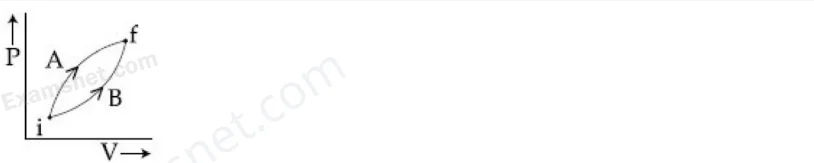
Following figure shows two process A and B for a gas. If and are the amount of heat absorbed by the system in two cases, and and are changes in internal energies, respectively, then:
A thermally insulated vessel contains 150 g of water at 0°C. Then the air from the vessel is pumped out adiabatically. A fraction of water turns into ice and the rest evaporates at 0°C itself. The mass of evaporated water will be closest to: (Latent heat of vaporization of water = and Latent heat of Fusion of water )
Two kg of a monoatomic gas is at a pressure of 4 × N/ . The density of the gas is 8 kg /. What is the order of energy of the gas due to its thermal motion ?
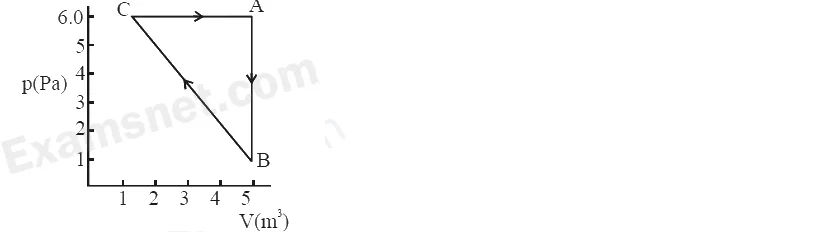
For the given cyclic process CAB as shown fora gas, the work is :
An ideal gas is enclosed in a cylinder at pressure of 2 atm and temperature, 300 K. The mean time between two successive collisions is 6 × s. If the pressure is doubled and temperature is increased to 500 K, the mean time between two successive collisionswill be close to:
Temperature difference of 120°C is maintained between two ends of a uniform rod AB of length 2L. Another bent rod PQ, of same crosssection as AB and length , is connected across AB (See figure). In steady state, temperature difference betweenP and Q will be close to : [9-Jan-2019 Shift 1]

A volume cylinder is field with 1 mol gas room temperature (300k) The molicular diameter of ,and its root mean square speed , are found to be 0.3 nm and 200m/s, respectively.what is the average collision rate (per second)for an Molecule?
The temperature, at which the root mean square velocity of hydrogen molecules equals their escape velocity from the earth, is closest to: $[Boltzmann Constant J/K Avogadro Number /kg Radius of Earth : m Gravitational acceleration on Earth = 10 ]$
A rod, of length L at room temperature and uniform area of cross section A, is made of a metal having coefficient of linear expansion α/ °C. It is observed that an external compressive force F, is applied on each of its ends, prevents any change in thelength of the rod, when its temperature rises by ΔT K. Young's modulus, Y, for this metal is : [9-Jan-2019 Shift 1]
n moles of an ideal gas with constant volume heat capacity Cv undergo an isobraric expansion by certain volume . The ratio of the work done in the process, to the heat supplied is :
A heat source at T= K is connected to another heat reservoir at T = K by a copper slab which is 1 m thick. Given that the thermal conductivity of copper is 0.1 , the energy flux through it in the steady state is :
At ,a brass wire of 1 mm radius is hung from the ceiling. A small mass, M is hung from the free end of the wire. When the wire is cooled down from to it regains its original length of 0.2 m. The value of M is close to. (Coefficientof linear expansion and Young's modulus of brass are \ and / respectively ; g = 10 ms )
Want unlimited AI-generated Thermodynamics questions?
Sign up free and practice with adaptive difficulty — Easy, Medium, Hard. New questions every session.
Start practising for free →

