Q1JEE Main 2026NAT
The terminal velocity of a metallic ball of radius 6 mm in a viscous fluid is . The terminal velocity of another ball of same material and having radius 3 mm in the same fluid will be .
JEE Main · Physics
Generate JEE Main level questions on Properties of Matter. Focus on Elasticity, Viscosity, and Surface Tension.
292 questions · 20 PYQs · 0 AI practice · JEE Main 2027
🎯 These are sample questions
Just sign in to unlock everything. Free for all students.
The terminal velocity of a metallic ball of radius 6 mm in a viscous fluid is . The terminal velocity of another ball of same material and having radius 3 mm in the same fluid will be .
Given below are two statements: Statement I: Pressure of a fluid is exerted only on a solid surface in contact as the fluid-pressure does not exist everywhere in a still fluid. Statement II: Excess potential energy of the molecules on the surface of a liquid, when compared to interior, results in surface tension. In the light of the above statements, choose the correct answer from the options given below
A small metallic sphere of diameter 2 mm and density is dropped in glycerine having viscosity 10 Poise and density respectively. The terminal velocity attained by the sphere is . ( and )
A ball of radius and density dropped through a viscous liquid of density and viscosity attains its terminal velocity at time , given by , where is a constant and and are integers. The value of is .
An aluminium and steel rods having same lengths and cross-sections are joined to make total length of 120 cm at . The coefficient of linear expansion of aluminium and steel are and , respectively. The length of this composite rod when its temperature is raised to , is cm .
Surface tension of two liquids (having same densities), and , are measured using capillary rise method utilizing two tubes with inner radii of and where . The measured liquid heights in these tubes are and respectively. [Ignore the weight of the liquid above the lowest point of miniscus]. The heights and and surface tensions and satisfy the relation:
A cubical block of density floats in a liquid of density . If the height of block is then height of the submerged part is cm .
Two wires and made of different materials of lengths 6.0 cm and 5.4 cm , respectively and area of cross sections and , respectively are stretched by the same magnitude under a given load. The ratio of the Young's modulus of to that of is . The value of is
Water flows through a horizontal tube as shown in the figure. The difference in height between the water columns in vertical tubes is 5 cm and the area of cross-sections at and are and respectively. The rate of flow will be . (take )

A brass wire of length 2 m and radius 1 mm at is held taut between two rigid supports. Initially it was cooled to a temperature of creating a tension in the wire. The temperature to which the wire has to be cooled in order to increase the tension in it to , is .
Sixty four rain drops of radius 1 mm each falling down with a terminal velocity of coalesce to form a bigger drop. The terminal velocity of bigger drop is .
The strain-stress plot for materials and is shown in the figure. Which material has the largest Young's modulus ?

When a part of a straight capillary tube is placed vertically in a liquid, the liquid raises upto certain height . If the inner radius of the capillary tube, density of the liquid and surface tension of the liquid decrease by each, then the height of the liquid in the tube will change by %.
A soap bubble of surface tension is blown to a diameter of 7 cm . If of work is done in blowing it further to make its diameter 14 cm , then the value of is 。
A cylindrical rod of length 1 m and radius 4 cm is mounted vertically. It is subjected to a shear force of at the top. Considering infinitesimally small displacement in the upper edge, the angular displacement of the rod axis from its original position would be (shear moduli, )
An air bubble of radius 0.1 cm lies at a depth of 20 cm below the free surface of a liquid of density . If the pressure inside the bubble is greater than the atmospheric pressure, then the surface tension of the liquid in SI unit is (use )
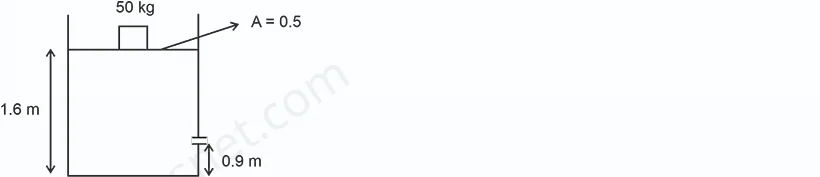
Consider a completely full cylindrical water tank of height 1.6 m and of cross-sectional area . It has a small hole in its side at a height 90 cm from the bottom. Assume, the cross-sectional area of the hole to be negligibly small as compared to that of the water tank. If a load 50 kg is applied at the top surface of the water in the tank then the velocity of the water coming out at the instant when the hole is opened is:
The excess pressure inside a soap bubble in air is half the excess pressure inside another soap bubble in air. If the volume of the bubble is times the volume of the bubble , then, the value of is .
Consider following statements: A. Surface tension arises due to extra energy of the molecules at the interior as compared to the molecules at the surface, of a liquid. B. As the temperature of liquid rises, the coefficient of viscosity increases. C. As the temperature of gas increases, the coefficient of viscosity increases. D. The onset of turbulence is determined by Reynold's number. E. In a steady flow two stream lines never intersect. Choose the correct answer from the options given below:
In the experiment for measurement of viscosity ' ' of given liquid with a ball having radius , consider following statements. A. Graph between terminal velocity and will be a parabola. B. The terminal velocities of different diameter balls are constant for a given liquid. C. Measurement of terminal velocity is dependent on the temperature. D. This experiment can be utilized to assess the density of a given liquid. E. If balls are dropped with some initial speed, the value of will change. Choose the correct answer from the options given below:
Want unlimited AI-generated Properties Of Matter questions?
Sign up free and practice with adaptive difficulty — Easy, Medium, Hard. New questions every session.
Start practising for free →