Q41JEE Main 2025MCQ
Two charges and are placed at and respectively. Given, , the electrostatic potential energy of the charge configuration is:
JEE Main · Physics
Generate JEE Main level questions on Electrostatics. Focus on Coulomb's law, Electric field, and Gauss's theorem.
280 questions · 20 PYQs · 0 AI practice · JEE Main 2027
Two charges and are placed at and respectively. Given, , the electrostatic potential energy of the charge configuration is:
Three infinitely long wires with linear charge density are placed along the -axis, -axis and -axis respectively. Which of the following denotes an equipotential surface?
Given below are two statements: one is labelled as Assertion A and the other is labelled as Reason R. Assertion A: Work done in moving a test charge between two points inside a uniformly charged spherical shell is zero, no matter which path is chosen. Reason R : Electrostatic potential inside a uniformly charged spherical shell is constant and is same as that on the surface of the shell. In the light of the above statements, choose the correct answer from the options given below
The electric flux is Where and are linear and surface charge density, respectively. represents
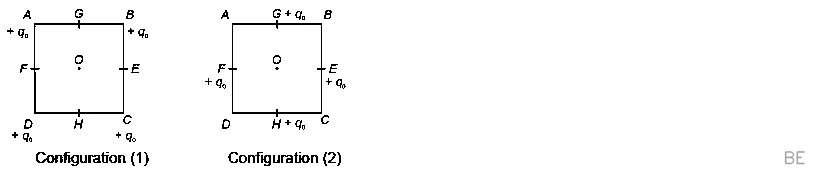
In the first configuration (1 ) as shown in the figure, four identical charges are kept at the corners , and of square of side length ' '. In the second configuration (2 ), the same charges are shifted to mid points and , of the square. If , the difference between the potential energies of configuration (2 ) and (1 ) is given by
An electric dipole of mass , charge , and length is placed in a uniform electric field . When the dipole is rotated slightly from its equilibrium position and released, the time period of its oscillations will be :
Two charges and are separated by a distance of 30 cm . A third charge initially at ' ' as shown in the figure, is moved along the circular path of radius 40 cm from C to D . If the difference in potential energy due to movement of from C to D is given by the value of is

A square loop of side is held normally in front of a point charge . The flux of the electric field through the shaded region is , where the value of is _____
A point charge is placed at the origin. A second point charge is placed at in Cartesian coordinate system. The point in between them where the electric field vanishes is:
Two metal spheres of radius and have same surface charge density . If they are brought in contact and then separated, the surface charge density on smaller and bigger sphere becomes and , respectively. The ratio is
A small uncharged conducting sphere is placed in contact with an identical sphere but having charge and then removed to a distance such that the force of repulsion between them is . The distance between them is (Take as in SI units)
Given below are two statements: one is labelled as Assertion (A) and the other is labelled as Reason (R). Assertion (A) : Net dipole moment of a polar linear isotropic dielectric substance is not zero even in the absence of an external electric field. Reason (R) : In absence of an external electric field, the different permanent dipoles of a polar dielectric substance are oriented in random directions. In the light of the above statements, choose the most appropriate answer from the options given below.
Two point charges and , constituting an electric dipole, are placed at and in a uniform electric field of strength . The work done on the dipole in rotating it from the equilibrium through is
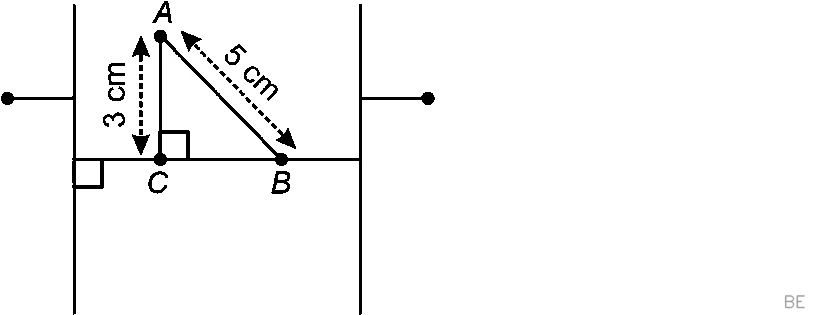
Two large plane parallel conducting plates are kept 10 cm apart as shown in figure. The potential difference between them is . The potential difference between the points and (shown in the figure) is
The electrostatic potential on the surface of uniformly charged spherical shell of radius is 120 V . The potential at the centre of shell, at a distance cm from centre, and at a distance from the centre of the shell respectively, are:
An infinitely long wire has uniform linear charge density . The net flux through a Gaussian cube of side length , if the wire passes through any two corners of the cube, that are maximally displaced from each other, would be , where is$[Neglect any edge effects and use SI units]$
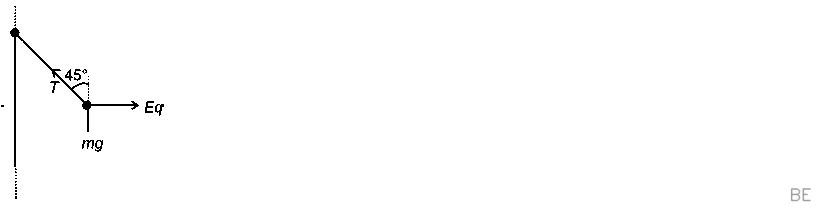
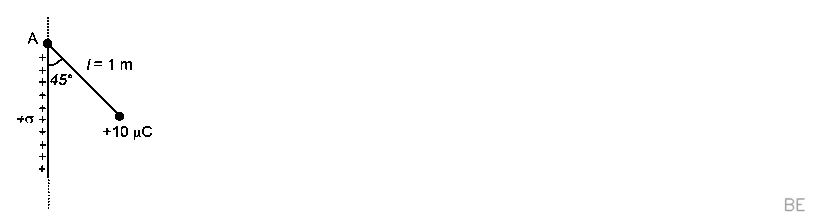
A small bob of mass 100 mg and charge is connected to an insulating string of length 1 m . It is brought near to an infinitely long non-conducting sheet of charge density ' ' as shown in figure. If string subtends and angle of with the sheet at equilibrium the charge density of sheet will be. Given and acceleration due to gravity,
Given below are two statements: one is labelled as Assertion (A) and the other is labelled as Reason (R). Assertion (A) : The outer body of an air craft is made of metal which protects persons sitting inside from lightning-strikes. Reason (R) : The electric field inside the cavity enclosed by a conductor is zero. In the light of the above statements, choose the most appropriate answer from the options given below:
An electric dipole of dipole moment is placed in uniform electric field of magnitude . Initially, the dipole moment is parallel to electric field. The work that needs to be done on the dipole to make its dipole moment opposite to the field, will be ______ J.
A particle of mass ' ' and charge ' ' is fastened to one end ' ' of a massless string having equilibrium length , whose other end is fixed at point ' '. The whole system is placed on a frictionless horizontal plane and is initially at rest. If uniform electric field is switched on along the direction as shown in figure, then the speed of the particle when it crosses the -axis is

Want unlimited AI-generated Electrostatics questions?
Sign up free and practice with adaptive difficulty — Easy, Medium, Hard. New questions every session.
Start practising for free →