Generate JEE Main level questions on Electrostatics. Focus on Coulomb's law, Electric field, and Gauss's theorem.
280 questions · 20 PYQs · 0 AI practice · JEE Main 2027
Q201JEE Main 2020MCQ
Two identical electric point dipoles have dipole moments vecp1=pi^ and p2=−pi^ and are held on the x axis at distance 'a' from each other. When released, they move along the x -axis with the direction of their dipole moments remaining unchanged. If the mass of each dipole is 'm', their speed when they arc infinitely far apart is:
Using energy conservation: KEi+PEi=KEf+PEfO+2KP/a3×P=21mv2×2+0V=4πϵ0a3m2P2=aP2πϵ0am1
Q202JEE Main 2020
MCQ
In finding the electric field using Gauss Law the formula |\vec{E}|=q_\text\frac{ene}{\epsilon _0|A|} is applicable. In the formula s0 is permittivity of free space, A is the area of Gaussian surface and qenc is charge enclosed by the Gaussian surface. The equation can be used in which of the following situation?
∣E∣ should be constant on the surface and the surface should be equipotential.
Q203JEE Main 2020MCQ
Two isolated conducting spheres S1 and S2 ofradius 32R and 31R have 12μC and −3μCcharges, respectively, and are at a large distancefrom each other. They are now connected bya conducting wire. A long time after this is donethe charges on S1 and S2 are respectively:
Now Q1+Q2=Q1′+Q2′=12μC−3μC=9μC&V1=V2⇒KQ1′/32R=KQ2′/3RQ1′=2Q2′⇒2Q2′+Q2′=9μC⇒Q2′=3μC&Q1′=6μC
Q204JEE Main 2020MCQ
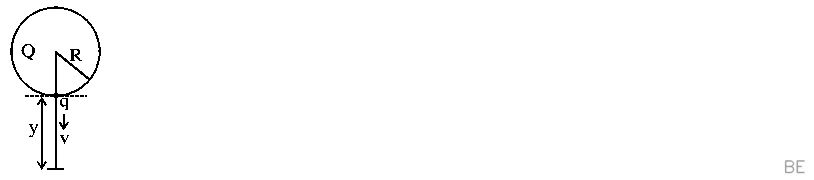
A solid sphere of radius R carries a charge (Q+q) distributed uniformly over its volume. A very small point like piece of it of mass m gets detached from the bottom of the sphere and falls down vertically under gravity. This piece carries charge q. If it acquires a speed v when it has fallen through a vertical height y (see figure), then : (assume the remaining portion to be spherical).
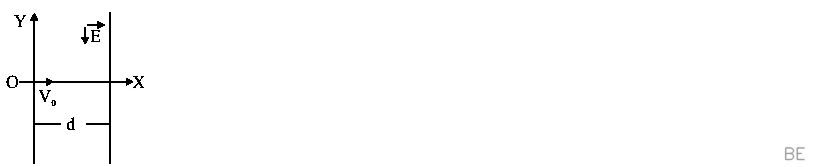
A charged particle (mass m and charge q )moves along X axis with velocity V0. When itpasses through the origin it enters a regionhaving uniform electric field E=−Ej^ whichextends upto x=d. Equation of path of electronin the region x>d is :
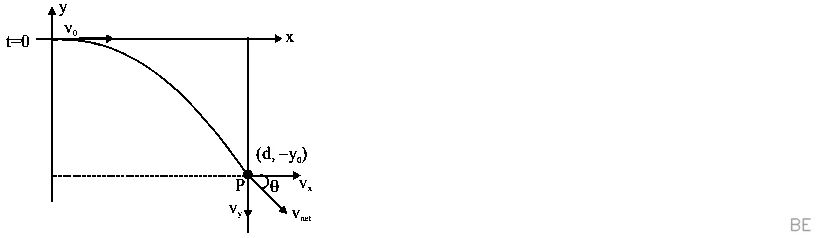
Let particle have charge q and mass 'm'Solve for (q,m) mathematically Fx=0,ax=0,(v)x=constant time taken to reach at 'P' =v0d=t0(let) ...... (1) (Along−y),y0=0+21.mqE.t02 .... .(2) vx=v0v=u+at (along -ve 'y') speed vy0=mqE.t0tanθ=vxvy=mv˙0qEt0,(t0=v0d)tanθ=m.v02qEd[slope=mv02−qEd] Now we have to find eq n of straight line whose slope is mv02−qEd and it pass throughpoint →(d,−y0) Because after x>d No electric field ⇒Fnet=0,v=const.{y}= {mx}+ {c}, \begin{cases}{m}=\frac{{qEd}}{ {mv}_{0}^{2}} \\ ( {d} & - {y}_{0} ) \}- {y}_{0}= \frac{- {qEd}}{ {mv}_{0}^{2}}\end{cases}{d}+ {c}⇒c=−y0+mv02qEd2 Put the value y=mv02−qEdx−y0+mv02qEd2y0=21.mqE(v0d)2=21mv02qEd2y=mv02−qEdx−21mv02qEd2+mv02qEd2y=mv02−qEdx+21mv02qEd2[y=mV02qEd(2d−x)]
Q206JEE Main 2020MCQ
A two point charges 4q and −q are fixed on the x -axis at x=−2d and x=2d, respectively. If a third point charge 'q' is taken from the origin to x=d along the semicircle as shown in the figure, the energy of the charge will:
Potential of −q is same as initial and final point of the path therefore potential due to 4q will only change and as potential is decreasing the energy will decrease Decrease in potential energy =q(Vi−Vf) Decrease in potential energy =q[d/2k4q−3d/2k4q]=3πϵ0d4q2 Therefore correct answer is 3 .
Q207JEE Main 2020MCQ
Consider two charged metallic spheres S1 and S2 of radii R1 and R2, respectively. The electric fields E1 (on S1) and E2 (on S2) on their surfaces are such that E1/E2=R1/R2. Then the ratio V1 (on S1) / V2 (on S2) of the electrostatic potentials on each sphere is :
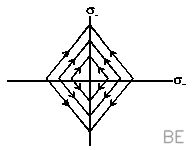
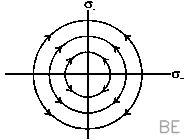
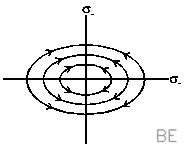
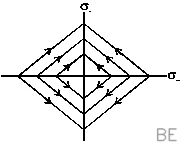
Two charged thin infinite plane sheets of uniform surface charge density σ+ and σ− where ∣σ+∣>∣σ−∣ intersect at right angle. Which of the following best represents the electric field lines for this system :
Thin infinite uniformly charged planes produces uniform electric field therefore option 2 and option 3 are obviously wrong. And as positive charge density is bigger in magnitude so its field along Y direction will be bigger than field of negative charge in Xdirection and this is evident in option 1 so it is correct.
Q209JEE Main 2020MCQ
A charge Q is distributed over two concentricconducting thin spherical shells radii r and R(R>r). If the surface charge densities on thetwo shells are equal, the electric potential at thecommon centre is :
Let the charges on inner and outer spheres are Q1 and Q2since charge density '\sigma ' is same for bothspheres, so σ=4πr2Q1=4πR2Q2⇒Q2Q1=R2r2Q1+Q2=Q⇒R2Q2r2+Q2=Q⇒Q2=(r2+R2)QR2Q1=R2r2.(R2+r2)QR2=(R2+r2)Qr2 Potential at centre 'O' =rkQ1+RkQ2=k[r(R2+r2)Qr2+R(R2+r2)QR2]=(R2+r2)kQ(r+R)=4π∈01(R2+r2)(R+r)Q
Q210JEE Main 2019MCQ
Four point charges -q, +q, +q and -q are placed on y-axis at y = 2d, y = -d, y = +d and y = +2d, respectively. The magnitude of the electric field E at a point on the x -axis at x = D, with D>>d, will behave as:
Electric field one to A and D together will be along -ve x-axis, since, the vertical components get cancelled. Similarly, due B and C, in the +ve X- axis Net electric field due to A and D =2×D2+4d2kq×D(−i^)/D2+4d2AtP Electric field one to B and C at P =2timesD2+d2kqtimesD/sqrtD2+d2(i^)∴ Net electric field at P=E=2kqD((D2+d2)3/21−(D2+d2)3/21)i^ Since, d<<< D, \ \vec{E} \approx 2 K q D\ (\ {1}/{D^{3}\ (1+\ \frac{d^{2}}{D^{2}}\ )^{3 / 2}}-\ {1}/{D^{2}\ (1+\ \frac{4 d^{2}}{D^{2}} )^{3 / 2}}\ ) \ {i} ^{\^}≈D32KqD(1−23D2d2−1+23×D24d2)i^∴E∝D41
Q211JEE Main 2019MCQ
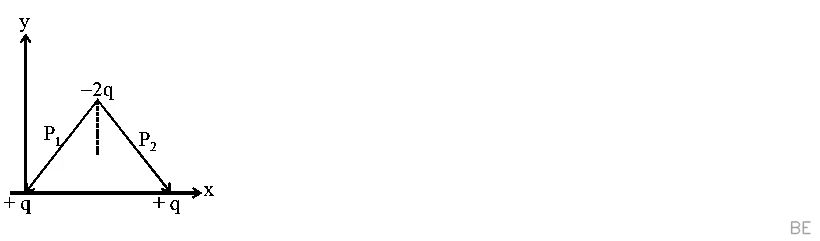
Determine the electric dipole moment of thesystem of three charges, placed on the verticesof an equilateral triangle, as shown in thefigure:
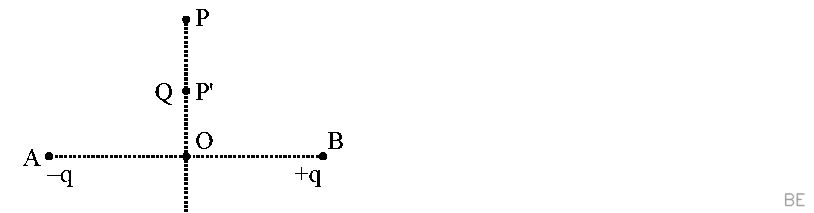
Charges -q and +q located at A and B, respectively, constitute an electric dipole. Distance AB = 2a, O is the mid point of the dipole and OP is perpendicular to AB. A charge Q is placed at P where OP = y and y ≫ 2a. The charge Q experiences and electrostaticforce F. If Q is now moved along the equatorial line to P' such that OP'= (y/3) , the force on Q will be close to : (y/3≫2a)
Electric field of equitorial plane of dipole = - KP/r3 ∴ At P , F = - KP/r3 At P1,F1 = - KPQ/(r/3)3 = 27F
Q213JEE Main 2019MCQ
There is a uniform spherically symmetricsurface charge density at a distance R0 from theorigin. The charge distribution is initially at restand starts expanding because of mutualrepulsion. The figure that represents best thespeed V(R(t)) of the distribution as a functionof its instantaneous radius R (t) is :
At any instant 't' Total energy of charge distribution is constant i.e. 1/2mV2 + 2RKQ2 = 0 + 2RKQ2 ∴ 1/2mV2 = 2R0KQ2 - 2RKQ2 ∴ V = 2/mKQ2/2.(1/R0−1/R) ∴ V = KQ2/m.(1/R0−1/R) = C 1/R0−1/R Also the slope of v-s curve will go ondecreasing ∴ Graph is correctly shown by option (1)
Q214JEE Main 2019MCQ
A solid conducting sphere, having a charge Q, is surrounded by an uncharged conducting hollow spherical shell. Let the potential difference between the surface of the solid sphere and that of the outer surface of the hollow shell be V. If the shell is now given a charge of -4 Q, the new potential difference between the same two surfaces is :
The bob of a simple pendulum has mass 2 g and a charge of 5.0μC. It is at rest in a uniform horizontal electric field of intensity 2000 V/ m. At equilibrium, the angle that the pendulum makes with the vertical is (take g = 10 m/s2 )
The electric field in a region is given by E=(Ax+B)i^, where E is in NC−1 and x is in metres. The values of constants are A=20 SI unit and B=10 SI unit. If the potential at x=1 is V1 and that at x=−5 is V2, then V1−V2 is:
Charge is distributed within a sphere of radius Rwith a volume charge density ρ (r) = A/r2e−2r/a , where A and a are constants. If Q is the total chargeof this charge distribution, the radius R is :
Let a total charges 2 Q be distributed in a sphere of radius R, with the charge density given by p(r)=kr , where r is the distance from the centre. Two charges A and B, of −Q each are placed on diametrically opposite points, at equal distance, a from the centre. If A and B not experience any force, then:
ρ(r)=KrQtotal=2Q=∫0Rρ(r)(4πr2dr)2Q=4πk∫0Rr3dr2Q=4πk(4R4)Q=24kR2⇒K=πR42Q Force between charges −Q and QF=4π∊01(2a)2Q2=4π\∊014a2Q2E∫ds=\∊0qinE(4πa2)=∫0aρdv\∊0E=2π\∊0R4Qa2F=QE16π∊0a2Q2=2π\∊0RnQ2a2a=8−1/4R
Q219JEE Main 2019MCQ
An electric field of 1000 V/m is applied to an electric dipole at angle of 45°. The value of electric dipole moment is 10−29 C.m. What is the potential energy of the electric dipole ?
The potential energy of +q, -q system is U1=d−kq2 The system of +q, -q act as an electric dipole as d<< D Hence, Potential energy between Q and dipole is U2=r2−kpQHence, U=U1+U2=4πϵ0+1[d−q2−D2dθd]