72 questions · 12 PYQs · 0 AI practice · JEE Main 2027
Q61JEE Main 2020MCQ
A particle of mass m is fixed to one end of a light spring having force constant k and unstretched length L The other end is fixed. The system is given an angular speed ω about the fixed end of the spring such that it rotates in a circle in gravity free space. Then the stretch in the spring is :
A clock has a continuously moving second's hand of 0.1m length. The average acceleration of the tip of the hand (in units of ms−2 ) is of the order of:
R=0.1mω=2π/T=602π=0.105rad/seca=ω2R=(0.105)2(0.1)=0.0011=1.1×10−3 Average acceleration is of the order of 10−3
Q63JEE Main 2019MCQ
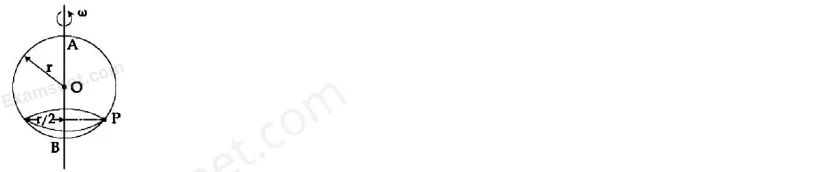
A smooth wire of the length 2πr is bent into a circle and kept in a vertical plane. A bead can slide smoothly on the wire. When the circle is rotating with angular speed ω about the vertical diameter AB , as shown in figure, the bead is rest with respect to the circular ring at position P as shown. Then the value of ω2 is equal to:
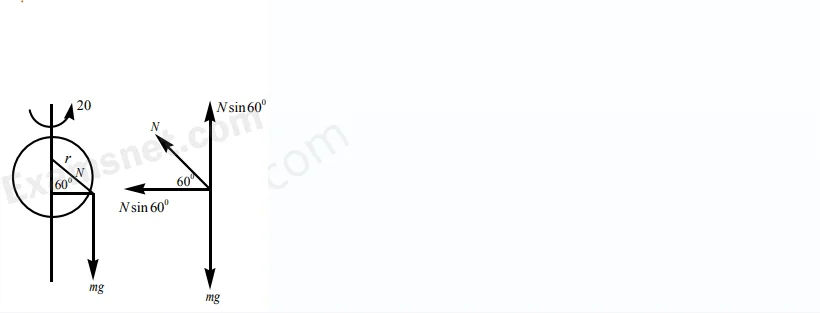
The bead is at rest with respect to the rotating ring. In the frame of the ring, the bead is in equilibrium under the action of:
Weight (mg): Acting vertically downwards.
Normal Reaction (N): Acting towards the center of the ring.
Centrifugal Force (mrω2): Acting horizontally outwards.
1. Vertical Equilibrium:
The vertical component of the normal force balances the weight: Nsin60∘=mg…(i)
2. Horizontal Equilibrium:
The horizontal component of the normal force provides the required centripetal acceleration (or balances the centrifugal force): Ncos60∘=m(2r)ω2…(ii) (Note: The radius of the bead's circular path is rcos60∘=r/2)
3. Solving for ω2:
Divide equation (i) by equation (ii): Ncos60∘Nsin60∘=m(2r)ω2mg tan60∘=rω22g
Since tan60∘=3: 3=rω22g ω2=r32g
Correct Option: (A)
Q64JEE Main 2019MCQ
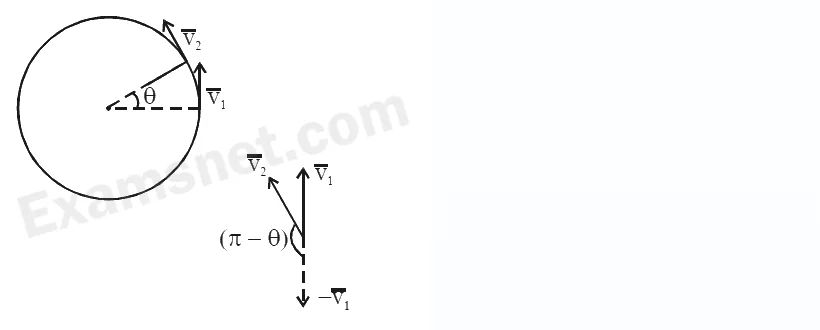
A particle is moving along a circular path with a constant speed of 10 ms-1. What is the magnitude of the change is velocity of the particle, when it moves through an angle of 60° around the centre of the circle?
∣Δv−∣ = v12+v22+2v1v1cos(π−θ) = 2v sin θ/2 since [∣v1−∣=∣v2−∣] = (2 × 10) × sin (30°) = 10 m/s
Q65JEE Main 2019MCQ
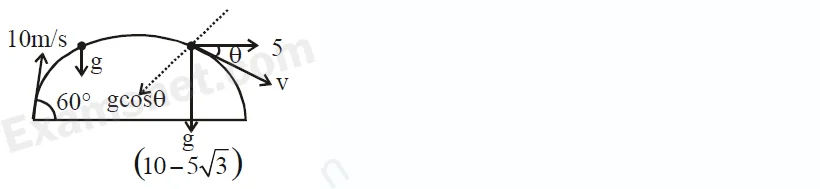
A body is projected at t = 0 with a velocity 10 ms−1 at an angle of 60° with the horizontal. The radius of curvature of its trajectory at t = 1s is R. Neglecting air resistance and taking acceleration due to gravity g = 10 ms−2, the value of R is :
vx = 10 cos 60° = 5 m/s vy = 10 cos 30° = 53 m/s velocity after t = 1 sec. xx = 5 m/s vy = ∣(53−10)∣ m/s = 10 - 53an = v2/R \Rightarrow R = vx2+vy2/an = 10cosθ25+100+75−1003 tan θ = 10−53/5 = 2 - 3 \Rightarrow θ = 15° R = 10cos15100(2−3) = 2.8 m
Q66JEE Main 2018MCQ
A disc rotates about its axis of symmetry in a horizontal plane at a steady rate of 3.5 revolutions per second. A coin placed at a distance of 1.25 cm from the axis of rotation remains at rest on the disc. The coefficient of friction between the coin and the disc is : (g=10m/s2)
The centripetal force required for the coin to remain at rest on the disc is provided by the static friction force, so mω2r≤μmg, which simplifies to μ≥gω2r.
Given frequency f=3.5 rev/s, the angular velocity is ω=2πf=2π×3.5=7π rad/s.
The radius is r=1.25 cm=0.0125 m and acceleration due to gravity g=10 m/s2.
Substituting these values: μ=10(7π)2×0.0125=1049×π2×0.0125.
Using the approximation π2≈9.86 (or ≈10 for standard calculations), we get μ≈1049×10×0.0125=49×0.0125≈0.6125.
Rounding to the given options, we find μ=0.6.
Q67JEE Main 2017MCQ
A conical pendulum of length 1 m makes an angle θ=45° w.r.t. Z-axis and moves in a circle in the XY plane. The radius of the circle is 0.4 m and its center is vertically below O. The speed of the pendulum, in its circular path, will be :(Take g=10ms−2)[Main 9 April 2017]
For a conical pendulum, the forces acting on the bob are the tension T and the weight mg. Resolving these forces gives the equations:
Horizontal (centripetal) component: Tsinθ=rmv2
Vertical equilibrium: Tcosθ=mg
Dividing the first equation by the second eliminates T: tanθ=rgv2⟹v=rgtanθ
Substituting the given values r=0.4 m, g=10 m/s2, and θ=45∘: v=0.4×10×tan(45∘)=4×1=2 m/s
Q68JEE Main 2012MCQ
Two cars of masses m1 and m2 are moving in circles of radii r1 and r2, respectively. Their speeds are such that they make complete circles in the same time t. The ratio of their centripetal acceleration is
For a particle in uniform circular motion,ac=Rv2 towards the center of the circleFrom figure, a=accosθ(−i∧)+acsinθ(−j∧)=R−v2cosθi∧−Rv2sinθj∧
Q70JEE Main 2010MCQ
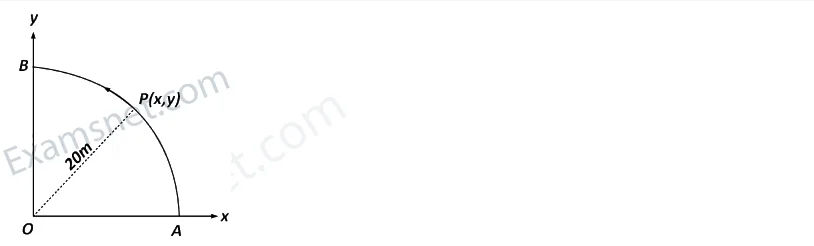
A point P moves in counter-clockwise direction on a circular path as shown in the figure. The movement of P is such that it sweeps out a length s=t3+5, where s is in metres and t is in seconds. The radius of the path is 20m. The acceleration of ′P′ when t=2s is nearly.
Given s=t3+5⇒ Speed, v=dtds=3t2 Tangential acceleration at=dtdv=6tRadial acceleration ac=Rv2=R9t4 At t=2s,at=6×2=12m/s2ac=209×16=7.2m/s2∴ Net acceleration=at2+ac2=(12)2+(7.2)2=144+51.84=195.84=14m/s2
Q71JEE Main 2004MCQ
Which of the following statements is FALSE for a particle moving in a circle with a constant angular speed?
Only option (b) is false since acceleration vector acts along the radius of the circle or towards center of the circle for uniform circular motion and velocity vector always acts along the tangent of the circle.
Q72JEE Main 2002MCQ
The minimum velocity (in ms−1 ) with which a car driver must traverse a flat curve of radius 150m and coefficient of friction 0.6 to avoid skidding is