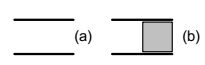
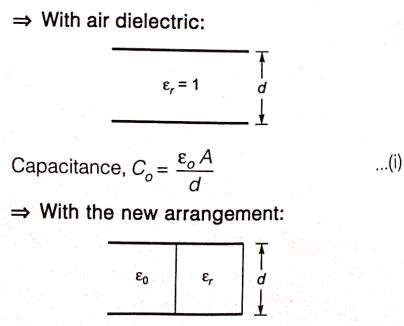
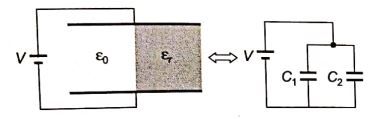
is the capacitance of a parallel plate capacitor with air as dielectric (as in figure (a)). If, half of the entire gap as shown in figure (b) is filled with a dielectric of permittivity , the expression for the modified capacitance is
GATE EE · Electromagnetic Theory
Generate GATE-level questions on Electrostatics. Focus on: 1. Coulomb's Law and Electric Field Intensity. 2. Gauss's Law and its applications. 3. Electric Potential, Capacitance, and Energy in electrostatic fields.
35 questions · 15 PYQs · 0 AI practice · GATE EE 2027
is the capacitance of a parallel plate capacitor with air as dielectric (as in figure (a)). If, half of the entire gap as shown in figure (b) is filled with a dielectric of permittivity , the expression for the modified capacitance is
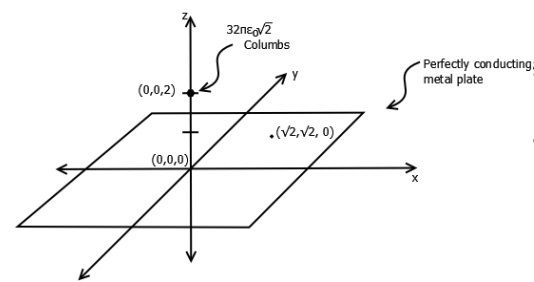
A perfectly conducting metal plate is placed in x-y plane in a right handed coordinate system. A charge of coulombs is placed at coordinate (0,0,2). is the permittivity of free space. Assume to be unit vectors along x, y and z axes respectively. At the coordinate , the electric field vector (Newtons/Coulomb) will be

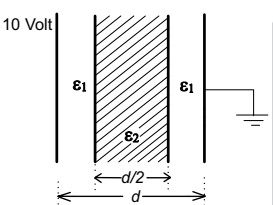
A parallel plate capacitor consisting two dielectric materials is shown in the figure. The middle dielectric slab is placed symmetrically with respect to the plates. If the potential difference between one of the plates and the nearest surface of dielectric interface is 2 Volts, then the ratio is

A dielectric slab with 500 mm x 500 mm cross-section is 0.4 m long. The slab is subjected to a uniform electric field of kV/mm. The relative permittivity of the dielectric material is equal to 2. The value of constant F/m. The energy stored in the dielectric in Joules is
A capacitor is made with a polymeric dielectric having an of 2.26 and a dielectric breakdown strength of 50 kV/cm. The permittivity of free space is 8.85 pF/m. If the rectangular plates of the capacitor have a width of 20 cm and a length of 40 cm, then the maximum electric charge in the capacitor is
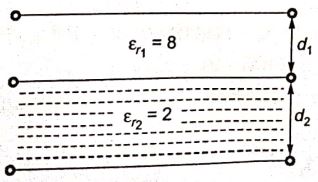
A capacitor consists of two metal plates each 500x500 and spaced 6 mm apart. The space between the metal plates is filled with a glass plate of 4 mm thickness and a layer of paper of 2 mm thickness. The relative primitivities of the glass and paper are 8 and 2 respectively. Neglecting the fringing effect, the capacitance will be (Given that F/m )
Two point charges C and C are placed at coordinates (1,1,0) and (-1,-1,0) respectively. The total electric flux passing through a plane z = 20 will be
A solid sphere made of insulating material has a radius R and has a total charge Q distributed uniformly in its volume. What is the magnitude of the electric field intensity, E, at a distance inside the sphere ?
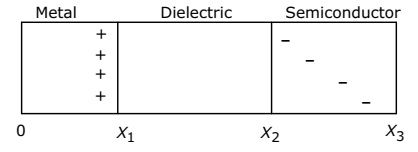
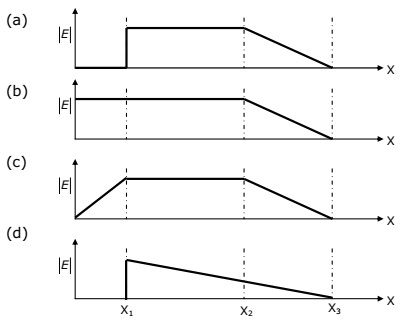
The charge distribution in a metal-dielectric-semiconductor specimen is shown in the figure. The negative charge density decreases linearly in the semiconductor as shown. The electric field distribution is as shown in


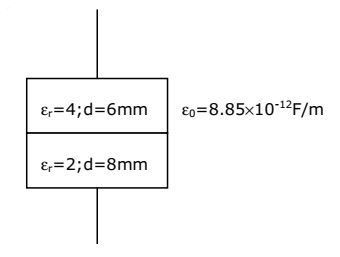
A parallel plate capacitor is shown in figure. It is made two square metal plates of 400 mm side. The 14 mm space between the plates is filled with two layers of dielectrics of = 4, 6 mm thick and = 2, 8 mm thick. Neglecting fringing of fields at the edge the capacitance is

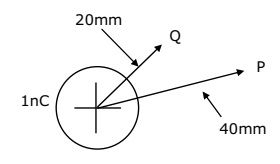
A point charge of +1 nC is placed in a space with permittivity of F/m as shown in figure. The potential difference between two points P and Q at distance of 40 mm and 20 mm respectively from the point charge is

A parallel plate capacitor has an electrode area of 100 , with spacing of 0.1 mm between the electrodes. The dielectric between the plates is air with a permittivity of F/m. The charge on the capacitor is 100 V. The stored energy in the capacitor is
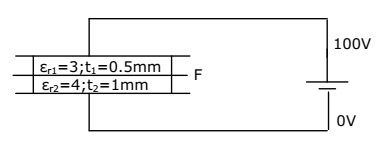
A composite parallel plate capacitor is made up of two different dielectric material with different thickness ( and ) as shown in figure. The two different dielectric materials are separated by a conducting foil F. The voltage of the conducting foil is

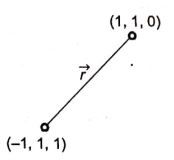
The electric field (in volts/metre) at the point (1,1,0) due to a point charge of located at (-1,1,1) (coordinates in metres)is
Given the potential function in free space to be volts, the magnitude (in volts/metre) and the direction of the electric field at a point (1,-1,1), where the dimensions are in metres, are
Want unlimited AI-generated Electrostatic Fields questions?
Sign up free and practice with adaptive difficulty — Easy, Medium, Hard. New questions every session.
Start practising for free →