Q101GATE 2004MCQ
What is the minimum number of NAND gates required to implement a 2-input EXCLUSIVE-OR function without using any other logic gate?
GATE CSE · Digital Logic
Generate GATE-level questions covering Boolean identities, De Morgan’s laws, simplification of expressions, canonical forms (SOP/POS), and equivalence transformations. Include tricky simplification and expression evaluation problems.
195 questions · 20 PYQs · 0 AI practice · GATE CSE 2027
What is the minimum number of NAND gates required to implement a 2-input EXCLUSIVE-OR function without using any other logic gate?
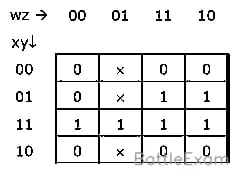
The literal count of a Boolean Algebra is the sum of the number of times each literal appears in the expression. For example, the literal count of (xy + xz) is 4. What are the minimum possible literal counts of the product-of-sum and sum-of product representations respectively of the function given by the following karnaugh map? Here, X denotes "don't care"

Let f(A,B) = A' + B. Simplified expression for function f(f(x+y,y),z) is
Minimum sum of product expression for f (w,x,y,z) shown in Karnaugh-map below is

Consider the following logic circuit whose inputs are functions f1, f2, f3 and output is f Given that f1(x, y, z) = (0, 1, 3, 5), f2(x, y, z) = (6, 7) and f(x, y, z) = (1, 4, 5), f3 is :

Given the following Karnaugh map, which one of the following represents the minimal sum-of-Products of the map ?

Which functions does NOT implement the Karnaugh map given below?
The simultaneous equations on the Boolean variables x, y, z and w, x + y + z = 1 xy = 0 xz + w = 1 have the following solution for x, y, z and w, respectively:
Which of the following sets of component(s) is/are sufficient to implement any arbitrary Boolean function?
Which of the following functions implements the Karnaugh map shown below?

Consider the circuit shown below. In a certain steady state, the line Y is at '1'. What are the possible values of A, B and C in this state?

Which of the following expressions is not equivalent to ?
Which of the following operations is commutative but not associative?
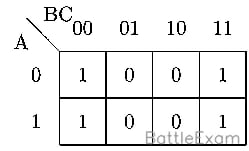
The function represented by the Karnaugh map given below is
What happens when a bit-string is XORed with itself n-times as shown:
Let * be defined as . Let . Value of is
Consider a logic circuit shown in figure below. The functions (in canonical sum of products form in decimal notation) are : The function is

Let be a switching function. Which one of the following is valid?
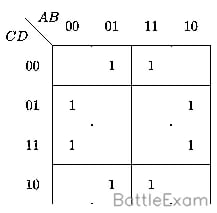
What is the equivalent Boolean expression in product-of-sums form for the Karnaugh map given in Fig
What values of A, B, C and D satisfy the following simultaneous Boolean equations?
Want unlimited AI-generated Boolean Algebra questions?
Sign up free and practice with adaptive difficulty — Easy, Medium, Hard. New questions every session.
Start practising for free →