Q61GATE 2011MCQ
If the jam density is given as and the free flow speed is given as , the maximum flow for a linear traffic speed-density model is given by which of the following options?
GATE CE · Transportation Engineering
Generate GATE-level questions on Traffic Engineering in Transportation Engineering. Focus on core concepts, previous year patterns, and numerical problem-solving techniques.
81 questions · 20 PYQs · 0 AI practice · GATE CE 2027
If the jam density is given as and the free flow speed is given as , the maximum flow for a linear traffic speed-density model is given by which of the following options?
The probability that k number of vehicles arrive (i.e. cross a predefined line) in time t is given as is the average vehicle arrival rate. What is the probability that the time headway is greater than or equal to time ?
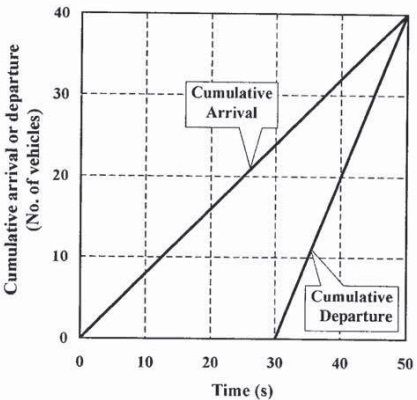
The cumulative arrival and departure curve of one cycle of an approach lane of a signalized intersection is shown in the figure. The cycle time is 50 s and the effective red time is 30 s and the effective green time is 20 s. What is the average delay?
As per IRC : 67 : 2001, a traffic sign indicating the Speed Limit on a road should be of
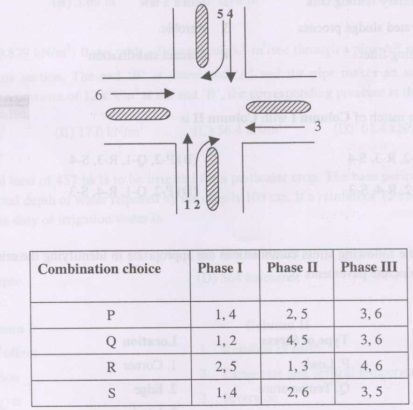
A three-phase traffic signal at an intersection is designed for flows shown in the figure below. There are six groups of flows identified by the numbers 1 through 6. Among these 1, 3, 4 and 6 are through flows and 2 and 5 are right turning. Which phasing scheme is not feasible ?
On a specific highway, the speed-density relationship follows the Greenbeg's model , where and are the free flew speed and jam density respectively. When the highway is operating at capacity, the density obtained as per this model is
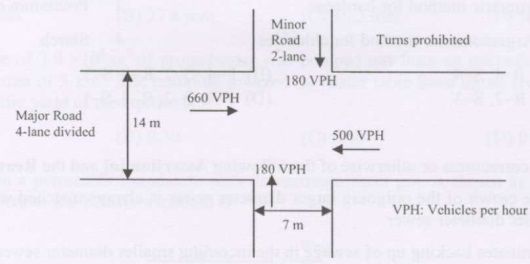
Design parameters for a signalized intersection are shown in the figure below. The green time calculated for major and minor roads are 34 and 18 s, respectively. The critical lane volume on the major road changes to 440 vehicles per hour per lane and the critical lane volume on the minor road remains unchanged. The green time will
A linear relationship is observed between speed and density on a certain section of a highway. The free flow speed is observed to be 80 km per hour and the jam density is estimated as 100 vehicles per km length. Based on the above relationship, the maximum flow expected on this section and the speed at the maximum flow will respectively be
The capacities of " One-way 1.5 m wide sidewalk (persons per hour)" and "One-way 2 lane urban road (PCU per hour, with no frontage access, no standing vehicles and very little cross traffic)" are respectively
The shape of the STOP sign according to IRC:67-2001 is
A roundabout is provided with an average entry width of 8.4 m, width of weaving section as 14 m, and length of the weaving section between channelizing islands as 35 m. The crossing traffic and total on the weaving section are 1000 and 2000 PCU per hour respectively. The nearest rounded capacity of the roundabout (in PCU per hour) is
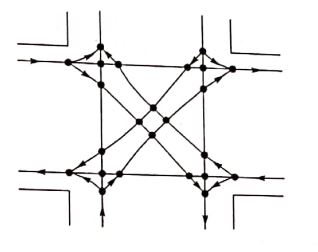
If a two-lane National Highway and a two-lane State Highway intersect at right angles, the number of potential conflict point at the intersection, assuming that both the roads are two-way is
In signal design as per Indian Roads Congress specifications, if the sum of the ratios of normal flows to saturation flow of two directional traffic is 0.50 and the total lost time per cycle is 10 seconds, the optimum cycle length in seconds is
For designing a 2-phase fixed type signal at an intersection having North-South and East-West road where only straight ahead traffic is permitted, the following data is available. Total time lost per cycle is 12 seconds. The cycle lenght (second) as per webster's approach is

Name the traffic survey data which is plotted by means of "Desire lines".
On an urban road, the free mean speed was measured as 70 kmph and the average spacing between the vehicles under jam condition as 7.0 m. The speed-flow-density equation is given by : and q=Uk Where, U = space-mean speed (kmph); k= density (veh/km); = free mean speed (kmph); = jam density (veh/km); q = flow (veh/hr). The maximum flow (veh/hr) per lane for this condition is equal to
A transport company operates a scheduled daily truck service between city P and city Q. One way journey time between these two cities is 85 hours. A minimum layover time of 5 hours is to be provided at each city. How many trucks are required to provide this service ?
A single lane unidirectional highway has a design speed of 65 kmph. The perception-brake-reaction time of drivers is 2.5 seconds and the average length of vehicles is 5 m. The coefficient of longitudinal friction of the pavement is 0.4. The capacity of this road in term of vehicles per hour per lane is
The road geometrics in India are designed for the
The speed and delay studies on a defined section of highway are conducted by
Want unlimited AI-generated Traffic Engineering questions?
Sign up free and practice with adaptive difficulty — Easy, Medium, Hard. New questions every session.
Start practising for free →