Q21GATE 2009MCQ
During a CBR test, the load sustained by a remolded soil specimen at 5.00 mm penetration is 50 kg. The CBR value of the soil will be
GATE CE · Transportation Engineering
Generate GATE-level questions on Pavement Design in Transportation Engineering. Focus on core concepts, previous year patterns, and numerical problem-solving techniques.
38 questions · 18 PYQs · 0 AI practice · GATE CE 2027
During a CBR test, the load sustained by a remolded soil specimen at 5.00 mm penetration is 50 kg. The CBR value of the soil will be
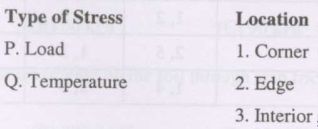
Which of the flowing stress combinations are appropriate in identifying the critical condition for the design of concrete pavements ?
It is proposed to widen and strength and existing 2-lane NH section as a divided highway. The existing traffic in one direction is 2500 commercial vehicles (CV) per day. The construction will take 1 year. The design CBR of soil subgrade is found to be 5 percent. Given : traffic growth rate for CV = 8 percent, vehicle damage factor =3.5 (standard axles per CV), design life = 10 years and traffic distribution factor =0.75. The cumulative standard axles (msa) computed are
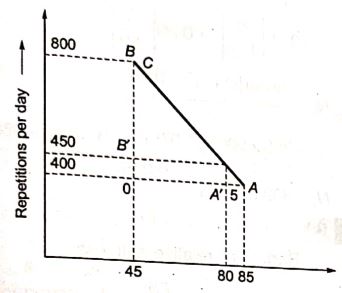
The following data pertains of the number of commercial vehicles per day for the design of a flexible pavement for a national highway as per IRC:37-1984 : Assuming a traffic growth factor of 7.5% per annum for both the types of vehicles, the cumulative number of standard axle load repetitions (in million) for a design life of ten years is

The width of the expansion join is 20 mm in a cement concrete pavement. The paying temperature is and the maximum slab temperature in summer is . The coefficient of the thermal expansion of concrete is and the joint filler compresses up to 50% of the thickness. The spacing between expansion joints should be
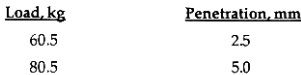
A subgrade soil sample was tested using standard CBR apparatus and the observations are given below. Assuming that the load-penetration curve is convex throughout, the CBR value(%) of the sample is
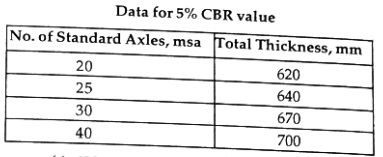
Using IRC:37-1984 "Guidelines for the Design of Flexible Pavements" and the following data, choose the total thickness of the pavement. NO. of commercial vehicles when construction is completed = 2723 veh/day Annual growth rate of the traffic =5% Design life of the pavement = 10 years Vehicle damage factor =2.4 CBR value of the subgrade soil=5%
In case of governing equation for calculating wheel load stresses using Westergaard's approach, the following statements are made : I. Load stresses are inversely proportional to wheel load. II. Modulus of subgrade reaction is useful for load stress calculation
The following observations were made of an axle-load survey on a road. The standard axle-load is 80 kN. Equivalent daily number of repetitions for the standard axle-load are

For a 25 cm thick cement concrete pavement, analysis of stresses gives the following values : Wheel load stress due to corner loading : 30 kg/c Wheel load stress due to edge loading : 32 kg/c Warping stress at corner region during summer : 9 kg/c Warping stress at corner region during winter : 7 kg/c Warping stress at edge region during summer : 8 kg/c Warping stress at edge region during summer : 6 kg/c Frictional stress during summer : 5 kg/c Frictional stress during winter : 4 kg/c The most critical stress value for this pavement is
The data given below pertain to the design of a flexible pavement : Initial traffic = 1213 cvpd Traffic growth rate = 8% per annum Design life = 12 years Vehicle damage factor = 2.5 Distribution factor = 1.0 The design traffic in terms of million standard axles (msa) to be catered would be
In the context of flexible pavement design, the ratio of contact pressure to tyre pressure is called the Rigidity Factor. This factor is less than unity when the tyre pressure is
The plate load test conducted with a 75 cm diameter plat on soil subgrade yielded a deflection of 2.5 mm under a stress of 800 . The modulus of elasticity of the subgrade soil, in is
Temperature stresses in concrete pavements may cause the slab to crack. If a slab cools uniformly then the crack will develop at the which of the following locations of the slab ?
Dowel bars in concrete pavement are placed
The average daily traffic on a stretch of road is 300 commercial vehicles per lane per day. Design traffic repetitions for 10 years when vehicle damage factor is 2.5 and traffic growth rate is 7%, is
In a concrete pavement (A) Temperature stress is tensile at bottom during day time (B) Load stress is compressive at bottom
The radius of relatives stiffness for a 20 cm thick slab with and poisson's ratio = 0.15, resting on a subgrade having modulus of 5 kg/ is
Want unlimited AI-generated Pavement Design questions?
Sign up free and practice with adaptive difficulty — Easy, Medium, Hard. New questions every session.
Start practising for free →