Q21GATE 2015MCQ
Net ultimate bearing capacity of a footing embedded in a clay stratum
GATE CE · Geotechnical Engineering
Generate GATE-level questions on Shallow Foundation And Bearing Capacity in Geotechnical Engineering. Focus on core concepts, previous year patterns, and numerical problem-solving techniques.
49 questions · 20 PYQs · 0 AI practice · GATE CE 2027
Net ultimate bearing capacity of a footing embedded in a clay stratum
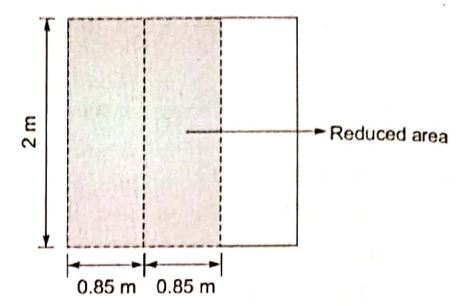
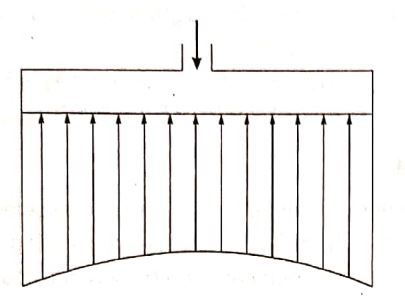
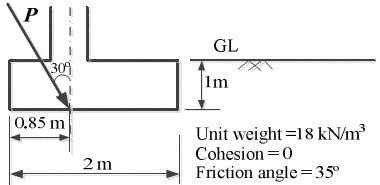
A square footing (2m x 2m) is subjected to an inclined point load P as shown in the figure below. The water table is located well below the base of the footing. Considering one-way eccentricity, the net safe load carrying capacity of the footing for a factor of safety of 3.0 is _________ kN. The following factor may be used: Bearing capacity factors: =33.3, =37.16; Shape factor: =1.314; Depth factors : =1.133; Inclination factors: =0.444, =0.02
The contact pressure for a rigid footing resting on clay at the center and the edges are respectively
A circular raft foundation of 20 m diameter and 1.6m thick is provided for a tank that applies a bearing pressure of 110 kPa on sandy soil with Young's modulus, MPa and Poisson's ration, . The raft is made of concrete ( GPa and ). Considering the raft as rigid, the elastic settlement (in mm) is
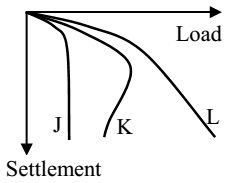
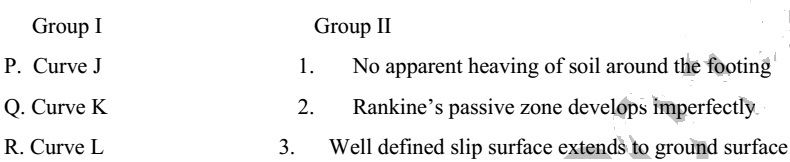
Group I contains representative load-settlement curves for different modes of bearing capacity failures of sandy soil. Group II enlists the various failure characteristics. Match the load-settlement curves with the corresponding failure characteristics.
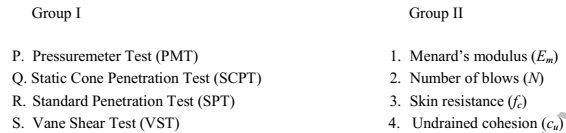
Group I enlists in-situ field tests carried out for soil exploration, while Group II provides a list of parameters for sub-soil strength characterization. Math the type of tests with the characterization parameters
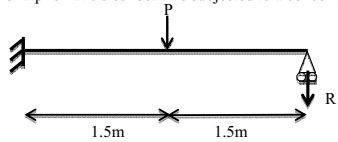
A multistory building with a basement is to be constructed. The top 4m consists of loose silt, below which dense sand layer is present up to a great depth. Ground water table is at the surface. The foundation consists of the basement slab of 6 m width which will rest on the top of dense sand as shown in the figure. For dense sand, saturated unit weight = 20kN/ , and bearing capacity factors =40 and =45. For loose silt, saturated unit weight = 18kN/ , =15 and =20. Effective cohesion c' is zero for both soils. Unit weight of water is 10 kN/ . Neglect shape factor and depth factor. Average elastic modulus E and Poisson's ratio of dense sand is and 0.3 respectively. The foundation slab is subjected to vertical downward stresses equal to net safe bearing capacity derived in the above question. Using influence factor = 2.0, and neglecting embedment depth and rigidity corrections, the immediate settlement of the dense sand layer will be:
An embankment is to be constructed with a granular soil (bulk unit weight = 20 kN/ ) on a saturated clayey silt deposit (undrained shear strength = 25 kPa). Assuming undrained general shear failure and bearing capacity factor of 5.7, the maximum height (in m) of the embankment at the point of failure is
Likelihood of general shear failure for an isolated footing in sand decreases with
The unconfined compressive strength of a saturated clay sample is 54kPa. The value of sobesion for the clay is
The unconfined compressive strength of a saturated clay sample is 54kPa. If a squre footing of size 4m x 4m is resting on the surface of a deposit of the above clay, the ultimate bearing capacity of the footing (as per Terzaghi's equation) is
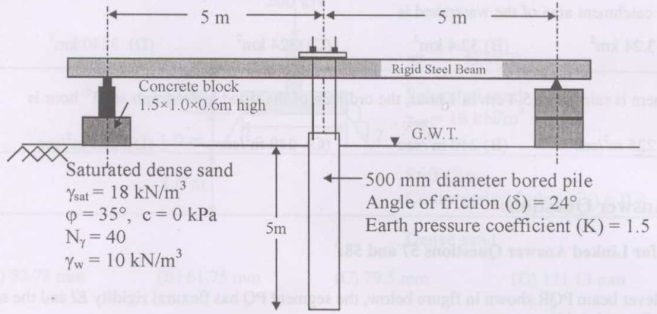
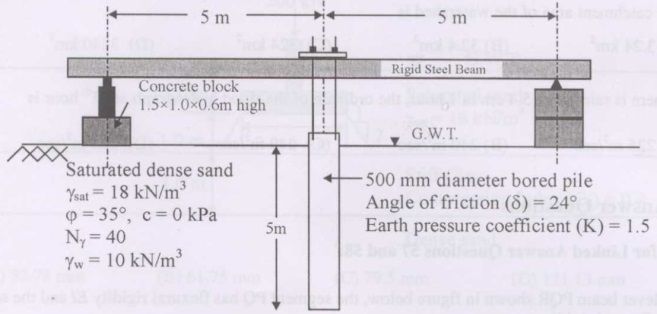
Examine the test arrangement and the soil properties given below : The maximum resistance offered by the soil through skin friction while pulling out the pile from the ground is
A plate load test is carried out on a plate placed at 2 m below the ground level to determine the bearing capacity of a footing placed at same depth of 2 m on a homogeneous sand deposit extending 10 m below ground. The ground water table is 3 m below the ground level. Which of the following factors does not require a correction to the bearing capacity determined based on the load test ?
Examine the test arrangement and the soil properties given below : The maximum pressure that can be applied with a factor of safety of 3 through the concrete block, ensuring no bearing capacity failure in soil using Terzaghi's bearing capacity equation without considering the shape factor, depth factor and inclination factor is
Dilatancy correction is required when a strata is
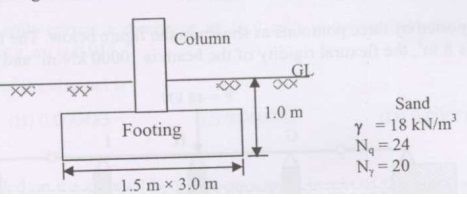
A column is supported on a footing as shown in the figure below. The water table is at a depth of 10 m below the base of the footing. The safe load (kN) that the footing can carry with a factor of safety 3 is
A test plate resting on a sand deposit settles by 10 mm under a certain intensity. A footing resting on the same sand deposit and loaded to the same load intensity settles by
The bearing capacity of a rectangular footing of plan dimensions 1.5m x 3m resting on the surface of a sand deposit was estimated as 600 kN/ when the water table is far below the base of the footing. The bearing capacities in kN/ when the water level rises to depths of 3 m, 1.5 m and 0.5 m below the base of the footing are
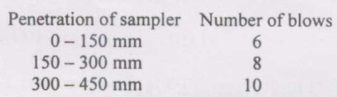
The number of blows observed in a Standard Penetration Test (SPT) for different penetration depths are given as follows : The observed N value is
There are two footings resting on the grounds surface. One footing is square of dimension 'B'. The other is strip footing of width 'B'. Both of them are subjected to a loading intensity of q . The pressure intensity at any depth below the base of the footing along the centre line would be
Want unlimited AI-generated Shallow Foundation And Bearing Capacity questions?
Sign up free and practice with adaptive difficulty — Easy, Medium, Hard. New questions every session.
Start practising for free →