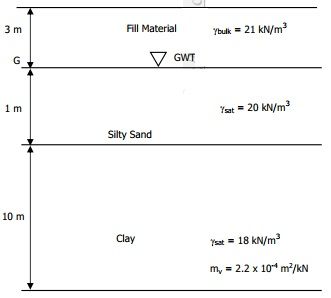
A 3 m thick clay layer is subjected to an initial uniform pore pressure of 145 kPa as shown in the figure. For the given ground conditions, the time (in days, rounded to the nearest integer) required for 90% consolidation would be ____________
GATE CE · Geotechnical Engineering
Generate GATE-level questions on Consolidation Of Soils in Geotechnical Engineering. Focus on core concepts, previous year patterns, and numerical problem-solving techniques.
42 questions · 20 PYQs · 0 AI practice · GATE CE 2027
A 3 m thick clay layer is subjected to an initial uniform pore pressure of 145 kPa as shown in the figure. For the given ground conditions, the time (in days, rounded to the nearest integer) required for 90% consolidation would be ____________
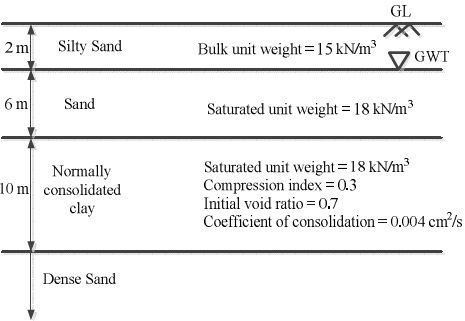
The results of a consolidation test on an undisturbed soil, sampled at a depth of 10 m below the ground level are as follows: Saturated unit weight : Pre-consolidation pressure : 90kPa The water table was encountered at the ground level. Assuming the unit weight of water as , the over-consolidation ratio of the soil is
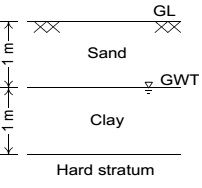
An undisturbed soil sample was taken from the middle of a clay layer (i.e., 1.5 m below GL), as shown in figure. The water table was at the top of clay layer. Laboratory test results are as follows: Natural water content of clay : 25% Preconsolidation pressure of clay : 60 kPa Compression index of clay : 0.50 Recompression index of clay : 0.05 Specific gravity of clay : 2.70 Bulk unit weight of sand : 17 kN/ A compacted fill of 2.5 m height with unit weight of 20 kN/ is placed at the ground level Assuming unit weight of water as10 kN/ , the ultimate consolidation settlement (expressed in mm) of the clay layer is ____________

A 4 m thick layer of normally consolidated clay has an average void ratio of 1.30. Its compression index is 0.6 and coefficient of consolidation is 1 . If the increase in vertical pressure due to foundation load on the clay layer is equal to the existing effective overburden pressure, the change in the thickness of the clay layer is ______ mm.
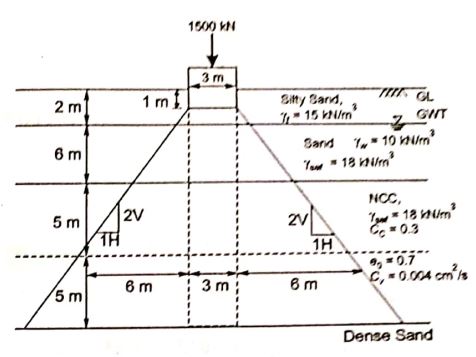
A water tank is to be constructed on the soil deposit shown in the figure below. A circular footing of diameter 3 m and depth of embedment 1 m has been designed to support the tank. The total vertical load to be taken by the footing is 1500 kN. Assume the unit weight of water as 10 and the load dispersion pattern as 2V:1H. The expected settlement of the tank due to primary consolidation of the clay layer is ________ mm.

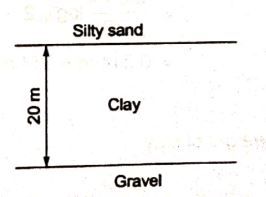
A 20 m thick clay layer is sandwiched between a silty sand layer and a gravelly sand layer. The layer experiences 30 mm settlement in 2 years. Given:
Where is the time factor and U is the degree consolidation in . If the coefficient of consolidation of the layer is 0.003 , the deposit will experience a total of 50 mm settlement in the next _______ years.
The following data are given for the laboratory sample. ; ; ; e=0.9 If thickness of the clay specimen is 25 mm, the value of coefficient of volume compressibility is___________
A layer of normally consolidated, saturated silty clay of 1 m thickness is subjected to one dimensional consolidation under a pressure increment of 20 kPa. The properties of the soil are: specific gravity = 2.7, natural moisture content = 45%, compression index = 0.45, and recompression index = 0.05. The initial average effective stress within the layer is 100 kPa. Assuming Terzaghi's theory to be applicable, the primary consolidation settlement (rounded off to the nearest mm) is
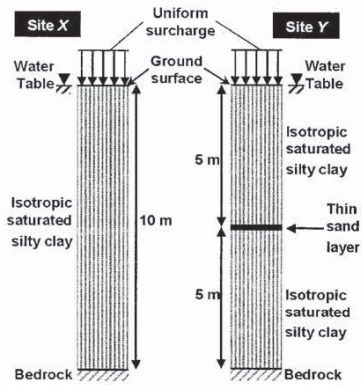
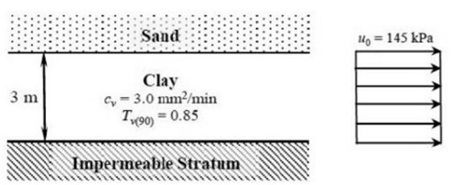
Identical surcharges are placed at ground surface at sites X and Y , with soil conditions shown in figure and water table at ground surface. The silty clay layers at X and Y are identical. The thin sand layer at Y is continuous and freedraining with a very large discharge capacity. If primary consolidation at X is estimated to complete in 36 months, what would be the corresponding time for completion of primary consolidation at Y ?

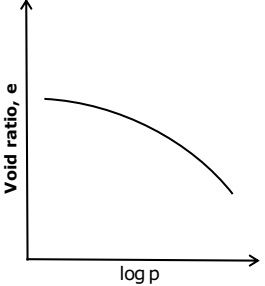
The e-log p curve shown in the figure is representative of

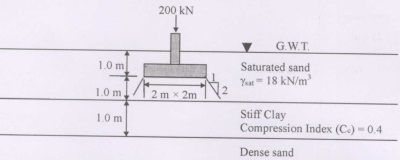
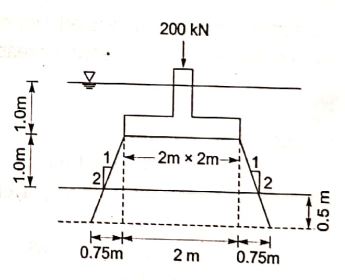
Using the properties of the clay layer derived from the above question, the consolidation settlement of the same clay layer under a square footing (neglecting its self weight) with additional data shown in the figure below (assume the stress distribution as 1H:2V from the edge of the footing and ) is

A saturated undisturbed sample from a clay strata has moisture content of 22.22% and specific weight of 2.7. Assuming , the void ratio and the saturated unit weight of the clay, respectively are
A saturated clay stratum draining both at the top and bottom undergoes 50 percent consolidation in 16 year under an applied load. If an additional drainage layer were present at the middle of the clay stratum, 50 percent consolidation would occur in
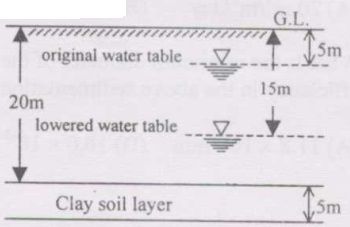
The ground conditions at a site are as shown in the figure. The water table at the site which was initially at a depth of 5 m below the ground level got permanently lowered to a depth of 15 m below the ground level due to pumping of water over a few years. Assume the following data : I unit weight of water= 10 II unit weight of sand above water table= 18 III unit weight of sand and clay below the water table= 20 IV coefficient of volume compressibility= 0.25 /MN What is the compression of the clay layer in mm due to the lowering of the water table ?

The average effective overburden pressure on 10 m thick homogeneous saturated clay layer is 150 kPa. Consolidation test on an undisturbed soil sample taken from the clay layer showed that the void ratio decreased from 0.6 to 0.5 by increased the stress intensity from 100 kPa to 300 kPa. (G=2.65) The total consolidation settlement of the clay layer due to the construction of a structure imposing an additional stress intensity of 200 kPa is
Root time method is used to determine
A 6 m thick clay layer undergoes 90% consolidation four times faster under two-way drainage as compared to one-way drainage. In an identical clay layer of 15 m thickness, two-way drainage will be faster as compared to one-way drainage by
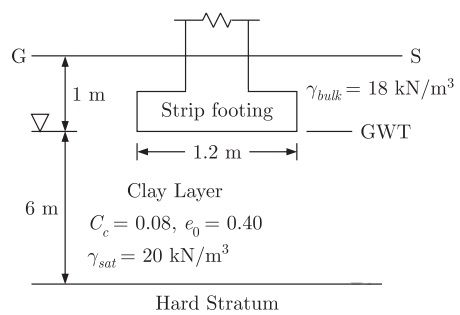
Figure shows the geometry of a strip footing supporting the load bearing walls of a three storied building and the properties of clay layer. If the elastic modulus and the Poisson's ratio of the clay layer are respectively kPa and 0.4 and if the influence factor for the strip footing is 1.75, the elastic settlement of the footing will be

A double draining clay layer, 6 m thick, settles by 30 mm in three years under influence of certain loads. Its final consolidation settlement has been estimated to be 120 mm. If a thin layer of sand having negligible thickness is introduced at a depth of 1.5 m below the top surface, the final consolidation settlement of clay layer will be
At a reclamation site for which the soil strata is shown in figure, a 3 m thick layer of a fill material is to be laid instantaneously on the top surface. If the coefficient of volume compressibility, for clay is , the consolidation settlement of the clay layer due to placing of fill material will be

Want unlimited AI-generated Consolidation Of Soils questions?
Sign up free and practice with adaptive difficulty — Easy, Medium, Hard. New questions every session.
Start practising for free →