Q21GATE 2019MCQ
Which one of the following is a secondary pollutant?
GATE CE · Environmental Engineering
Generate GATE-level questions on Air And Noise Pollution in Environmental Engineering. Focus on core concepts, previous year patterns, and numerical problem-solving techniques.
48 questions · 20 PYQs · 0 AI practice · GATE CE 2027
Which one of the following is a secondary pollutant?
A sample of air analysed at 0 C and 1 atm pressure is reported to contain 0.02 ppm(parts per million) of . Assume the gram molecular mass of as 46 and its volume at 0 C and 1 atm pressure as 22.4 litres per mole. The equivalent concentration (in microgram per cubic meter, round off to 2 decimalplaces) would be ______
As per Noise Pollution (Regulation and Control) Rules 2000 of India, the day time noise limit for a residential zone, expressed in dB(A) , is
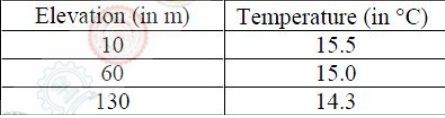
Following observations have been made for the elevation and temperature to ascertain the stability of the atmosphere: The atmosphere is classified as
Which one of the following is NOT present in the acid rain?
The equivalent sound power level (in dB) of the four sources with the noise levels of 60 dB, 69 dB, 70 dB and 79 dB is_______
Pre-cursors to photochemical oxidants are
It was decided to construct a fabric filter, using bags of 0.45 m diameter and 7.5 m long, for removing industrial stack gas containing particulates. The expected rate of airflow into the filter is 10 . If the filtering velocity is 2.0 m/min, the minimum number of bags (rounded to nearest higher integer) required for continuous cleaning operation is
The sound pressure (expressed in ) of the faintest sound that a normal healthy individual can hear is
An electrostatic precipitator (ESP) with 5600 of collector plate area is 96 percent efficient in treating 185 of flue gas from a 200 MW thermal power plant. It was found that in order to achieve 97 percent efficiency, the collector plate area should be 6100 . In order to increase the efficiency to 99 percent, the ESP collector plate area (expressed in ) would be ______
A noise meter located at a distance of 30 m from a point source recorded 74 dB . The reading at a distance of 60 m from the point source would be _________
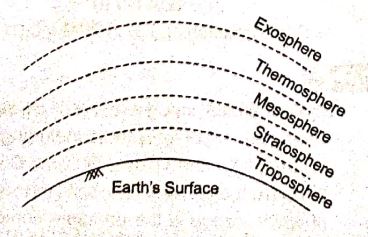
The atmospheric layer closest to the earth surface is
and CO adversely affect
The concentration of Sulfur Dioxide ( ) in ambient atmosphere was measured as 30 . Under the same conditions, the above concentration expressed in ppm is ___________. Given: (P/(RT) = 41.6 ; where, P=Pressure; T=Temperature; R=universal gas constant; Molecular weight of = 64.
The two air pollution control devices that are usually used to remove very fine particles from the flue gas are
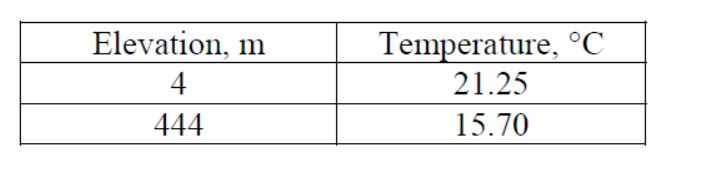
Elevation and temperature data for a place are tabulated below: Based on the above data, lapse rate can be referred as:
Consider four common air pollutants found in urban environments, NO, , Soot and . Among these with one is the secondary air pollutant?
Total suspended particulate matter (TSP) concentration in ambient air is to be measured using a high volume sampler. The filter used for this purpose had an initial dry weight of 9.787 g. The filter was mounted in the sampler and the initial air flow rate through the filter was set at 1.5 /min. Sampling continued for 24 hours. The airflow after 24 hours was measured to be 1.4 /min. The dry weight of the filter paper after 24 hour sampling was 10.283 g. Assuming a linear decline in the air flow rate during sampling, what is the 24 hour average TSP concentration in the ambient air?
An air parcel having 40 C temperature moves from ground level to 500 m elevation in dry air following the "adiabatic lapse rate". The resulting temperature of air parcel at 500m elevation will be
According to the Noise Pollution (Regulation and Control) Rules, 2000, of the Ministry of Environment and Forests, India, the day time and night time noise level limits in ambient air for residential areas expressed in dB(A) Leq are
Want unlimited AI-generated Air And Noise Pollution questions?
Sign up free and practice with adaptive difficulty — Easy, Medium, Hard. New questions every session.
Start practising for free →